
12-month project called PRISM will fuse satellite heat maps with the repair records and contact logs councils already hold, scoring every property for risk before problems turn into emergencies. Welfare decisions, the team says, stay with human officers.
England's councils spend much of their housing budget reacting to failure: a roof that has already let in water, a wall already black with mould, a tenant already cold. Researchers at the University of Cambridge want to flip that sequence.
A new tool called PRISM, short for Predictive Risk Intelligence for Social Housing Maintenance, would scan data from thousands of homes and score each one for the chance it is about to deteriorate. It then goes a step further, flagging the residents most likely to be harmed if it does. The work is a collaboration between the university and two local authorities, Cambridge City Council and South Cambridgeshire District Council, and is being built as a 12-month proof of concept.
The pitch to councils is about timing. Move first, before the damage spreads.
"At the moment we're very much waiting for things to break before we act," said Peter Campbell, Head of Housing at South Cambridgeshire District Council, which manages around 5,500 social homes. When something does fail, he said, the cost rarely stops at the broken part. A leak that starts at the roof ends up soaking everything beneath it, and a single repair turns into several.
Combining satellite heat maps with council records
The system being built by Professor Ronita Bardhan and Dr Ramit Debnath, both from Cambridge's Department of Architecture and its Centre for Human-Inspired AI, draws on three separate streams of information and folds them into one score for each property.
The first stream comes from space. Bardhan's team has spent years training algorithms to detect heat escaping from buildings, using thermal imagery captured by satellites in low Earth orbit. That work has already produced a building-level map of energy efficiency covering all of England and Wales, property by property.
The second is the paperwork councils already keep: a building's construction type and Energy Performance Certificate rating, set against its logged history of damp and repairs.
The third stream is the one the team finds most interesting, and the hardest to use well. Councils sit on years of soft signals about their tenants: fuel-poverty flags, rent arrears and the contact logs that pile up over a tenancy but rarely get used at any scale.
"The housing officers have a much more grounded idea of how they see vulnerability," said Debnath, who is also executive director of the Centre for Human-Inspired AI. "They have information about things like fuel poverty, repair logs, tenancy history and health calls." What sets the project apart, he said, is the source of its predictions. The model learns from the physical state of a building and from records of how people actually live in it.
The output is a live dashboard, a map of risk hotspots that does two jobs at once. It marks the buildings in the worst physical condition, and it shows where a vulnerable person is living inside one of them.
How PRISM scores a homeSatellite heat mapsThermal imagery from orbitBuilding recordsEPC bands and repair historyLived-experience dataFuel poverty and contact logsPRISM risk modelFuses the three streamsRisk score for every propertyRisk hotspot mapBad homes and vulnerable people overlapEvery alert reviewed by a housing officer
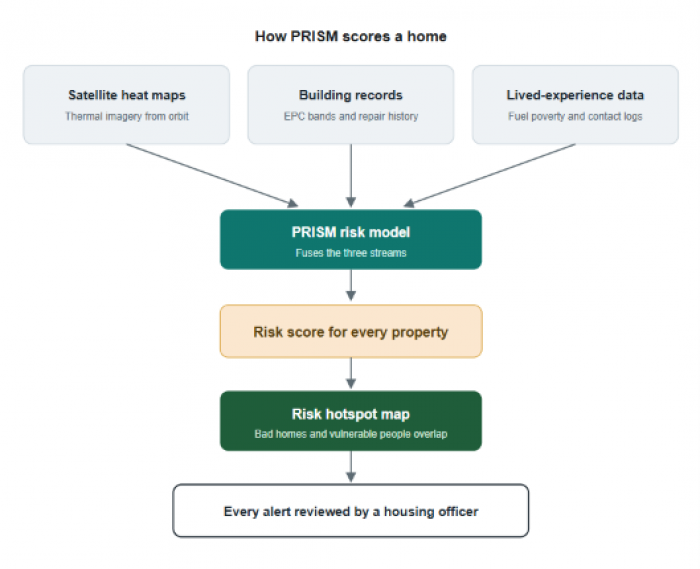
AI flags the risks. Housing officers make the calls. How PRISM turns three data sources into a single risk picture.
Two identical homes, two outcomes
Campbell offers an example. Picture two identical homes side by side, each with the same crack in an outside wall. In one, a family is out at work all day, so the heat bleeding through that crack barely registers in their lives. Next door, the same crack sits above a single resident who is housebound with a disability, where the lost heat steadily erodes comfort and health.
The tool would allow us to target the person most in need. It's not just about the properties, it's about the people who live in them.
Peter Campbell, Head of Housing, South Cambridgeshire District Council
A regulator that now expects more
PRISM arrives at a moment when the rules around social housing in England are tightening.
After a run of cases involving damp, mould and disrepair, including the death of two-year-old Awaab Ishak in a Rochdale flat in 2020, government and the social housing regulator have pushed landlords to manage their stock more actively and to make better use of the data they already hold. The first phase of Awaab's Law, which sets legal deadlines for social landlords to investigate and fix damp and mould, took effect in 2025.
"There's been a changing approach to the way social housing is managed through the housing regulator," Campbell said. "There's an expectation from government to make better use of data in order to plan our services."
One group worries housing teams in particular: the tenants they almost never hear from. People with mental health problems and older residents who rarely ask for help can stay invisible to their landlord until a crisis forces contact. So can people who hide problems rather than report them.
"What we're doing now is identifying people with whom we've had absolutely no contact and prioritising them for a home visit," Campbell said. "But we don't have the resources to do that for everybody, all the time."
He argues that better data would stretch thin teams further. In an earlier job he brought in route-planning software for repair crews and watched the number of visits each worker made in a day climb from six to eight. The geography in Cambridgeshire makes that kind of gain matter. The two councils cover both the dense centre of Cambridge and the scattered villages of South Cambridgeshire, where two addresses can sit more than an hour apart by road.
Keeping people in charge of the decisions
The researchers are blunt about one thing. PRISM is not built to decide anyone's fate.
Every alert the model produces would be read by a housing officer before anything happens on the ground. The system runs on anonymised data and is designed so that nothing in its output can be traced back to a named person.
AI helps, but welfare decisions stay with trained officers.
Professor Ronita Bardhan, University of Cambridge
For Debnath, that guardrail is where the difficult engineering sits. "Modelling a building with a machine learning model is relatively straightforward," he said. "Removing all the risks around personal data and making it tight within the context of its ethics: that's the complex part."
Those concerns are being handled as a project in their own right. A separate strand of the same Cambridge programme, led by Viviana Bastidas Melo with Professor Jennifer Schooling at Anglia Ruskin University, is writing the governance and ethics rules for exactly these kinds of early-warning systems, with the aim of producing a reusable blueprint that other housing authorities can follow.
Part of a bigger bet on council AI
PRISM is one of six projects in the inaugural Local Government AI Accelerator, a 12-month scheme run by ai@cam, the university's central artificial intelligence effort, and funded by the Ministry of Housing, Communities and Local Government. Each project receives up to 25,000 pounds and a dedicated machine learning engineer to work alongside.
The other five aim at equally unglamorous problems. One automates the statutory housing paperwork councils have to file every year. Another, using cameras already bolted to refuse trucks, tries to spot fly-tipping during normal collection rounds, set against more than 1.15 million fly-tipping incidents recorded across England in 2023/24. A project with the London Borough of Camden draws on nearly a decade of lettings data to tell people bidding for social housing what their realistic chances actually are.
The programme also pulls residents into the design. Cambridge ran public dialogue sessions on AI in local government before the projects were chosen, and built further resident feedback into the work itself.
The idea took shape at a workshop in late 2025, where 21 councils set out the operational problems grinding them down: residents lost in fragmented services, vulnerable people slipping through the gaps, staff buried in manual admin.
If PRISM works, both councils say they want it to travel. The team has already drafted a roadmap for other authorities to copy the approach.
This is just a starting point. But we hope it can be replicated across different councils across the country.
Professor Ronita Bardhan, University of Cambridge