DuckDuckGo App Installs Climb 30% as Google's AI Search Overhaul Drives User Defections
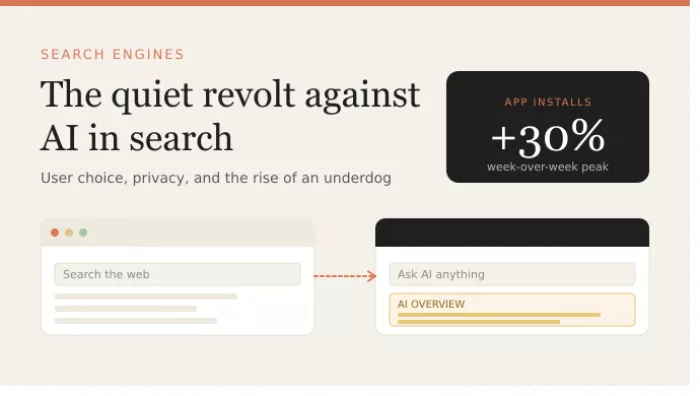
DuckDuckGo, the privacy-focused search engine, recorded a sharp rise in United States app installs during the final week of May, with week-over-week growth peaking at 30.5% on May 25. The spike followed Google's announcement at its I/O developer conference of a sweeping AI-driven overhaul to Search, a change that has drawn pointed criticism from users who say the new format leaves no clean way to opt out of AI features.
Install figures point to a clear uptick
According to figures shared by DuckDuckGo with TechCrunch, U.S. app installs averaged 18.1% week-over-week growth between May 20 and May 25, when compared with the May 13 to May 18 baseline. The company said that growth held for six consecutive days. On iOS specifically, the average week-over-week install rate reached 33%, with a one-day peak of 69.9%.
Traffic to noai.duckduckgo.com, the AI-free search page that disables features like AI-assisted answers and AI-generated images by default, also climbed. DuckDuckGo reported an average of 22.7% week-over-week growth on that page, peaking at 27.7% on May 24. The company added that gains continued over the Memorial Day weekend, a period when search activity typically dips.
Backlash centers on the I/O Search overhaul
At Google I/O, the company said its long-standing list of blue links would be replaced by an AI agent capable of answering queries, executing tasks, and running background monitoring processes. Coverage from TechCrunch and other outlets has framed the move as a fundamental rewrite of how Search will work going forward.
Critics have raised several concerns. Publishers have warned the format could reduce referral traffic to the open web. Others have flagged cases where AI Overviews return inaccurate responses, while a subset of users have voiced frustration at the absence of a clear off-switch. DuckDuckGo CEO Gabriel Weinberg, in a statement carried by TechCrunch, said Google is "force-feeding AI with no way to opt out" and argued the company's results are getting worse rather than better.
"We want to be the place that puts users in charge and allows them to decide how much or how little AI they want," Weinberg said, per TechCrunch.
Privacy stance and Duck.ai shape the alternative pitch
DuckDuckGo's pitch to defectors rests on two pillars: search privacy and optional AI. The company strips user IP addresses before requests reach model providers, deletes conversations within 30 days, and prevents chat data from being used for model training, according to its published help documentation.
Through Duck.ai, the company offers free access to several models without requiring an account, including Anthropic's Claude 4.5 Haiku, Meta's Llama 4 Scout, Mistral's Small 3 24B, and OpenAI's GPT-5 mini. The platform also runs a Search Assist feature similar to Google's AI Overviews, alongside an AI Image Filter that screens AI-generated images out of results. Kamyl Bazbaz, DuckDuckGo's chief communications and policy officer, told TechCrunch that both AI features rank among the company's most-used, despite the firm's broader objection to forced AI exposure. "People just want a choice," Bazbaz said.
Market context frames what comes next
DuckDuckGo's U.S. search market share has hovered near 2%, according to StatCounter, well behind Google's dominant position. Weinberg testified during Google's 2023 search antitrust trial that exclusive default-placement contracts had limited DuckDuckGo's ability to win distribution on major browsers, a constraint that has shaped the company's growth trajectory ever since.
Whether the current install surge converts into durable market share gains is an open question. Past spikes tied to specific Google controversies have often faded once news cycles moved on. What appears different this time, based on the figures DuckDuckGo has shared, is the breadth of the trigger: the change is product-wide and central to how the dominant search engine operates, not a one-off feature decision. TechCrunch has reached out to Google for comment.
Reporting methodology
This report draws on install and traffic figures published by DuckDuckGo for the May 20 to May 25 window, public statements from CEO Gabriel Weinberg and chief communications officer Kamyl Bazbaz carried by TechCrunch, market share data from StatCounter, and product documentation from DuckDuckGo and Duck.ai. Vendor-supplied install and traffic figures have not been independently audited; they reflect first-party data the company has chosen to disclose. Source attribution is given inline by name. Any response issued by Google after the original report has not been incorporated and would warrant a follow-up update.