BrumeBlog.com looks clean, loads fast and is straightforward to browse. The challenge is not the interface, but whether a site with eight broad categories, very thin Travel content, and only a handful of Technology posts can genuinely serve readers as more than a search‑optimised content hub.
At first glance, BrumeBlog behaves like a modern digital magazine. It groups content into Home, Business, Education, Finance, Health, Lifestyle, Technology and Travel, with a layout designed for quick scanning and low friction. That structure is friendly on the surface, but the underlying execution shows a clear bias toward search‑first publishing: topics are chosen for query potential more than for a tight editorial mission.
Quick overview of BrumeBlog.com
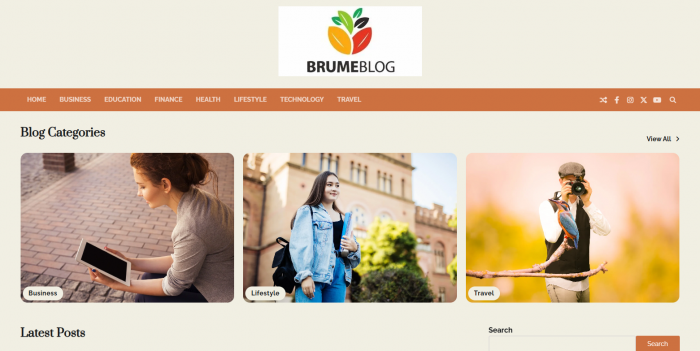
BrumeBlog functions primarily as a broad‑interest content site. It is built to capture search traffic from multiple directions: money, wellness, lifestyle, tech curiosities, and occasional travel using accessible, long‑form articles that read like SEO‑optimised explainers. The upside is variety; the downside is that no category feels deeply owned.
For a first‑time visitor, the value lies in convenience:
● Familiar section labels across the top.
● Articles that are simple to read, often structured as introductions, benefits and practical tips.
● A homepage feed that surfaces recent pieces across categories instead of hiding them.
This makes BrumeBlog approachable, but it also reinforces that the site is designed to answer search questions efficiently rather than to build a tight, opinionated editorial brand.
Site structure, categories and content mix
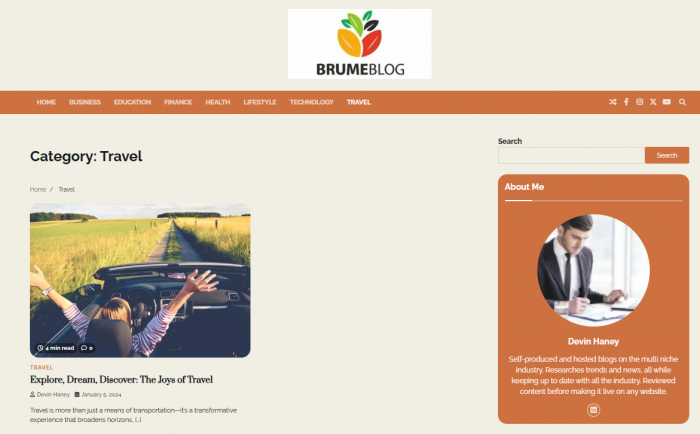
The eight categories suggest a complete editorial universe, yet the actual distribution of content is uneven. Core sections like Business, Education, Finance, Health and Lifestyle carry most of the weight. Technology has only a small cluster of posts, and Travel currently shows just a single article, which makes that section feel more like a placeholder than a true vertical.
This tells readers something important: the site is not equally committed to every category it lists. Some sections are clearly active, while others exist more as menu items, likely chosen for their long‑term search potential.
Category emphasis snapshot
| Category | Actual feel on-site | Content volume signal | Reader takeaway |
| Home | Mixed feed of latest and featured posts | Medium | Good for discovery, light on identity |
| Business | General business and work topics | Moderate | Practical but not expert-level |
| Education | Explainers and information pieces | Moderate | Serviceable, can feel generic |
| Finance | High‑level money topics | Moderate | Needs stronger authority for serious use |
| Health | General wellness content | Moderate | Fine for casual reading only |
| Lifestyle | Everyday lifestyle and fashion‑style topics | Moderate | Natural fit, not very unique |
| Technology | Very few technology posts | Low | Thin section, not a tech destination |
| Travel | Only one visible travel post | Very low | Feels experimental / unfinished |
How each section actually performs
1. Business is readable and straightforward, suited to people who want broad introductions rather than deep dives. Articles explain rather than analyze, so they work as starting points but do not compete with specialist business sites.
2. Education aligns well with BrumeBlog’s search‑first style. Many queries online are educational in nature, and the site responds with straightforward explainers that answer “what” and “how” questions. The gap is differentiation: similar content exists on countless other sites.
3. Finance is more sensitive. Financial topics require accurate, well‑sourced content and ideally visible expertise. BrumeBlog’s finance section feels more like generic personal‑finance blogging, with limited trust signals, meaning readers should treat it as orientation rather than advice.
4. Health content falls into the same category. Light wellness pieces are acceptable, but once content touches anything remotely medical or high‑impact, credibility and sourcing matter. BrumeBlog does not yet project the level of E‑E‑A‑T needed to be a primary health authority.
5. Lifestyle is where the magazine‑style model works best. Readers often look here for inspiration and everyday ideas rather than strict facts, and BrumeBlog delivers accessible, low‑friction reading in this space. It still lacks a distinctive voice, but the fit between topic and format is stronger than in Finance or Health.
6. Technology is clearly underbuilt. With only a small number of posts, it cannot realistically claim to be a tech section in the way readers expect. The few articles that exist lean toward explainers and trend‑style coverage rather than original analysis, reinforcing the search‑first pattern.
7. Travel is the thinnest of all. A single visible article does not constitute a real travel vertical. It signals intent perhaps the site plans to expand here but in its current state, readers should not come to BrumeBlog expecting substantive travel guides.
Design, UX and readability
Where BrumeBlog does perform well is user experience. The site uses a clean, uncluttered layout, a straightforward top navigation, and typography that remains readable on both desktop and mobile. It largely avoids intrusive pop‑ups and chaotic ad placements that can ruin even decent content.
The reading model is tailored to scanners:
● Headings break up the text.
● Paragraphs are reasonably short.
● Language stays simple, making it easy for non‑expert audiences.
The trade‑off is that this efficiency can make the site feel generic. Many WordPress‑style magazines use nearly identical themes, so without distinctive visuals or a strong editorial voice, BrumeBlog risks blending into the background of similar sites.
UX at a glance
| UX factor | BrumeBlog performance | Impact on readers |
| Navigation | Clear eight‑category menu | Easy to find topics |
| Layout | Clean, low clutter | Comfortable reading |
| Speed | Modern, fast‑loading feel | Good for mobile users |
| Character | Generic magazine look | Low memorability |
The Authorship Problem
BrumeBlog lists two contributors. Devin Haney is the primary voice described in his bio as someone who "self-produces and hosts blogs on the multi-niche industry." His LinkedIn links to an entity called Web Rank Agency, which makes clear that BrumeBlog is one node in a broader commercial content operation rather than an independent editorial venture. Shivi Hyde handles a portion of the Business and Blog content but similarly carries no verifiable niche credentials.

For Lifestyle or Pets, that's acceptable lived experience is currency enough. For Finance, Crypto, and Health, it isn't. Google's E-E-A-T framework (Experience, Expertise, Authoritativeness, Trustworthiness) treats these as sensitive categories requiring demonstrable expertise, and BrumeBlog's author bios offer none. That's a structural vulnerability that growing domain authority alone cannot permanently shield.
Casino and gaming content
The newer Online Game and casino-related content adds another layer to BrumeBlog’s identity. A post like “How Visa Works at Online Casinos” shows the site is not limited to standard lifestyle, education, finance and health explainers. It is also willing to publish commercially sensitive topics where the reader expectation is different.
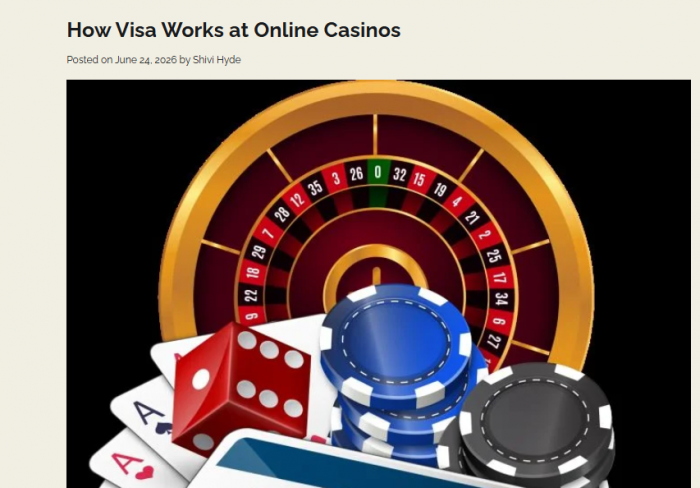
Casino and gaming content is not automatically a problem, but it does require more care. Payment methods, online gambling access, bonuses, platform safety and user risk are areas where readers need clear disclaimers, responsible-gaming context and careful sourcing. On BrumeBlog, this content currently fits the wider search-first pattern: readable, accessible and useful as a basic explainer, but not strong enough to function as a deeply vetted gambling or gaming authority.
This section also reinforces the site’s broader editorial issue. BrumeBlog can cover many topics, but not every topic carries the same responsibility. A pet guide or lifestyle post can survive with a lighter tone. Casino-related content needs sharper transparency, clearer risk framing and stronger editorial controls.
Outbound link footprint
One section worth noting is BrumeBlog’s “Websites” page. It contains a long list of external domains, Blogspot links and shortened links rather than a normal editorial resource page. For a casual reader, this page may not matter during ordinary browsing. For a site review, however, it changes the trust picture.
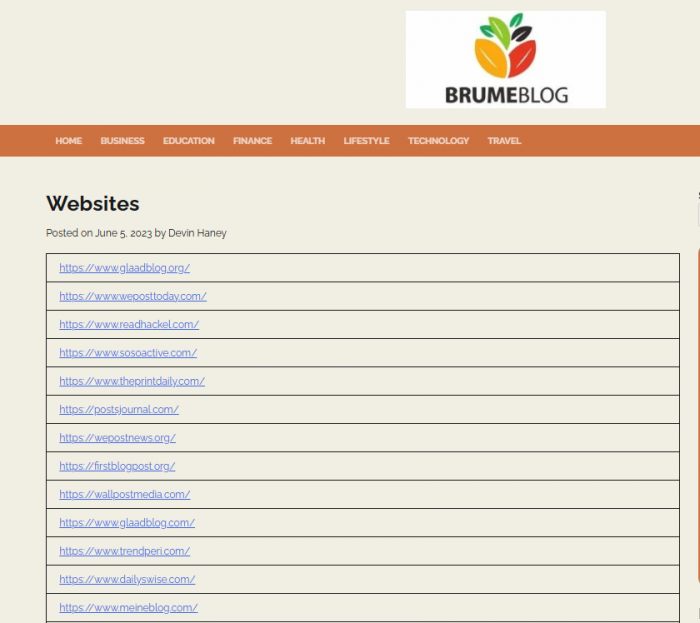
A large outbound-link page makes BrumeBlog feel less like a standalone magazine and more like part of a broader publishing or web-network environment. That does not mean the site is unsafe, but it does weaken the clean editorial impression created by the homepage and category layout.
The problem is not simply that external links exist. Most websites link out. The issue is that the page does not clearly explain why those links are listed, whether they are partner sites, owned properties, old projects, publishing references or promotional placements. Better labeling would help readers understand the purpose of the page instead of leaving them to guess.
Safety, transparency and trust signals
On the pure safety side, BrumeBlog behaves like a normal content site: secure connection, no obvious malicious behavior, and no forced high‑risk user actions. For everyday browsing, that is enough: opening and reading articles should not pose unusual technical risk.
Trust and transparency are a different question. Readers evaluating credibility will look for:
● Clear information about who runs the site.
● Meaningful author details or bylines.
● Consistent, visible sourcing for sensitive or data‑heavy topics.
Here, BrumeBlog remains relatively thin. Identity and editorial processes are not emphasized, which makes it harder to judge how content is produced and reviewed. As a result, the site feels safe to open but not deeply transparent.
Simple trust profile
| Trust area | Current state | Reader takeaway |
| Basic safety | Behaves like a standard content site | Fine to browse |
| Transparency | Limited visibility into ownership and authorship | Harder to fully trust |
| Sourcing | Mixed, stronger for light topics than for YMYL topics | Cross‑check important claims |
| Accountability | Editorial standards not clearly showcased | More publishing than publishing‑with‑oversight |
E‑E‑A‑T: experience, expertise, authoritativeness, trustworthiness
Helpful, people‑first content is expected to demonstrate real understanding, not just repeat information that exists elsewhere. Guidance on E‑E‑A‑T places emphasis on lived experience where relevant, clear expertise, and strong signals that a site deserves to be trusted on its chosen subjects. BrumeBlog partially meets those expectations in low‑stakes topics, but not in areas where decisions or wellbeing are at risk.
● Experience: Articles tend to be generic explainers rather than grounded in first‑hand use or case‑based storytelling.
● Expertise: Works for broad, introductory content, but feels thin in finance and health where subject‑matter credentials matter most.
● Authoritativeness: The site has structure and breadth, yet lacks flagship content or clear experts that would position it as a leader in any one field.
● Trustworthiness: Browsing is safe, but transparency and sourcing do not fully support a “go‑to authority” label.
Simple E‑E‑A‑T profile
| Area | BrumeBlog position | Practical implication |
| Experience | Mostly generalized perspectives | Good for orientation, not deep lived insight |
| Expertise | Adequate in simple topics | Cross‑check serious advice elsewhere |
| Authoritativeness | Broad but shallow | Rarely the final reference stop |
| Trustworthiness | Safe but not strongly transparent | Use as a starting point, not sole source |
Is BrumeBlog a search‑first website?
Everything about the way topics are chosen and articles are structured points toward a search‑first content strategy. The site targets broad, high‑interest queries across multiple niches, produces long explanatory pieces designed to match those queries, and organizes them under SEO‑friendly category labels.
It behaves more like an SEO‑driven magazine than a community‑driven blog. Indicators include:
● Broad topical spread across several unrelated niches.
● Uneven content depth, with clearly strategic categories (Finance, Health, Business) and token sections (Travel, thin Technology) that still exist for their long‑term search value.
● Article structures that look optimized for search intent (definitions, benefits, tips) rather than distinctive narrative or deep reporting.
For readers, this is not automatically bad. It simply means BrumeBlog is designed first to capture search traffic and then to satisfy it at a “good enough, easy to read” level rather than to build a loyal specialist audience.
Strengths, weaknesses and editorial reality
Strengths
● Clean UX and clear navigation make it painless to move around the site.
● Articles are approachable for non‑expert readers and suitable for quick orientation.
● The breadth of categories lets users sample different topics in one visit.
Weaknesses
● Travel and Technology are visibly underdeveloped, with Travel down to a single post and Tech carrying only light coverage.
● Finance and Health lack the strong E‑E‑A‑T signals expected in higher‑stakes topics.
● The site feels like a search‑first content machine rather than a distinct editorial brand with recognizable voices.
Who BrumeBlog is best for
BrumeBlog is best for casual readers who arrive from search and want a simple introduction to a topic. It works well when the subject is low-risk, general or lifestyle-oriented: basic business explainers, everyday lifestyle ideas, pet content, light education pieces and simple web or blogging topics.
It is also useful for readers who want quick orientation before moving to more specialist sources. The site’s clean layout, readable structure and straightforward language make it easy to scan, which is one of its stronger qualities.
BrumeBlog is less suitable for readers who need authoritative guidance in areas like health, finance, crypto, trading, casino payments or medical-adjacent topics. Those areas require stronger sourcing, visible expertise and clearer editorial accountability than the site currently shows.
Simple reader fit
| Reader type | Fit | Why |
|---|---|---|
| Casual search visitor | Good fit | The articles are easy to read and answer broad questions quickly. |
| Lifestyle or pet reader | Good fit | These topics suit the site’s light magazine-style format. |
| Beginner researcher | Partial fit | Useful for orientation, but not strong enough as a final source. |
| Finance, health or crypto reader | Weak fit | These topics need stronger trust and sourcing signals. |
| Casino or gaming reader | Cautious fit | Basic explainers may help, but risk, safety and disclosure need more depth. |
Who should avoid relying on it
Readers should avoid treating BrumeBlog as a primary source for serious decisions. That is especially true for topics involving money, health, crypto, trading, employment screening, online gambling or medical care. In those areas, BrumeBlog may be readable, but readability is not the same as authority.
The site is better used as a starting point than a final reference. If an article affects personal finance, health, legal exposure, platform safety or gambling decisions, readers should cross-check the information with official sources, specialist publications or qualified professionals.
This does not make BrumeBlog useless. It simply defines the right expectation. It is a convenient general-interest blog, not a specialist advisory site.
Final Quality Scorecard - Six Dimensions
| Dimension | Score |
| Readability | 7.5 / 10 |
| Content depth | 3.8 / 10 |
| Originality | 3.2 / 10 |
| Design & UX | 7.0 / 10 |
| Author credibility | 2.8 / 10 |
| Publish consistency | 6.5 / 10 |
Verdict
BrumeBlog.com is best viewed as a search‑first, general‑interest content site that does a respectable job of making information easy to read, but only a partial job of making that information deeply authoritative or unique. It is well suited to casual readers who arrive from search, skim an article in Business, Education, Lifestyle or a similar section, and then move on.
However, the combination of thin Travel content, a light Technology section, and only moderate E‑E‑A‑T in Finance and Health means it is not yet the kind of site a reader should treat as a primary reference. BrumeBlog is useful, safe to browse, and visually calm, but it still feels more like an efficient SEO property than a destination publication that readers follow for its voice, depth and editorial conviction.