
The promise of artificial intelligence in financial markets has become one of the most compelling narratives of the digital economy. Automated trading bots, predictive algorithms, and passive income systems are now widely marketed as the future of investing. Among the newer names drawing attention is CrossMarket AI, a platform that positions itself within the fast-growing AI trading ecosystem.
First Impressions: What the Website Reveals

Upon visiting CrossMarket AI, users are greeted primarily with a login and registration interface. Unlike many financial technology platforms that offer detailed landing pages explaining their services, leadership team, compliance structure, and technical architecture, the publicly accessible information here appears limited.
There is minimal explanatory content outlining how the system works, what markets it operates in, who operates the company, or under which regulatory jurisdiction it falls. For a platform reportedly centered on AI-driven financial operations, this lack of visible context may leave new visitors with more questions than answers.
Transparency is not merely a preference in financial services it is foundational to trust.
The Broader Context: AI Trading Platforms in 2026
To understand CrossMarket AI, it helps to understand the larger industry trend it appears to be part of.
AI-powered trading platforms generally claim to use algorithmic models to analyze market patterns, execute trades, and optimize returns without human intervention. These systems often market themselves as:
● Emotion-free
● Faster than human traders
● Data-driven
● Capable of generating passive income
While algorithmic trading is indeed widely used by institutional investors and hedge funds, the retail market has also seen a surge of platforms promising access to similar technology. The challenge for users lies in distinguishing between well-documented, regulated services and platforms that operate with limited public verification.
How CrossMarket AI Appears to Operate
Based on publicly visible elements, CrossMarket AI functions as a gated-access platform, meaning users must register to view internal features.
What remains unclear from the outside is:
● The specific trading strategy used
● The asset classes involved (crypto, forex, equities, etc.)
● Risk disclosures
● Regulatory licensing
● Corporate ownership structure
When a financial platform does not provide comprehensive public documentation, it becomes difficult for potential users to evaluate its operational legitimacy before committing funds.
In traditional financial services, transparency typically includes publicly listed executives, company registration numbers, regulatory approvals, risk disclaimers, and clear fee structures. The absence of these details does not automatically indicate wrongdoing — but it does increase the burden on the user to conduct deeper due diligence.
Transparency and Regulatory Considerations
One of the most critical aspects of evaluating any financial or trading platform is regulatory oversight.
Legitimate trading platforms are generally registered with recognized financial authorities, depending on their jurisdiction. These may include:
● Securities regulators
● Financial conduct authorities
● Commodity trading regulators
● Cryptocurrency compliance bodies
At the time of review, publicly verifiable regulatory licensing information is not clearly displayed on CrossMarket AI’s website interface. Additionally, company ownership and physical business location details are not prominently accessible.
For investors, regulatory oversight matters because it provides:
● Legal accountability
● Consumer protection frameworks
● Dispute resolution channels
● Financial reporting obligations
Without these structures, users may have limited recourse if disputes arise.
Evaluating Risk: What Users Should Consider
It is essential to approach any AI trading system with healthy skepticism. Artificial intelligence can assist with pattern recognition, but it does not eliminate market risk.
Investors should ask:
● Are returns described as guaranteed or fixed?
● Are risk disclosures clearly outlined?
● Are withdrawal policies transparent?
● Is there a detailed explanation of how profits are generated?
Financial markets are inherently volatile. No algorithm, regardless of sophistication, can eliminate risk entirely. Any suggestion of consistent, high-yield returns without proportional risk explanation warrants careful scrutiny.
Additionally, users should consider data privacy. Platforms requiring identity documents, payment details, or crypto wallet information must have clear data protection policies in place. Without transparent policies, personal and financial data could be vulnerable.
Public Sentiment and Online Discussions
1. Divergent Trust Scores from Review Sites
Independent website analysis tools paint conflicting pictures about CrossMarket AI’s credibility:
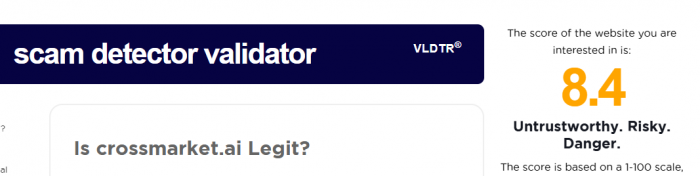
● Scam Detector, a site that aggregates multiple fraud risk factors, assigns crossmarket.ai a very low trust score of 8.4/100, labeling the platform as high-risk and potentially unsafe. This score is based on technical risk indicators like proximity to suspicious sites, phishing potential, and unknown ownership.
● ScamAdviser, another widely referenced site, gives the domain a moderate trust score noting valid SSL encryption and safety against phishing lists, but also highlighting hidden ownership and recent domain creation. Their conclusion: medium to low risk, but caution advised.
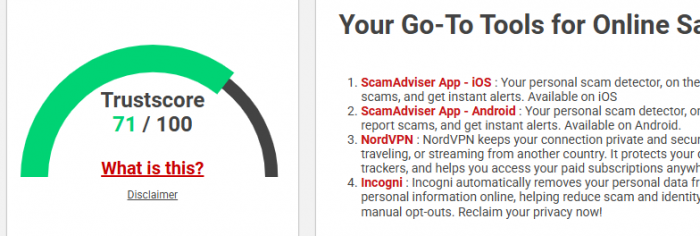
These contrasting assessments indicate no definitive consensus, but both emphasize a need for careful user verification before engagement.
2. Mixed Public Ratings on Review Platforms
Public review platforms show polarized sentiment, which often characterizes controversial or heavily marketed products:
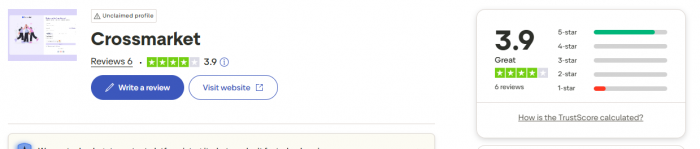
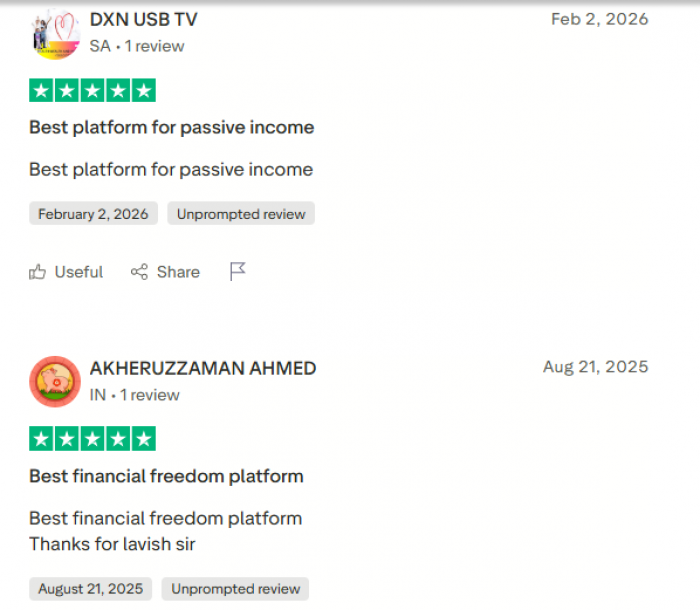
On Trustpilot, crossmarket.ai’s profile shows a 3.9 out of 5 stars average, but this rating is based on only six reviews, a very small sample size. Most positive reviews praise the platform as a “great opportunity for passive income” or “best financial freedom platform,” while at least one user outright labels it a “scam” and says the site became inaccessible.
What this tells us:
● The majority of showcased reviews are overwhelmingly positive.
● Such extreme polarization could suggest either genuine mixed outcomes or review manipulation (very positive short testimonials vs. negative real-world experience).
In digital finance communities, patterns like this are consistent with platforms that combine affiliate-driven promotion and user testimonials lacking verifiable proof.
3. User Experiences Shared on Forums and Blogs
Beyond structured review platforms, user-generated feedback on forums, blogs, and discussion sites reveals recurring themes:
a) Withdrawal Difficulties
Several investigations include firsthand or reported user accounts where:
● Users see “profits” growing on dashboards.
● Withdrawal requests remain pending or deny payouts unless additional fees are paid (network fees, verification fees, etc.).
● Support communication becomes difficult after initial investment.
A blog analyzing real cases cites a user from Phoenix who saw his deposited funds grow visually on the platform, but could not withdraw without repeated excuses and additional charges, a pattern echoed across Reddit and other forums.
This kind of feedback of easy deposits but hard or impossible withdrawals is frequently flagged as a top warning sign by consumer protection analysts.
b) Pattern Recognition in Third-Party Analysis
Several independent reviews mention:
● Lack of verified AI trading mechanisms, whitepapers, or performance audits. =
● Hidden or anonymous ownership through WHOIS privacy, limiting accountability.
● Claims of unrealistic guarantees (e.g., stable high daily returns) that conflict with real market behavior.
These observations reflect community skepticism regarding both transparency and technical legitimacy.
4. Community Interpretation and Concerns
While not specific to CrossMarket AI discussions, broader conversations in scam-focused communities reflect general attitudes toward AI trading promises:
● Users often note that AI trading platforms promising guaranteed returns are frequently scams or high-risk ventures.
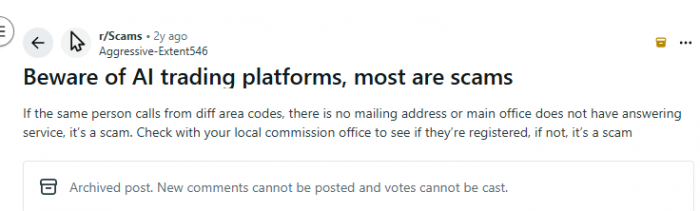
● There is significant concern about fake or incentivized reviews in digital finance spaces which can mislead uninformed investors.
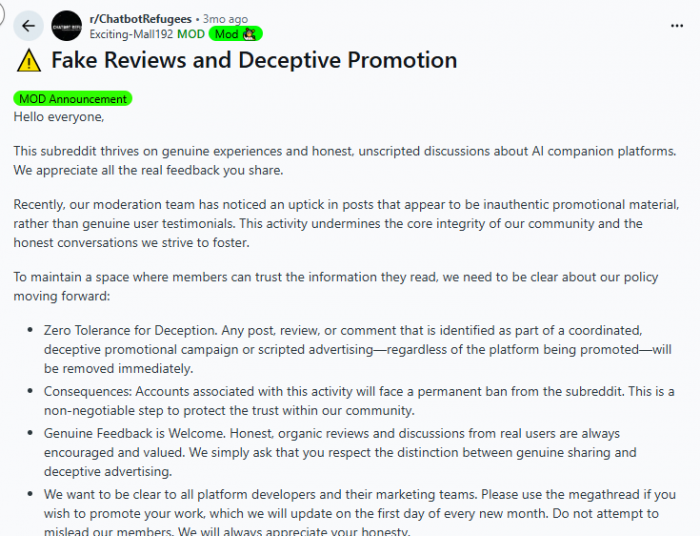
When forum participants talk about “most AI trading platforms being scams,” it reflects a cautious and skeptical user culture, especially where financial loss is involved.
5. Weighing Public Sentiment: What the Pattern Suggests
Positive user comments often:
● Highlight ease of use.
● Celebrate small profits or passive income potential.
● Come from users with only brief exposure.
Negative experiences tend to:
● Focus on operational issues like withdrawal restrictions or disappearing support.
● Appear in negative reviews or in community discussions warning others.
● Mirror patterns associated with “investment schemes” rather than regulated trading services.
This duality extremely positive micro-testimonials versus serious negative patterns is a classic signal analysts observe in contentious platforms, especially where:
1. Users are recruited through referral networks,
2. Positive reviews are short and superficial,
3. Negative outcomes relate to real financial losses.
Important Note
While mixed and polarized sentiment doesn’t prove fraud, patterns of feedback (especially withdrawal issues and lack of transparency) significantly increase risk perception and warrant deeper due diligence before engaging financially. (Scam Detector)
The Psychological Dimension of AI Investment Platforms
AI trading platforms often tap into a powerful psychological appeal: automation combined with passive income.
The concept of earning without active management is attractive, particularly in uncertain economic climates. However, emotional triggers such as urgency, exclusivity, or referral-based incentives can sometimes influence decision-making.
Investors may experience:
● Fear of missing out (FOMO)
● Overconfidence in automation
● Underestimation of market risk
● Trust in technological branding without verification
Understanding these psychological influences helps individuals make more rational financial decisions.
Who Should Exercise Extra Caution?
Certain categories of users should be particularly careful when engaging with platforms lacking detailed public transparency:
● First-time investors unfamiliar with financial markets
● Individuals seeking guaranteed income streams
● Users unfamiliar with algorithmic trading mechanics
● Those investing funds they cannot afford to lose
Diversification, independent research, and consultation with licensed financial professionals remain essential safeguards.
How to Conduct Independent Verification
When evaluating a platform like CrossMarket AI, independent verification is not optional, it is essential. In the digital finance space, appearance can be polished while underlying structures remain opaque. Proper verification is about systematically reducing uncertainty before exposing yourself to financial risk.
Begin With Corporate Identity, Not Marketing Claims
The first and most important question is simple: Who is legally operating this platform?
A legitimate financial service should clearly disclose its registered company name, jurisdiction, and registration number. If this information is not visible on the website, that absence itself is informative.
Once you identify a company name, search official government business registries in the stated jurisdiction. Most countries maintain publicly searchable databases for registered businesses. Confirm that:
● The company exists.
● Its status is active (not dissolved or struck off).
● Its incorporation date aligns with the platform’s claimed operational history.
If you cannot identify a legal entity behind the platform, accountability becomes difficult and that dramatically increases risk exposure.
Verify Regulatory Oversight
In financial services, regulation is the backbone of consumer protection.
A trading or investment platform that handles user funds should typically fall under a recognized financial regulator. The specific authority depends on where the company claims to operate. For example:
● In the United States, firms are regulated by bodies such as the SEC or CFTC.
● In the United Kingdom, the FCA oversees financial service providers.
● In India, SEBI regulates securities and investment activity.
Visit the official website of the relevant regulator and search their authorized firm database. Do not rely on screenshots or certificates displayed on the platform itself; these can be fabricated. Always verify directly through the regulator’s official portal.
If the company claims to be “registered” but not “regulated,” understand the distinction. Business registration does not equal financial authorization. Only regulatory licensing ensures compliance with financial laws.
Examine the Domain History and Ownership Structure
The website itself carries valuable technical information.
Using WHOIS lookup tools (such as ICANN’s public WHOIS service), you can determine when the domain was registered and whether ownership information is public or anonymized. A recently registered domain does not automatically imply wrongdoing, but it does mean the platform lacks historical track record.
If ownership details are hidden behind privacy services, this does not prove illegitimacy; many companies use privacy protection but when combined with limited corporate transparency, it contributes to opacity.
Also review whether the domain has changed ownership multiple times, which may indicate instability.
Scrutinize Legal Documentation Thoroughly
Serious financial platforms provide comprehensive legal documentation. This includes:
● Terms and Conditions
● Risk Disclosure Statements
● Privacy Policies
● Refund and Withdrawal Policies
Take time to read these documents carefully. Look for clarity rather than vague language. Well-structured legal documents should clearly define:
● How profits are generated
● Whether returns are guaranteed or variable
● How user funds are handled
● What happens in the event of losses
● Dispute resolution mechanisms
If risk disclosures are missing or superficial, that is concerning. Financial markets are inherently volatile, and any credible platform must acknowledge the possibility of loss.
Evaluate the Business Model Rationally
Beyond paperwork, consider whether the business model itself makes economic sense.
If a platform suggests consistently high daily or weekly returns, ask yourself how such stability is achievable in volatile markets. Even institutional hedge funds cannot guarantee fixed returns.
A legitimate AI trading system would typically explain:
● The markets it operates in (crypto, forex, equities, etc.)
● The strategy type (arbitrage, trend-following, market-making)
● The risk management framework
If performance claims are presented without explanation of underlying mechanisms, skepticism is warranted.
Investigate Withdrawal Transparency
Deposit processes are usually straightforward. Withdrawal processes reveal the real test of credibility.
Before funding any account, examine:
● Minimum withdrawal thresholds
● Processing times
● Associated fees
● Identity verification requirements
Search independent forums for user experiences related specifically to withdrawals. Consistent reports of delays, unexpected fees, or denied access to funds represent significant warning signs.
A reputable platform should clearly outline withdrawal terms and honor them consistently.
Cross-Reference Independent Reviews
Do not rely solely on testimonials featured on the platform’s website. Instead, search for discussions on neutral forums and independent review platforms.
When reading reviews, focus less on extreme praise or isolated complaints and more on recurring patterns. Multiple users reporting similar issues particularly regarding withdrawals or customer support deserve attention.
At the same time, recognize that online feedback can be manipulated. Look for detailed experiences rather than one-line promotional comments.
Assess Customer Support Responsiveness
Direct communication can provide valuable insight.
Contact customer support with specific questions regarding regulation, company structure, and risk management. Observe whether responses are:
● Prompt and professional
● Specific and informative
● Transparent rather than evasive
A legitimate financial service should be able to clearly articulate its regulatory standing and operational structure without hesitation.
Analyze Marketing Tone and Psychological Triggers
Finally, step back and evaluate how the platform markets itself.
High-pressure tactics such as countdown timers, exclusive access claims, referral bonuses, or guaranteed income narratives are often designed to accelerate decision-making. Sound financial decisions, however, require patience.
If urgency replaces clarity, caution is appropriate.
The Core Principle: Verification Is About Pattern Recognition
Independent verification is not about finding a single piece of proof. It is about assembling multiple data points and evaluating the overall pattern.
When corporate registration, regulatory licensing, legal documentation, domain transparency, withdrawal processes, and independent reviews all align coherently, confidence increases.
When several of these elements are unclear, inconsistent, or inaccessible, risk multiplies.
In digital finance, protecting your capital begins not with investment but with investigation.
The Larger Question: Innovation vs. Accountability
Artificial intelligence continues to transform industries, including finance. However, innovation does not replace accountability.
A credible financial platform typically balances technological advancement with:
● Clear legal structure
● Transparent leadership
● Regulatory oversight
● Detailed operational disclosures
When any of these pillars are missing, uncertainty increases.
CrossMarket AI may represent part of a broader wave of AI-driven financial experimentation. Whether it evolves into a transparent, regulated entity or remains opaque depends on its commitment to public accountability.
Final Thoughts
AI trading is not inherently problematic. In fact, algorithmic trading has been a cornerstone of institutional finance for decades. The issue arises when accessibility outpaces transparency.
As of this review, CrossMarket AI presents limited publicly verifiable information regarding its operations, ownership, and regulatory framework. That alone does not confirm legitimacy or illegitimacy but it does highlight the need for caution.
In the world of digital finance, skepticism is not negativity; it is protection.
Before depositing funds into any automated trading system, ensure you fully understand:
● How profits are generated
● What risks are involved
● Who operates the platform
● What legal protections exist
Financial growth should be built on informed decision-making, not assumption.