
Droven.io is one of those AI platforms that blurs the line between “knowledge hub” and “product promise”: it talks like both an editorial destination and an AI‑powered solution, but what actually reaches the user is mostly content explainers, reviews, and trend pieces wrapped in the language of automation and intelligence.
A sharp look at what Droven.io really is
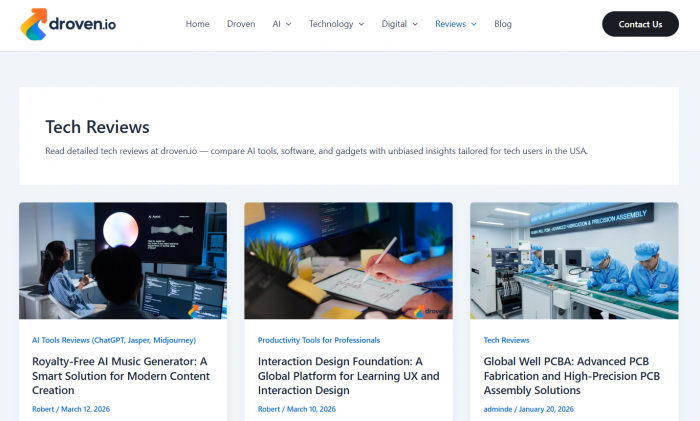
At a practical, user‑facing level, Droven.io behaves like an AI‑centric content and education site. It publishes structured articles on artificial intelligence, automation, startups, software development, digital transformation, data analytics, and future‑of‑work themes, positioned mainly for readers in or interested in the US market. The experience you actually get is reading and research, not logging into a typical SaaS dashboard with clear pricing tiers and SLAs.
Around that core, various narratives present Droven.io as an AI automation platform, a cybersecurity solution, a developer productivity engine, or even a provider of “new gadgets,” which creates a noisy halo of claims. For a user‑first review, it’s important to treat those claims as marketing layers around a still‑maturing ecosystem rather than as proven, cohesive product lines.
Content architecture: eight pillars and many promises
Droven.io’s strongest visible asset is its content structure. Its own positioning highlights eight broad categories that try to map the AI landscape in a logical way: artificial intelligence, AI tools, generative AI, technology news, software development, digital transformation, big data and analytics, and the future of work. These categories give the site enough breadth to feel like a general AI destination, but they are still narrow enough to avoid becoming a random tech grab bag.
Within this structure, there are more specific streams. A “Tech Reviews and Comparisons” section focuses on AI tools, software, and gadgets, promising “unbiased insights tailored for tech users in the USA.” Other content highlights machine learning trends, responsible AI, and governance, with references to topics such as explainability, model fairness, and differential privacy. On paper, this architecture supports a 360‑degree view of how AI shows up in business, development, infrastructure, and everyday products.
The tension is that this wide scope depends heavily on contributors and secondary narratives. Some external pieces attach Droven.io’s name to domains like cybersecurity platforms or AI gadgets, stretching the brand into directions that its own core site doesn’t fully substantiate for an everyday user.
From a reader’s perspective, the categories are useful but you still need to check whether the article you opened is truly expert‑level or just wearing expert language.
| Category | Coverage | Depth | Audience Fit | Critical Note |
| Artificial Intelligence | High | High | All levels | Core pillar; most consistently updated |
| AI Tools | High | Medium | Practitioners, SMBs | Practical focus; occasionally shallow on trade‑offs |
| Generative AI | Medium‑High | Medium‑High | Marketers, creators | Fast‑moving space — freshness is critical here |
| Automation & RPA | Medium | Medium | Ops teams, founders | Strong conceptual coverage; fewer implementation details |
| Cloud Computing | Medium | Medium | IT teams, developers | Introductory‑level; misses enterprise nuance |
| Cybersecurity | Medium‑High | Medium‑High | SMBs, IT pros | Timely; AI‑threat angle is a genuine differentiator |
| Machine Learning | Medium | Medium | Technical learners | Conceptual clarity good; advanced practitioners need more |
| Career & Developer Resources | Medium‑High | Medium | Job seekers, students | Salary data and roadmaps are genuinely useful |
Writing style: accessible, structured, occasionally generic
Most descriptions of Droven.io’s content point to the same broad pattern: the platform focuses on clear, structured, and accessible explanations rather than dense academic writing or thin AI-style summaries. Its articles are usually organised with direct headings, practical examples, and simple takeaways, which makes them easy to scan and fairly easy to understand.
The content works best when it stays focused on reader utility. In many pieces, Droven.io first explains why a topic matters, such as developer productivity, machine learning trends, or cybersecurity, and then moves into key points, use cases, and possible implications.
Key strengths include:
● Clear structure with easy-to-follow headings
● Explanatory tone that avoids unnecessary jargon
● Practical framing around real technology topics
● Useful middle ground between basic blogs and technical whitepapers
The trade-off is that the style is not always distinctive. Because Droven.io covers many sub-domains and appears to rely on contributor-style content, some articles can drift into broad claims without enough concrete proof. Phrases around “AI-driven cybersecurity dashboards” or “new gadgets,” for example, can feel more like concept marketing than tightly evidenced product analysis. So while the site is readable and useful at a basic level, the quality is not always deep, original, or strongly documented.
Depth and research: from solid explainers to stretched narratives
Droven.io is often described as publishing “research‑backed” content and avoiding thin AI‑generated summaries, and there is some support for that claim. Longer articles on AI, tools, or analytics are usually structured to provide context, use cases, and practical value aiming to help readers make better decisions about skills, tools, or strategies rather than just inflating word count.
Yet depth is not a constant. Some supporting narratives around Droven.io present highly confident technical capabilities real‑time analytics, AutoML and MLaaS for sectors like e‑commerce and healthcare, and advanced data analytics that uncover “hidden trends” without corresponding public technical documentation, customer case studies, or detailed implementation walkthroughs. From a critical standpoint, that mapping between described capability and demonstrable depth remains thin.
In practical terms, Droven.io’s best content works well as a framing layer: it gives a reader enough to understand the “why” and “where” of a technology, the categories of tools, and the typical use cases. It is less dependable as a primary technical reference or source of validated performance claims. For that, a careful reader will still need vendor docs, benchmarks, and community feedback.
Author transparency and editorial model
Droven.io runs on a multi‑author model and openly invites contributions via a “write for us” channel. This makes sense for a site that wants to cover everything from AI basics to developer tools, gadgets, and cybersecurity updates. A contributor‑driven structure allows it to publish regularly across categories and to bring in varied perspectives.
From a trust and expertise perspective, the model is more ambiguous. Public, independent analyses note that ownership and editorial team details are relatively light, and that there is limited transparent information about who exactly is behind each article and what their domain background is. Readers are encouraged to evaluate content article by article rather than treating the site as a top‑tier, automatically authoritative source.
That doesn’t mean Droven.io is untrustworthy; it means that, as of now, it sits closer to “useful AI and tech reading platform with mixed authorship” than to “named‑expert‑driven outlet with established editorial pedigree.” For user‑first evaluation, the absence of strong, public author profiles and detailed editorial standards is a noticeable gap.
Product and feature claims: AI platform or content brand?
One of the most confusing aspects of Droven.io is the way different narratives attach product‑grade language to what is, in practice, a mostly editorial platform. Various descriptions portray Droven.io as:
● An AI automation and workflow engine that integrates data, triggers, and actions to optimise operations and decision‑making.
● A cybersecurity platform that uses machine learning for threat detection, behavioural analysis, and zero‑trust verification, managed from a single dashboard.
● A source of “new gadgets” AI‑powered smart devices that improve daily life, productivity, and health.
These claims paint a picture of a broad AI product ecosystem rather than just a blog. The critical issue is that public evidence tying all of these capabilities into a coherent, accessible, and verifiable product suite is limited. Much of the detail is presented narratively rather than through technical docs, pricing, APIs, or user onboarding flows that a typical buyer would expect.
For a user, the safest interpretation is that Droven.io’s core offering you can reliably touch today is knowledge: articles, reviews, and guides. The more expansive platform claims should be treated as marketing or aspirational until they are backed by clearer product surfaces and independent validation.
User experience: navigation, usability, and practical value
From a usability standpoint, Droven.io generally earns positive commentary. Its interface is described as clean and intuitive, making it straightforward even for beginners to find and navigate content. Category‑based navigation enables readers to follow their interests logically rather than wading through a single undifferentiated blog stream.
For developers and technical readers, some content is explicitly positioned as helping to cut noise and highlight tools that address concrete problems such as slow development cycles, high error rates, or poor collaboration. The value proposition here is less “here is yet another list of 30 tools” and more “here is how certain tools reduce specific pain points,” though, again, the execution varies by article.
In day‑to‑day use, Droven.io appears most useful as a starting point: a place to gather context, understand vocabulary, and identify themes or tools worth deeper investigation. It is not yet at the stage where a risk‑sensitive organisation would treat it as a primary reference for technical or strategic decisions without cross‑checking.
Snapshot: content and experience at a glance
To make the picture more concrete, this table captures key content‑ and experience‑level dimensions as they look today.
| Dimension | Droven.io today |
| Core offering | AI‑ and tech‑focused articles, explainers, reviews, trend pieces |
| Topic coverage | AI, AI tools, generative AI, tech news, software dev, digital transformation, analytics, work |
| Writing style | Accessible, structured, explanatory; avoids ultra‑thin AI summaries |
| Depth | Moderate to good; varies by topic and contributor; stronger as framing than as deep reference |
| Author transparency | Multi‑author; contribution‑based; limited visible credentials and ownership detail |
| Product claims | Ambitious narratives (automation, cybersecurity, gadgets) with limited public technical backing |
| UX and navigation | Clean, intuitive interface; category‑based navigation for easier exploration |
| Best use case for readers | Discovering AI topics, following trends, framing decisions; not sole source for critical calls |
Where Droven.io genuinely adds value
Despite the noise around it, Droven.io does manage to create real value for certain reader profiles. The combination of AI‑focused categories, regular publishing, and non‑academic writing makes it accessible for people who are late to AI but now need to catch up quickly.
It is especially usable if you are trying to understand which themes matter: machine learning trends, responsible AI, developer tooling, cybersecurity risks before you commit to specific tools or vendors.
The editorial stance, at least in some analyses, is explicitly against thin, AI‑generated content and affiliate‑heavy listicles. That alone differentiates it from many “AI blogs” created purely to chase search traffic. Articles on tools and trends often try to discuss fit, limitations, and context rather than just repeating feature lists. For a user who wants to feel less manipulated by promotional content, that intent counts.
Where it falls short and what to watch for
However, Droven.io is not a finished product in credibility terms. The multi‑author, contributor‑driven model, combined with light public information about ownership and editorial leadership, means readers cannot yet treat the brand as a default stamp of authority. Quality is uneven, and some content leans heavily into benefit‑driven messaging without showing the underlying evidence or constraints.
The wider cluster of claims around AI automation, cybersecurity platforms, and “new gadgets” also raises expectations that the publicly visible product surface does not fully meet. Without detailed docs, transparent feature sets, and independent validation, those narratives remain closer to positioning than to proven capability.
For a critical user, this is the main red flag: not that the site is fake, but that its loftiest promises are not yet matched by equally visible proof.
The Verdict: Right Platform, Finite Jurisdiction
DRoven.io does one thing genuinely well and does it without apology: it gives non-expert readers a credible, non-commercial entry point into artificial intelligence, automation, and the technologies reshaping how businesses operate. In 2026, that is rarer than it should be.
The platform's editorial discipline resisting vendor partnerships, avoiding demo funnels, maintaining accessible language without collapsing into oversimplification is a genuine market contribution. The cybersecurity content's dual-lens treatment of AI as both threat multiplier and defence asset is precisely the kind of nuanced framing that most public platforms avoid because it is less marketable than pure optimism.
The honest criticism is not that DRoven.io falls short of its promise, it largely fulfils it. The problem is that the promise has a ceiling most readers will hit faster than expected. The moment implementation begins, the platform's depth becomes insufficient. Technical practitioners, enterprise architects, and active developers will need to graduate to more specialised resources quickly.
That is not a fatal flaw. Encyclopaedia Britannica never tried to replace the laboratory. DRoven.io should be clear that it is the briefing before the work not the work itself.