There is a specific kind of website that tries to be everything and risks becoming nothing. The Sindi, live at thesindi.com, sits squarely at that crossroads. It covers technology, finance, business, law, health, education, lifestyle, fashion, automotive, and sports across what now amounts to 58+ pages of archived content, a genuinely ambitious spread for an independent digital publication. This audit doesn't grade it on ambition. It grades it on delivery.
The numbers at a glance
| Content pages | Active categories | Publishing since | Author type |
| 58+ | 10 | 2024 | Solo author |
A single-author publication running 58 pages across ten categories is not unusual in the independent media world, but it raises immediate questions about depth, consistency, and editorial authority all of which we'll unpack category by category.
The content universe : what's actually covered
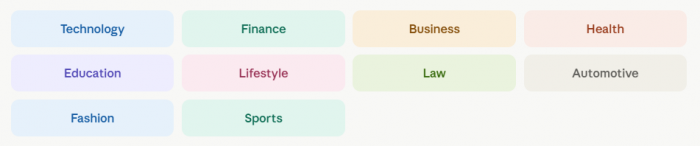
TheSindi.com's navigation bar surfaces seven primary categories Technology, Finance, Business, Education, Health, Lifestyle, and Law while the article stream reveals additional verticals like Automotive, Fashion, and Sports quietly operating beneath the surface. This hidden depth is both a missed opportunity and a mild navigation frustration.
Publishing cadence : how consistent is it?
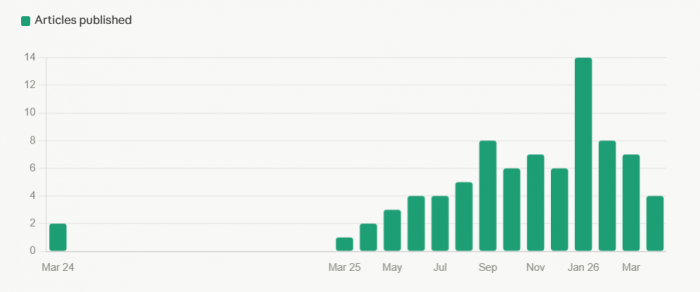
The archive tells an interesting story. Publishing launched in March 2024 with a gap, then resumed seriously around mid-2025. The January 2026 period shows the densest publishing sprint a common pattern for content sites trying to build SEO mass quickly. April 2026 data is still partial at the time of this audit.
Category-by-category breakdown
Technology : the anchor section
Technology is the most prominently featured category, getting prime real estate in the "Hot Topics" sidebar. Articles here range from full-stack hiring strategy and cybersecurity threat intelligence to app builder comparisons. The writing is notably more confident in tech headlines like "Beyond the Buzzword: Decoding the True Power of Threat Intelligence" signal an editorial voice that understands its audience. That said, an article promoting "CracksTube for Professionals" introduces a credibility wobble: the subject matter sits in a legally grey area that a maturing publication should handle with more care.
Finance : promising but thin
Finance content includes cryptocurrency guides (Bitcoin buying with USD) and occasional money management pieces. The volume here is notably lower than Tech, which is a missed opportunity given that personal finance consistently ranks among the highest-search-intent categories online. What's present is competent, but the section lacks the analytical rigour that distinguishes a trusted finance resource from a general interest blog.
Health : a genuine bright spot
The Health section demonstrates some of the sharpest user-first thinking on the site. An article asking whether plant-based Omega-3 supplements are as effective as fish oil is exactly the kind of question real people are actively searching for driven by a shift in consumer behaviour toward plant-based nutrition. The prescription coupon guide and tea tree oil respiratory piece follow the same pattern: specific, actionable, search-aware. This is where TheSindi.com feels most like a publication with a reader in mind.
Education : globally curious
Education pieces span boarding school assessment for A-levels, US study consultants, California psychology PhD programs, and India's Jamboree adventure program. The range is geographically scattered which either signals a deliberately international readership strategy or an absence of focus. Pieces like the LMS software breakdown show genuine research, but the section's identity feels undefined.
Business : operationally solid
The Business section includes pieces that are genuinely useful for SME operators: shipping fragile goods internationally, dispensary visits, and entrepreneurship basics. It functions less as a thought-leadership vertical and more as a practical guide hub, a positioning that could actually work well if leaned into more deliberately.
Lifestyle, Fashion & Automotive : the softer edges
These three categories feel the most opportunistic. Matching couple outfits, Rolls-Royce customisations in Charlotte, and McLaren maintenance are engaging topics in isolation, but their connection to the publication's broader identity is tenuous. When a platform covers McLaren servicing and prescription drug savings in the same week, it needs a very strong editorial voice to hold it together and that's currently where the site is still finding itself.
Law : underserved but needed
Law appears in the navigation but is one of the quietest sections in terms of output. This is a category where authoritative, accessible content is genuinely scarce on the internet; most legal writing is either too academic or too vague to be useful. TheSindi.com's stated goal of explaining legal rights in plain language is admirable; the execution is yet to match the ambition.
Content quality scorecard
| Metric | Score |
| Headline quality | 7.8 |
| Depth & analysis | 5.8 |
| User-first framing | 7.0 |
| Category consistency | 5.2 |
| Editorial voice | 6.2 |
| SEO awareness | 7.5 |
| Design & UX | 6.5 |
The credibility question : what the About Us reveals
"We want to grow the website into a recognized circle of knowledge that caters to readers who like a variety of topics." — TheSindi.com About page
The About Us page is where a publication either earns trust or loses it before the first article is read. TheSindi.com's version is warm and well-intentioned but suffers from two problems: the writing quality is visibly lower than the best articles on the site (including grammatical roughness like "inadverttent knowledge"), and there is no mention of who is actually writing the content. A byline of "Roland" appears consistently, but no credentials, background, or editorial philosophy is offered. For a platform covering health, law, and finance all YMYL (Your Money, Your Life) categories, this is a meaningful gap.
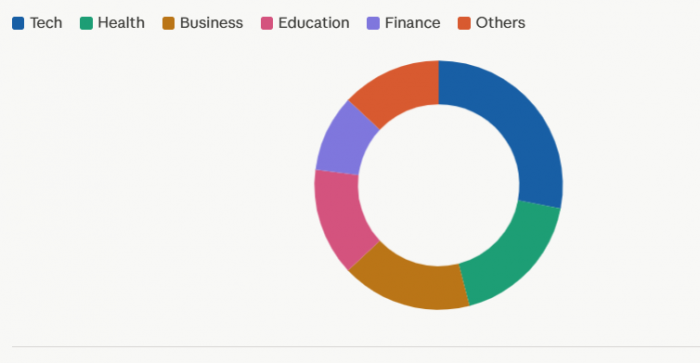
Category content balance : where the weight falls
The headline strategy : punchy but occasionally oversells
| Headline pattern type | Example(s) | Verdict |
| "Beyond the X" framing | Beyond the Buzzword / Beyond the Pretty Pixels | Smart |
| Specific number claims | Slash Rear-End Collisions by Over 40% | Verify it |
| Question-led headlines | Are Plant Based Omega-3s as Effective as Fish Oil? | Excellent |
| Decoding / Unlocking metaphors | Unlocking Your Digital Vision / Decoding US Study Consultants | Overused |
| Low-relevance promotional pieces | CracksTube for Professionals | Risk |
The headline writing is one of the site's strongest suits; titles are genuinely curious and rarely dull. The "Beyond the X" construction in particular is a reliable format that signals depth to readers. The risk is overuse: when every third article promises to decode or unlock something, the framing loses its edge.
Site design & user experience
TheSindi.com runs on a clean, conventional WordPress-style layout. Navigation is functional without being inspired. A handful of observations worth noting:
● The "Trending" strip at the top is currently static and doesn't reflect actual reader engagement data, it shows the same personal-growth article regardless of context.
● There are hidden categories (Sports, Automotive, Fashion) that don't appear in the main navigation — a discoverability miss.
● The sidebar guest post marketplace advertisement signals monetisation strategy clearly, which is honest, but it also signals to sophisticated readers that some content may be commercially placed.
● Article imagery is handled competently — Pexels stock is used tastefully and images are generally relevant, though not distinctive.
● Mobile responsiveness appears solid based on standard responsive design patterns.
The transparent monetisation question
The sidebar carries a visible "Guest Post Marketplace" advertisement linking to an external link exchange. This is common practice in the independent publishing world, but it has editorial implications. Guest post marketplaces typically introduce content that prioritises link placement over reader value. The article on CracksTube categorised under Tech reads as promotional and sits awkwardly next to more rigorous tech pieces. As The Sindi matures, separating clearly between editorially-driven content and sponsored/guest contributions will become increasingly important for trust.
Strengths and gaps : the honest verdict
| What works | What needs work |
| Health content is user-first and search-savvy | No author credentials on sensitive (health, law, finance) topics |
| Tech headlines and framing are genuinely sharp | About page quality inconsistent with article standards |
| Publishing cadence has been consistent since mid-2025 | Some promotional pieces dilute editorial credibility |
| Question-led articles show real audience awareness | Hidden categories not surfaced in main navigation |
| Clean, navigable layout with no clutter overload | Depth of analysis varies widely across categories |
| Broad category coverage gives wide discovery potential | No community, comments, or reader engagement layer |
The trajectory : where this is heading
TheSindi.com is a publication in the middle of figuring itself out, and there is nothing wrong with that almost every credible independent media brand spent its first two years doing exactly the same thing. The raw material is genuinely promising. The instinct for search-aware, user-first framing is evident in the best pieces. The publishing engine is running. What the site needs now is not more articles, but more conviction about what it stands for.
The platforms that win in the age of AI-generated content saturation will be those that offer a perspective a reason for the reader to trust this source over the algorithmic default. Author transparency, tighter category focus, and a clearer editorial philosophy would take TheSindi.com from a capable content hub to a publication readers return to by name rather than by accident.
Overall editorial score : 6.4 out of 10
A site with genuine potential, a clear publishing rhythm, and content instincts that occasionally hit well above their weight held back by a lack of editorial identity and author transparency.