Zavalio.com is the kind of website many users encounter before they fully understand what they are looking at: a broad, search-native content platform that packages business, finance, law, health, lifestyle, education, travel, and technology topics into highly structured explainer articles. It is useful, readable, and easy to browse, but its real story lies in the gap between what it does well—clarity, breadth, accessibility—and what it does not yet fully prove editorial transparency, visible expertise, and consistently deep reporting.
The short answer
At its core, Zavalio.com is a free multi-category publishing platform built for informational discovery rather than original reporting or specialist research. It is best understood as an SEO-oriented knowledge hub: a site designed to answer broad user queries quickly, keep readers moving through related pages, and turn fragmented search intent into one structured reading experience.
That framing matters because it explains almost everything about the site’s design and editorial behavior. Zavalio is not trying to look like a newspaper, a SaaS company, or a niche expert blog; it is trying to become a reliable first stop for readers who type a question into Google and want a clean, plain-English answer without a paywall.
What the website is trying to be

Zavalio’s own platform description says the site is built around a simple principle: information should be useful, not overwhelming. That mission shapes the site’s tone, article formatting, and category design, which all favor readability over density and consistency over voice-heavy editorial personality.
A useful way to think about Zavalio is this: it is less a publication with a sharply defined beat and more a content operating system for broad, everyday search queries. The site’s value proposition is not “exclusive reporting” or “expert commentary”; it is “here is a structured overview of the thing you searched for.”
The category map
Zavalio covers a wide spread of everyday informational territory, and the breadth is part of its identity. The site’s published overview and third-party analyses consistently point to these major content areas: business, finance, law, health, lifestyle, education, travel, real estate, and technology.
| Category | What it typically covers | What it signals about the site |
| Business | Entrepreneurship, market shifts, strategy, operations. | Built to attract practical, career-adjacent searches. |
| Finance | Money management, awareness content, simplified investing topics. | Designed for explainers, not advanced financial analysis. |
| Law | Rights, regulations, legal awareness topics for general readers. | Informational, not a substitute for legal expertise. |
| Health | Wellness, lifestyle habits, preventive awareness, general health explainers. | Broad health literacy angle rather than medical authority. |
| Lifestyle | Daily habits, personal choices, modern living topics. | High search volume, broad audience fit. |
| Education | Learning guidance, student-focused and skill-building content. | Beginner-friendly orientation content. |
| Travel / Real Estate | Destinations, planning, property and relocation basics. | Utility content with commercial-search overlap. |
| Technology | Domains, AI tools, websites, apps, digital explainers. | One of the site’s most visible and naturally scalable areas. |
| Fashion | Dedicated category page for style and beauty content. | Shows the platform’s willingness to extend into adjacent consumer topics. |
The category spread reveals something important: Zavalio is not niche by design. It is deliberately expansive, which helps it reach more search surfaces but also makes consistent topical authority harder to maintain across the entire site.
Where the content emphasis appears strongest
Independent reviews suggest that technology, domains, AI-related explainers, and general business/finance topics appear especially prominent in the site’s content mix. That aligns with what broad SERP behavior rewards: high-curiosity queries, emerging tools, vague brand searches, and practical “what is this?” informational intent.
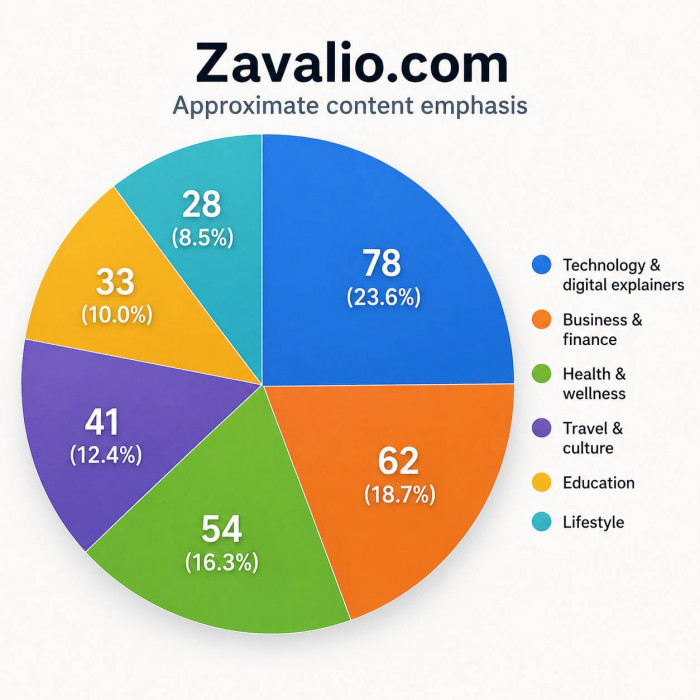
The percentages above come from third-party analysis and indicate relative visibility or presence, not mutually exclusive content shares. Even with that caveat, the pattern is useful: Zavalio behaves like a search-led generalist site whose center of gravity tilts toward technology explainers and commercially adjacent informational content.
How the reading experience is built
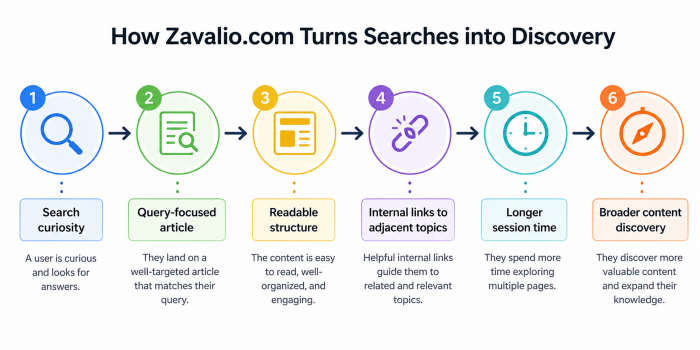
Zavalio’s clearest strength is structural discipline. Articles tend to use short paragraphs, clean heading hierarchy, predictable sectioning, and internal links that help the user move laterally across related topics without much friction.
That may sound simple, but on the open web it is not trivial. Many multi-topic sites overload pages with clutter, pop-ups, or noisy templates; reviewers note that Zavalio’s experience is comparatively clean and readable, which makes it easier to skim and easier to trust at first glance.
What the user sees
● A homepage that surfaces recent and featured posts rather than a tightly curated editorial front page.
● Category-led navigation that helps readers sort by topic rather than by newsroom-style beats.
● Article pages built more like search-landing explainers than magazine features.
● Internal linking intended to deepen session time and topical exploration.
In practical terms, the site feels optimized for the reader who wants a fast orientation pass: enough context to understand the subject, enough structure to stay engaged, and enough related links to continue browsing.
Writing style: clear, competent, and intentionally low-friction
Zavalio’s writing style is best described as streamlined explanatory prose. The platform’s own editorial guidance favors professional tone, logical flow, clarity, original content, and accessible language, with article length expectations commonly in the 800 to 1,000-plus word range.
This produces a style that is easy to read but rarely signature-heavy. The writing does not usually aim for narrative flourish, investigative rhythm, or strong authorial personality; instead, it aims to reduce confusion and answer a query in a manner that feels orderly and complete enough for a general audience.
A useful shorthand is that Zavalio writes like a well-templated SEO explainer site trying to sound more polished than a content farm. Often it succeeds on polish and readability; more inconsistently, it succeeds on depth.
Depth: enough for orientation, not enough for authority
The core trade-off behind Zavalio’s model is breadth versus expertise. Reviews repeatedly describe the content as beginner-friendly and useful for quick understanding, but they also note that it is not peer-reviewed, not specialist-led in a visible way, and not consistently deep enough to be treated as an expert endpoint.
That distinction matters most in categories like law, finance, and health, where clarity is valuable but confidence can become misleading if readers mistake simplified content for expert judgment. Zavalio’s own disclaimer says the site is for general informational and educational use, reinforcing that it should not replace professional advice.
Depth by use case
| Use case | How well Zavalio fits | Why |
| Quick topic orientation | Strong. | The site is built to provide clean first-pass explanations. |
| Beginner learning | Strong to good. | Low-friction writing and broad coverage support accessible learning. |
| Research starting point | Good. | Useful for getting bearings before moving to primary or specialist sources. |
| Expert reference | Weak. | Limited visible credentials and inconsistent depth reduce authority. |
| High-stakes decisions | Weak. | Informational content should be verified elsewhere for health, law, or finance. |
Zavalio is therefore most useful at the top and middle of the research funnel, not the bottom. It helps users ask better next questions, but it should not be the final source for consequential decisions.
Trust, transparency, and reliability
This is where the platform becomes more complicated. On basic legitimacy, outside reviews are broadly reassuring: the site uses HTTPS, publishes standard policy pages, does not appear scammy, and is generally described as safe to browse. That is the low bar, and Zavalio clears it.
But transparency is not the same as basic safety. Several analyses point out that author credentials are limited, public ownership or editorial leadership is not especially prominent, and the site does not foreground the kind of newsroom-style accountability signals that sophisticated readers often look for.
The practical conclusion is straightforward: Zavalio is reliable enough to browse, but not transparent enough to earn automatic authority status. Readers should treat it as a useful informational layer, not as a final validator of truth.
SEO strategy hiding in plain sight
Zavalio’s self-description makes its search strategy fairly visible. The platform emphasizes topic-based structure, internal linking, heading hierarchy, search-intent alignment, long-form development, and natural use of keyword variations. In other words, it is intentionally engineered for discoverability.
That does not make the site low quality by default. In fact, many modern publications depend heavily on SEO discipline. The key difference is that on Zavalio, the SEO architecture is not just a distribution layer—it is part of the product itself.
The operating model appears to look like this
Strengths that genuinely matter
Despite the caveats, Zavalio does several things well enough to deserve credit.
● It reduces information friction by presenting broad subjects in readable, structured formats.
● It creates a consistent user journey across very different categories, which many generalist sites fail to do.
● It gives users fast topic orientation without registration barriers or obvious intimidation.
● It appears to avoid the most aggressive content-farm behaviors that make some multi-topic sites unusable.
● It is especially useful for high-curiosity, low-context searches involving websites, domains, tools, and general explainers.
Those strengths are not glamorous, but they are practical. On the open web, utility and clarity often matter more than brand prestige for first-click behavior.
Weaknesses that limit its ceiling
The platform’s limitations are equally clear.
● Editorial transparency is not strong enough to support expert-level trust.
● Visible author credentials are limited, which weakens perceived authority in sensitive categories.
● Depth varies by article, making consistency a real issue.
● The site’s multi-niche model makes true subject-matter leadership hard to sustain across every section.
● Some articles appear more search-shaped than insight-shaped, which can leave advanced readers underwhelmed.
This does not make the site bad. It simply defines what class of site it belongs to: useful, broad, accessible, and commercially aware, but not yet a reference-grade authority.
A category-by-category reading of the platform
Looking at Zavalio section by section helps separate where the model works best from where it becomes thinner.
Technology
This is arguably the site’s most natural home. Fast-moving tools, domains, AI products, and platform explainers fit Zavalio’s structured, query-led format extremely well because readers in these areas often want quick orientation before deciding whether to go deeper.
Business and finance
These sections benefit from the site’s clear formatting and practical tone, but they also expose the depth challenge. For early-stage understanding—definitions, market context, entry-level frameworks—the format works. For advanced strategic, investment, or regulated decision-making, the site does not display enough visible expertise to be a final authority.
Health and lifestyle
Here the clarity-first approach can help readers who want accessible wellness or everyday advice. But because these subjects can shape real-world behavior, the absence of visible expert authorship matters more. As a result, these sections are useful as general reading, less so as decision-grade guidance.
Law and education
Law works only when treated carefully as awareness content. Zavalio seems to position it that way, but readers still need to verify anything consequential independently. Education is a more natural fit because structure and accessibility carry more value there, especially for students or general learners.
Travel, real estate, and adjacent consumer topics
These categories benefit from the site’s generalist structure, particularly when users want quick planning guidance, concept intros, or broad context. They are less dependent on visible expert identity than law or finance, so Zavalio’s model holds up a bit better here.
Who should actually use Zavalio.com
The site works best for readers who know what kind of help they want from the web.
| User type | Fit | Reason |
| Casual searchers | Excellent. | The platform is built around accessible first-pass answers. |
| Students / beginners | Good to excellent. | Structured content lowers the barrier to entry. |
| Bloggers and content strategists | Good. | Useful for studying category architecture and SEO formatting. |
| Researchers | Mixed. | Helpful for orientation, but not strong enough for final citation. |
| Professionals needing expert validation | Limited. | Authority signals remain too thin. |
For the average user, that is enough. For advanced readers, it means the site is a prelude, not a destination.
What Zavalio tells us about the wider web
Zavalio is interesting not only for what it is, but for what it represents. It belongs to a growing class of websites that are not quite magazines, not quite knowledge bases, and not quite affiliate blogs, but blend elements of all three into a search-native publishing model.
That model responds to a real problem: online information is abundant but often badly organized. Zavalio’s answer is to improve structure, reduce friction, and give users a cleaner first layer of understanding. The unresolved question is whether that first layer can evolve into durable authority without stronger authorship signals, clearer editorial accountability, and deeper reporting standards.
Final reading
Zavalio.com is best described as a polished, multi-topic explainer platform built to win informational search traffic and make broad subjects easier to consume. It succeeds on organization, readability, and cross-category accessibility; it is weaker on visible expertise, transparency, and consistently high-depth analysis.
That means Zavalio is useful when used correctly: as a map, not the territory; as a primer, not the final word. For content professionals, the site is also a revealing case study in where modern SEO publishing is heading toward cleaner structure, broader topical nets, and user-friendly explainers that feel helpful enough to trust, even when they still require verification.