You've probably arrived here the same way thousands of others have typed "OnlyWorkMoods.com" into Google after seeing it mentioned somewhere online, curious about a name that sounds like it should mean something specific but somehow doesn't quite tell you what. That gap between expectation and reality is, in many ways, the entire story of this website.
Let's be honest upfront: OnlyWorkMoods.com is not a productivity tool, not a mood-tracking app, and not a focused professional platform. It is, at its core, a general-interest content blog, a WordPress-powered website publishing articles across a wide spread of topics from automotive to finance, travel to technology. Whether that's a problem or simply a reality depends on what you expected walking in. This analysis examines the site on its own terms: what it actually is, how it functions, what it does well, and where it falls genuinely short.
1. Identity & Positioning : A Name That Works Against Itself
The domain name is the first and most persistent point of friction. "OnlyWorkMoods" implies a focused, perhaps even niche, space something to do with emotional states in professional environments, perhaps a corner of the internet for remote workers navigating burnout, or a curated feed of productivity-boosting content. The tagline the site actually carries "Forming Informed Viewpoints" is a completely different promise, and a far more generic one.
This disconnect is not trivial. On the modern web, a domain name is a first-impression signal. Readers, search engines, and potential collaborators all use it to make instant judgments about relevance and authority. A site whose name strongly implies one niche but whose content spans nine unrelated categories creates a trust gap before a single article is even read.
“A name that promises a focused lens but delivers a wide-angle view.”
The site appears to have been active since at least mid-2023 (archive data shows posts from June 2023), with a noticeable acceleration in publishing activity from early 2025 onward. It runs on WordPress, uses a theme called Pixatres by PixaHive, and hosts its images via a CDN. All of this is structurally sound. The identity problem is not technical, it is strategic.
2. Content Architecture : Nine Categories, One Voice
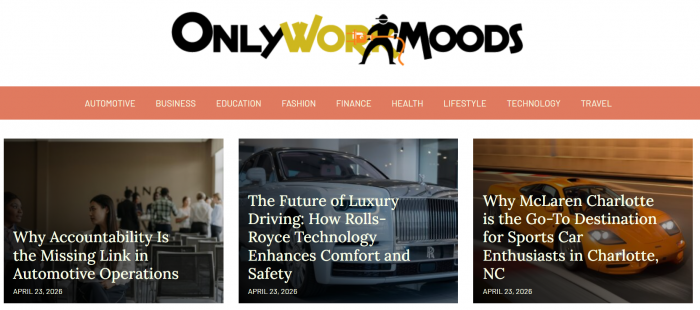
The site is organised into nine primary content categories. Looking at the homepage and navigating through the archives, a clear pattern emerges: the categories exist in name, but the editorial philosophy that typically distinguishes one content vertical from another is mostly absent. A piece on Rolls-Royce technology sits comfortably beside an article on shipping parcels to the UK both published the same week in April 2026.
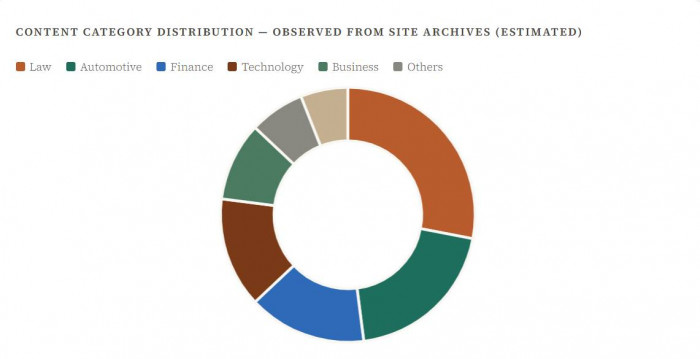
What's worth noting here is that some categories punch above their stated weight. The Law section, for example, contains genuinely in-depth pieces disability discrimination attorneys, traffic lawyer guides, JD salary analyses that suggest either a client brief or a specific editorial focus in that vertical. The Automotive section follows a similar pattern, with articles covering dealership operations, luxury manufacturers, and performance cars that feel more intentional than random.
The Business, Finance, and Technology sections, by contrast, read more like general-purpose keyword targeting: articles that exist because the topic has search volume rather than because the publication has something specific to say about it. This is not unusual for newer content sites, but it does create a noticeably uneven reading experience across the site's own categories.
3. Content Quality Assessment : Reading the Work Carefully
A site is ultimately only as valuable as its articles. Across the observable published content, quality is genuinely inconsistent not in a careless way, but in the way that tends to characterise sites that source content from multiple writers without a strong editorial layer to harmonise them.
| Category | Depth | Originality | Practical Value | Source Transparency |
| Law | Above average | Moderate | High | Partial |
| Automotive | Moderate | Moderate | Mixed | Low |
| Finance | Moderate | Low | Mixed | Low |
| Technology | Surface level | Low | Mixed | Low |
| Travel | Moderate | Moderate | Good | Partial |
| Business | Surface level | Low | Limited | Low |
The law-focused content is where the site earns genuine credit. Articles on topics like disability discrimination law and traffic attorneys are structured with enough granularity to actually help a reader understand their situation better before speaking to a professional. They don't pretend to replace legal advice, but they orient the reader usefully. This kind of calibrated helpfulness is harder to achieve than it looks.
The automotive content occupies a middle ground. Pieces on Rolls-Royce technology or the business mechanics of car dealerships are reasonably well-researched, though they occasionally slide into promotional language that blurs the line between journalism and sponsored-adjacent writing. This is a small but real editorial concern and one the site does not address with any disclosure policy that's visible to readers.
Technology and Finance articles are the weakest links. They tend to explain concepts that are already widely covered at much greater depth elsewhere, without adding a meaningful angle or new data. Readers seeking substantive analysis in these areas will likely find themselves moving on quickly.
4. Transparency & Trust Signals : What the Site Doesn't Tell You
This is where the most substantive criticism of OnlyWorkMoods.com lives. The site's authorship structure is opaque in ways that matter. Articles are published under a single author identity "Kevin" but there is no author biography, no professional background, no indication of expertise or subject-matter credentials, and no About Us page that might contextualise the publication's mission or team.
The absence of an About Us page, editorial disclosure, or team credentials is not simply a UX gap it's a reader trust problem. When a site publishes legal guidance, financial commentary, and health-adjacent content without identifying the expertise behind it, readers have no basis for calibrating how much weight to give it.
The contact options are similarly minimal; a generic contact form exists, but no email address, no social media handles with visible activity, and no editorial submission or feedback process. This isn't necessarily evidence of bad intent, but it does mean the site is functioning entirely without accountability infrastructure. Trusted publications, even small independent ones typically provide readers with some mechanism to verify who they're reading and why that person is qualified to write about a given topic.
| SSL (Certificate) | Domain Established | Author Bios | About / Team Page | Disclosure Policy | Content Verticals |
| Active | 2023 | 0 | None | None | 9 |
On the technical safety front, the picture is more reassuring. The domain has an active SSL certificate, the site does not appear to use dark patterns or aggressive redirects in normal browsing, and Scamadviser's automated analysis rates it as broadly legitimate. These are baseline requirements, not achievements but they do mean that a visitor reading an article is not being actively harmed or misled in a technical sense.
5. Publishing Behaviour : Volume Over Velocity
One way to understand a content site's editorial philosophy is to examine its publishing cadence. OnlyWorkMoods.com's archive reveals a publishing history that started cautiously, went quiet for a long period, and then resumed with considerably more volume in 2025.
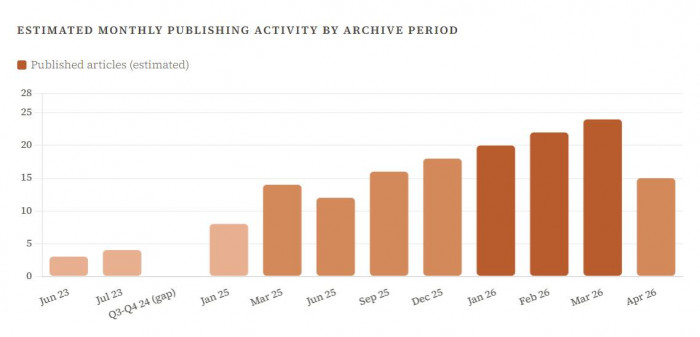
The gap in publishing activity, essentially a dormant period of over a year between mid-2023 and early 2025 is notable. Sites that pause and then restart often do so with either a significantly different editorial focus or a shift in business model. In OnlyWorkMoods.com's case, the restart coincided with a broader spread of categories, a higher overall publishing volume, and a single consistent author attribution. This pattern is consistent with a site that pivoted from an early experimental phase to a more systematic content production approach.
The current publishing cadence of roughly 15–25 articles per month across nine categories means that no single area receives consistent, sustained attention. A reader interested specifically in law or automotive content will find useful material, but may have to wait weeks between relevant new articles and the homepage does not make category filtering easy for first-time visitors.
6. User Experience : Functional, But Not Memorable
The site's UX is best described as adequate. It uses a clean WordPress theme with a standard navigation bar at the top, a two-column homepage layout featuring recent posts with thumbnail images, and a right-hand sidebar showing recent articles and category archives. Nothing about this is wrong, it loads reasonably quickly, articles are legible, and the mobile experience is serviceable.
What it lacks is any sense of design intentionality. The site's visual identity does not reflect a clear editorial voice, and there are no structural elements featured in the series, curated reading paths, editorial newsletters, or even a "Start Here" section that help a new visitor understand what the site is for or where to go first. First-time readers are left to browse in an undifferentiated way, which rarely builds loyalty.
● Page load speed is adequate but unoptimised - image CDN helps, but no lazy loading is evident
● No search bar on mobile navigation - a meaningful omission for a text-heavy site
● Internal linking between related articles is inconsistent
● No newsletter, RSS badge, or community element to encourage return visits
● Comment sections are enabled but empty - "No comments to show" is a persistent signal to new readers that engagement is low
● These are all solvable problems, and none of them are catastrophic. But they collectively suggest that the site has been built with content production as the primary focus, with user experience treated as a secondary consideration. For a media property trying to build a long-term readership, that order of priorities tends to limit growth.
7. Competitive Context : Where It Sits in the Wider Media Landscape
Understanding OnlyWorkMoods.com requires placing it in its actual competitive environment. The site is not competing with the New York Times or Medium, it is competing with the vast, largely anonymous layer of the web that produces informational articles designed to answer specific search queries. This is a legitimate and enormous segment of the content economy, and operating within it is not inherently a criticism.
| Dimension | OnlyWorkMoods.com | Medium | Lifehacker | Niche Expert Blogs |
| Topic Focus | Broad, 9 categories | Very broad | Productivity focus | Deep single niche |
| Author Credentials | Not disclosed | Writer profiles | Verified staff | Domain expert |
| Editorial Voice | Developing | Writer‑dependent | Consistent | Strong |
| Community Signals | Absent | Claps, comments | Comments, shares | Varies |
| Transparency | Low | High | High | Moderate |
| Content Depth | Mixed | Mixed | Generally strong | Usually strong |
The honest conclusion from this comparison is that OnlyWorkMoods.com occupies a lower-trust tier primarily because of its transparency deficit, not because of any fundamental quality problem with its best content. The infrastructure of credibility, author bios, editorial disclosures, contact information, about pages is what separates a general-interest blog that readers return to from one they forget after a single visit.
8. Reputation Landscape : How the Internet Has Received It
One of the more interesting aspects of OnlyWorkMoods.com is that it has generated a small ecosystem of review articles, which themselves tell a revealing story about how the site is perceived. The reviews that exist range from broadly neutral assessments acknowledging it as a legitimate general blog to more cautious evaluations flagging the absence of ownership transparency. Crucially, none of the independent reviews that can be found treat it as outright dangerous; the consensus is closer to “unclear but not threatening.”
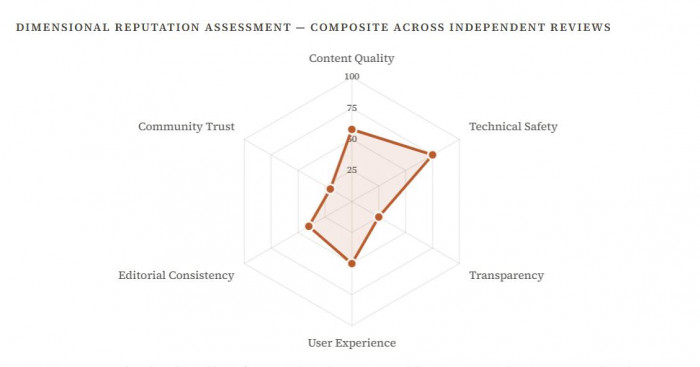
The most striking finding here is the divergence between technical safety (where the site performs well) and transparency or community trust (where it performs poorly). This is a pattern common to many newer content sites; they meet the basic technical requirements of web publishing without having yet built the trust infrastructure that converts casual visitors into loyal readers.
It is also worth noting that several of the "review" articles about OnlyWorkMoods.com are themselves from low-credibility review sites that appear to be generating content opportunistically around trending keywords. The irony of low-quality sites reviewing another site for potential quality issues is real, and readers should apply the same critical lens to those reviews that they would to the site itself.
9. Synthesis : What OnlyWorkMoods.com Actually Is
Stripping away the confusion created by its name and the often poorly-reasoned reviews that have appeared about it, OnlyWorkMoods.com is a general-interest content blog in an early-to-mid growth phase. It publishes frequently across multiple categories, has identifiable content strengths in the law vertical, and is technically competent. It is not a scam. It is not a productivity tool. It is not a focused professional resource. It is a content site trying to find its footing.
The most significant decision the site needs to make and which it has so far avoided is whether it intends to build audience trust or simply build traffic. These are not mutually exclusive, but they require meaningfully different investments. Trust-building requires editorial transparency, author credibility, and consistent voice. Traffic-building can be done through volume and keyword targeting alone. Right now, OnlyWorkMoods.com is doing the latter without the former, which limits how far the former can grow.
10. Final Assessment :The Honest Verdict
OnlyWorkMoods.com is a legitimate, functional, and occasionally genuinely useful content website. Its best work particularly in the legal guidance category holds real value for readers navigating unfamiliar territory. Its weakest work is indistinguishable from the vast generic layer of the internet. The site's most pressing problems are not technical or even editorial; they are structural. Without visible authorship, editorial transparency, and a coherent identity, even good content struggles to build the trust that makes a reader bookmark a site and return.
For casual reading on a topic it covers well, it is fine to use. For anything requiring reliable expertise medical, financial, legal decisions the usual rule applies: verify with credentialled sources. The site does not currently provide the transparency needed to evaluate whether its authors are qualified, and that absence is the reader's risk to manage.
If the site invests in what it's currently missing identity clarity, author credibility, editorial voice it has a reasonable foundation to build something more meaningful. As of April 2026, that investment has not yet been made.