Why I Started Studying Social Media Captions (And What I Noticed)
A while back I started saving screenshots of posts that did well next to posts that flopped. Same niches. Similar photos. Wildly different results.
The gap was rarely the image. It was the words sitting underneath it.
One bakery near me posted a gorgeous croissant with the caption 'fresh croissants today.' A smaller shop posted a blurrier croissant and asked, 'butter or chocolate, which are you grabbing first?' The second post pulled ten times the comments. I kept finding that same pattern everywhere I looked.
That is when captions stopped looking like text to me and started looking like strategy.
The Real Problem With Most Social Media Captions
Here is the pattern I noticed once I started paying attention. Most captions get written last, in a rush, after the photo is already chosen and the post button is calling.
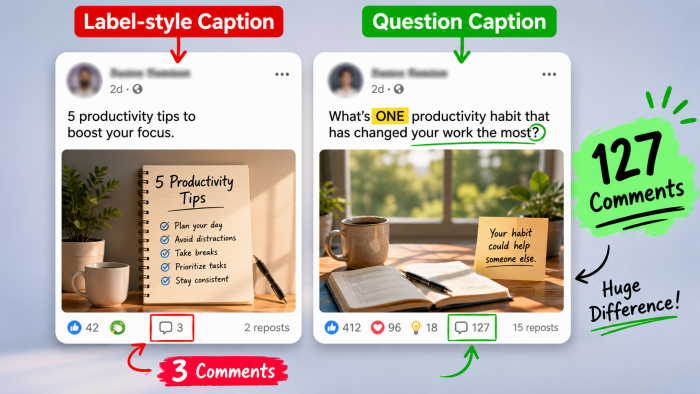
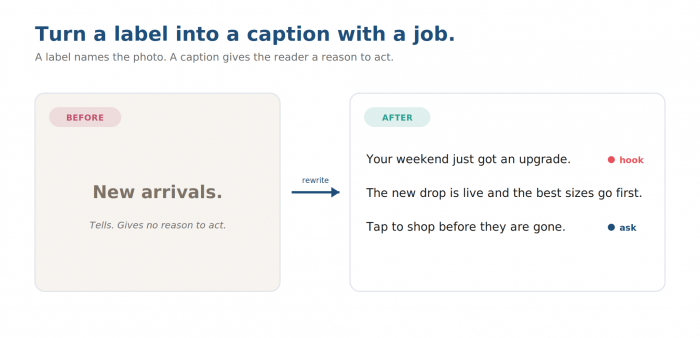
So they end up as labels. 'New arrivals.' 'Happy Friday.' Accurate and completely forgettable.
A label tells people what they are looking at. It gives them no reason to stop scrolling or reply. No opening line that earns attention. No point of view. Nothing that asks the reader to do one specific thing after they finish reading.
I did this for years with my own posts. An hour on the photo, ninety seconds on the words, then silence.
Once I understood this, I started breaking captions into parts. One structure kept showing up in every post that actually worked, and I will walk you through it next.
The 5-Part Caption Framework I Use for Every Post
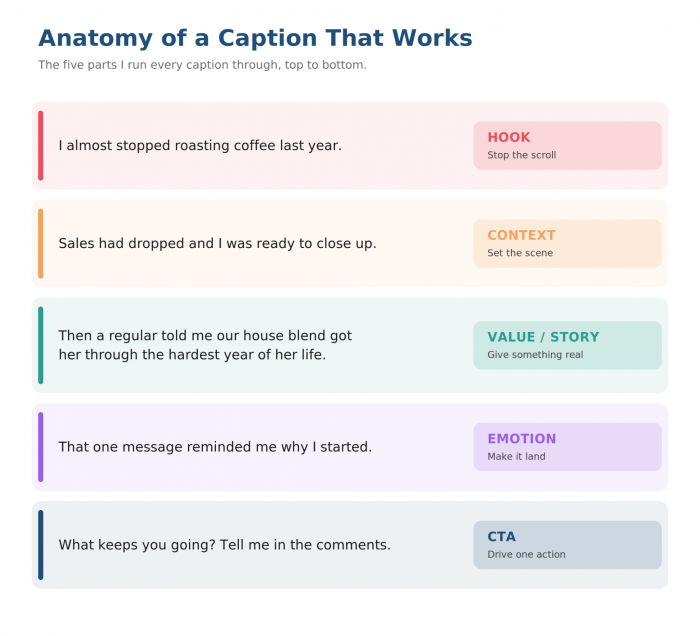
The structure has five parts. Every caption I write now runs through them in order, even the short ones. You will recognize all five in the 100 examples further down, so it helps to meet them first.
1. Hook (Stop the Scroll)
The first line has one job: earn the second line. People decide in about a second whether to keep reading, so I open with a question or a claim sharp enough that the next line feels necessary. 'I deleted my best post on purpose' makes you want the next sentence. 'Here is our new menu' does not.
2. Context (Set the Situation)
Once the hook lands, the reader needs a quick frame. What is this about, and why should they care right now? A line or two is plenty. Skip it and even a strong hook leaves people unsure where you are taking them.
3. Value / Story (Main Content)
This is the body, where you deliver. Sometimes that means teaching something useful. Sometimes it means telling a short story the reader sees themselves in. My rule: give before you ask. If the reader gets nothing from the caption, no call to action will rescue it.
4. Emotion Trigger
Somewhere in the body I aim for one honest feeling: recognition, relief, a flicker of ambition, mild frustration at a shared problem. People share and comment when a post puts words to something they already felt but had not named. This part is easy to skip and expensive to lose.
5. CTA (Call to Action)
The last line tells the reader what to do next. Comment an answer, save the post for later, send it to a friend, tap the link. One clear ask beats five vague ones. Most captions die here, because they simply stop and leave the reader with nowhere to go.
Put those five parts together and a label turns into a small piece of communication that does a job. Below is one caption with each part marked, so you can see the seams before they disappear into something that reads smoothly.
Now that the framework is clear, let me hand you the 100 captions it produces. They are grouped by the goal each one serves, and every group leans on the five parts you just read.
The 100 Captions
A quick note before you start copying. Treat these as fill-in-the-blank templates, not finished lines. Anything inside [brackets] is yours to swap: your product, your niche, your audience, your own words. Read them, adjust them, and rotate between the groups so your feed never sounds like one note on repeat. I will show you how to rotate them in the section right after this.
Engagement Caption Ideas (1-20)
These earn comments. I reach for them when a post needs replies more than it needs polish, usually mid-week when reach tends to dip.
- Be honest: [common opinion] or [opposite opinion]? Drop your pick below.
- Unpopular opinion: [a mildly controversial take about your niche]. Am I wrong?
- Finish this sentence: the best [product or experience] always has ______.
- Two paths: [Option A] or [Option B]? Tell me which one you'd choose and why.
- What is one thing about [topic] that nobody warned you about?
- Rate your [relevant habit or setup] from 1 to 10. I'll go first: [your number].
- If you could fix one thing about [a common frustration], what would it be?
- Tag the friend who needs to hear this about [topic].
- Quick poll in the comments: [Option A] gets a fire emoji, [Option B] gets a clap.
- What is the sharpest piece of advice you've ever gotten about [topic]?
- I'll start: my favorite [category item] is [example]. Yours?
- Hot take: [a bold statement]. Agree or push back below.
- Describe [your niche or brand] using only one word. Go.
- What made you start [an activity related to your audience]?
- Choose your fighter: [Option A] versus [Option B]. Comments are open.
- Be real: how many [tabs or projects] do you have open right now?
- What is a [topic] myth you used to believe?
- Drop a [emoji] if you've ever [a relatable struggle].
- Fill in the blank: I can't start my day without ______.
- If [your product or service] could solve only one problem for you, which would you pick?
Storytelling Caption Ideas (21-40)
The engagement captions above pull people in fast. Storytelling captions keep them close. Use these when you want someone to feel connected to you or your brand, which builds the trust that makes every later sell easier.
- I used to [an old struggle]. Then [the turning point]. Now [the current result].
- Three years ago I [a starting point]. Here is the exact moment it turned around.
- Nobody saw the [number] failed attempts behind this [win]. Here is the real story.
- The day I almost quit [a pursuit], [what happened] stopped me.
- Behind this post: [an honest detail about the messy reality].
- I made a [costly mistake] so you don't have to. Here is what it taught me.
- [A time period] ago I believed [an old belief]. I was wrong, and here is why.
- This [product or result] started as a [humble origin]. Let me take you back.
- The first time I [a milestone], I [an emotional reaction]. Today feels different.
- Everyone sees the [highlight]. Few see the [hidden cost] it took.
- I almost didn't share this, but [the reason it matters to your audience].
- [A low point] once. [The current point] now. The part I never talk about sits in between.
- Here is the message that changed how I run [your business or content].
- My biggest [pursuit] regret? [The regret]. Please don't repeat it.
- I tried [a common approach] for [a length of time]. It failed. So I built [your approach] instead.
- The story behind [your brand name] starts with one small moment: [the moment].
- A customer once said [paraphrased feedback], and it rewired how I think about [topic].
- I kept [an old habit] for years before I noticed [the cost]. Then I changed one thing.
- This photo was taken right after [a significant moment]. Here is what you can't see.
- Let me tell you about the project that nearly broke me, and what came after.
Educational Caption Ideas (41-60)
Stories build trust; teaching proves it. These position you as the account worth following, because the reader leaves a little smarter than they arrived. Save them for the moments you want to be the most useful voice in someone's feed.
- [Number] ways to [achieve an outcome] without [a common obstacle].
- The simplest way to [a task]: [one concrete step]. Save this for later.
- Stop doing [a common mistake]. Do [a better approach] instead. Here is why it works.
- Here is how I [achieve a specific result] in [a timeframe].
- [Number] signs your [thing] needs fixing, plus a quick test for each.
- A [topic] checklist I wish I had when I started: [first item], [second item].
- The [number]-minute habit that improved my [metric] more than anything else.
- Most people skip [a step]. That single step is why [the outcome] happens.
- If you only learn one thing about [topic], make it this: [the key principle].
- Read this before you buy your next [product category].
- The difference between [the good version] and [the weak version] comes down to [one factor].
- How to spot [a problem] before it costs you [a consequence].
- [Number] tools I use every week to [a task]. The second one surprised me.
- Here is the exact [process or routine] I follow for [an outcome].
- What [an expert role] actually look for when they judge [a thing].
- Turn [a common input] into [a better output] with one adjustment.
- The myth: [a false belief]. The reality: [the correction]. Save this.
- A beginner's map to [topic], minus the jargon.
- Why [a popular piece of advice] backfires, and what to try instead.
- Give me five minutes and a notebook and I'll show you [an outcome].
Promotional Caption Ideas (61-80)
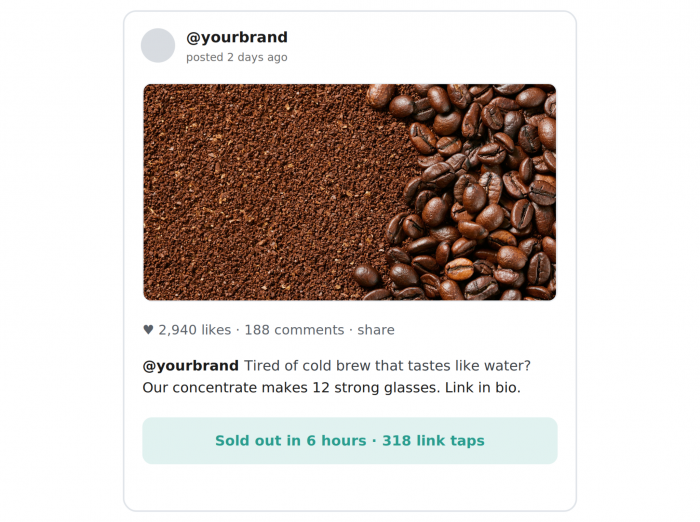
Here is where the trust you built earlier pays off. Promotional captions ask for the sale or the booking. They land because the reader already got value from the posts that came before, so the ask feels earned rather than pushy.
- Struggling with [a problem]? [Product] handles it for you. Link in bio.
- [Product] is back in stock. Last time it sold out in [a timeframe].
- You asked, we listened. [The new feature or product] is live today.
- Here is what [number] customers say after using [product] for [a timeframe]: [paraphrased result].
- Tired of [a pain point]? Here is the [product] that fixed it for [a persona].
- Only [number] spots left for [an offer]. Booking closes [date].
- [Product] does in [a short time] what used to take you [a long time].
- If [a problem] sounds familiar, [product] was built for you. Details below.
- We dropped the price on [product]. Here is why, and how long it lasts.
- Meet [product]: the fix for [a specific frustration your audience has].
- Real results from a real customer: [the before] became [the after] in [a timeframe].
- New launch. [Product] solves [a problem] without [the common downside].
- Your [routine or setup] is missing one thing. [Product] fills the gap.
- Limited bundle: [item one] plus [item two] for [an offer]. Ends [date].
- Why [number] people switched to [product] this month.
- Before you spend on [an alternative], read why [product] does it better.
- Free [resource or trial] inside. Try [product] before you commit a cent.
- We made [product] for people who are done settling for [a poor alternative].
- Here is exactly what you get with [product], step by step.
- [A holiday or event] is coming. [Product] is the gift they will actually use.
Community & Brand Building Captions (81-100)
Selling is one transaction. Community is repeat business. This last group turns followers into regulars who feel like part of something, and I post these often, because the warmth they create carries an account through slow weeks and quiet launches.
- Tag someone who [a relatable behavior your audience shares].
- We hit [a milestone] this week. None of it happens without you.
- Drop your [city or country] in the comments. Let's see how far this community reaches.
- What does [your brand value] mean to you? We want to hear it.
- Meet the person behind [a task]: [team member name and role].
- Share this with someone who is just starting their [journey related to your niche].
- We stand for [a value]. Here is one way we put it into practice.
- Your turn: show us how you use [product] and we will feature our favorites.
- Comment [a word] and we will send you [a resource or freebie].
- A peek behind the scenes at how we [a process]. The honest version, not the polished one.
- This community taught me [a lesson]. Thank you for that.
- Who in your life would love this? Tag them and start a conversation.
- We read every comment. What should we make next?
- [Number] of you joined us this month. Tell us what brought you here.
- Our promise to you: [a specific commitment]. Hold us to it.
- Celebrate with us: [a customer or member] just hit [their milestone] using [product].
- What is one thing you wish more brands in [your industry] did? We are listening.
- Repost this if [a value or belief] matters to you too.
- We are nothing without our regulars. A shoutout to [a customer or member].
- Tell us in one sentence why you follow [brand]. The answers might surprise you.
How to Use These Caption Ideas Effectively
Copying a caption word for word is the fastest way to sound like everyone else who copied it. So here are the rules I follow when I use the list above.
First, adapt every template to your own voice. If you would never say 'hot take' out loud, rewrite it as something you would say. The bracket is a prompt, not a script.
Match the caption to the moment. A promotional line on a day your audience wants entertainment falls flat, and a playful poll during a launch wastes the attention you paid for.
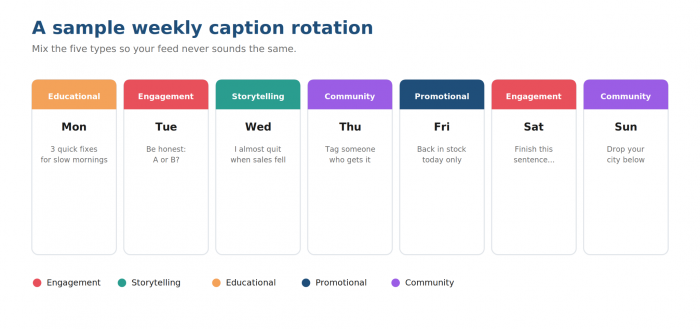
Rotate the five groups. I keep a loose weekly rhythm: a couple of engagement posts, one story, one teaching post, one promotional, the rest community. Your mix will look different, and that is the point.
Then test. Watch which groups earn saves and replies from your specific audience, and lean harder into those. The list gives you a hundred starting points. Your own numbers tell you which ones to keep.
Even with the right mix, a few small habits quietly kill posts. I made all of them, so here is what to watch for.
Caption Mistakes That Stop Your Posts From Performing
These are different from the bigger problem I opened with. That one was about mindset. These are small, fixable habits hiding inside otherwise good captions.
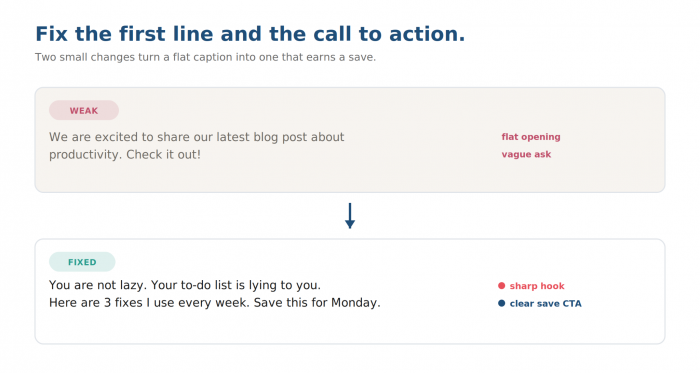
A weak first line. If your opening could be pasted onto any other post in your niche, it is not a hook. Make line one specific to this exact post.
Selling in every sentence. When every caption asks for money, people stop reading all of them. Earn attention before you spend it.
Burying the ask. Plenty of captions teach or entertain well, then forget to tell the reader what to do. No prompt, no action.
A caption that argues with its own image. If the photo shows a calm morning and the words shout about a flash sale, the reader feels the mismatch even without naming it. The two should agree.
Writing for everyone. A caption aimed at no one in particular lands on no one in particular. Picture one reader and write to them.
Final Thoughts: Captions Are Strategy in Disguise
The captions in this list will save you time. They will not replace the part that makes them work, which is you paying attention to your own audience and adjusting as you go.
Start with one group this week. Pick three templates, make them sound like you, and watch what your readers do with them.