A polished photo can carry a post, but the caption decides what the audience does with it. Some posts need five words and a clean exit. Others need enough space to explain the thinking, story or proof behind the visual.
The useful question is not whether Instagram prefers short or long captions. It is whether the caption gives the reader exactly what the post needs, without stopping too early or continuing after the point has been made.
The Length Debate Is Misleading
Caption advice often starts with a number: stay under a certain character count, write three short paragraphs or use every available line. Those rules sound practical, but they remove the post from its context. A six-word caption under a funny Reel may feel sharp. The same six words under a detailed case study may feel careless.
Research does not support a single universal length. A 2025 preregistered study analysed 75,000 social posts from almost 1,000 influencers and found that the relationship between caption length and engagement was not linear. Engagement initially fell as captions became longer, then rose again to a local high that, in the dataset, could outperform very short captions. The pattern also changed depending on whether the post used video or an image and whether it was sponsored.
The finding challenges the idea that every additional sentence either helps or hurts. Length interacts with format, subject, audience expectation and the information already present in the post. Caption length is a content decision, not a platform trick.
What the Caption Must Do
Before choosing a length, decide what responsibility the caption carries. Writing an Instagram caption may explain context, direct attention, make the account sound human, support discovery or encourage a specific action. Problems begin when one caption tries to perform all of those jobs at once.
A product photograph, for example, may already show colour, design and finish. The caption does not need to describe what viewers can see. It may be more useful to explain why the product was made, who it suits or what changed from the previous version. An educational carousel has the opposite problem. If the slides already contain the lesson, repeating them below creates length without adding value.
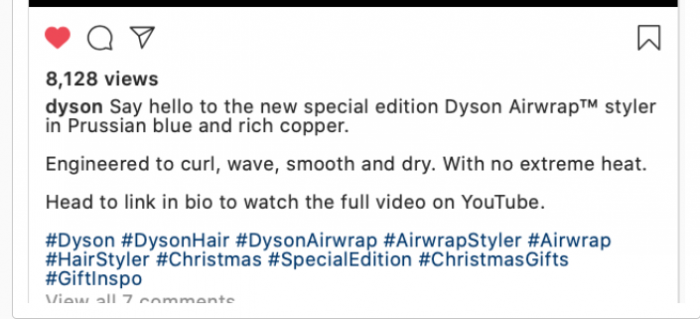
Captions can also help Instagram understand the subject of a post. Instagram’s own search guidance recommends placing relevant keywords and hashtags in the caption rather than moving them into the comments. That does not mean stuffing phrases into every paragraph. It means using the words a real person would expect when reading about the topic.
A useful caption normally performs one primary job and one supporting job. Once those jobs are clear, the necessary length becomes easier to judge.
Where Short Captions Work
A short caption communicates one central thought without asking the reader to open a substantial block of text. It may be one sentence, several compact lines or a brief paragraph. Its strength comes from concentration, not from an arbitrary character count.
Short captions work best when the visual already contains the information or emotional payoff. A Reel with clear narration may only need a summary. A meme becomes weaker when the joke is explained. A strong product image may require one benefit and one action rather than a miniature sales page.
They are particularly effective in the following situations:
● The content is immediately understandable. The viewer can recognise the subject, message and mood without needing background information from the caption.
● The post is built around timing or humour. A quick reaction, cultural reference or punchline usually benefits from a caption that preserves the pace.
● The audience knows the account well. Regular followers understand recurring formats, inside references and the creator’s voice, so less explanation is required.
● The intended response is simple. A focused choice, opinion or instruction is easier to act on when it is not buried beneath several unrelated points.
● The post is part of a repeated series. Once viewers understand a weekly format, the caption can concentrate on what is different in the current post.
Brevity can be mistaken for confidence. Captions such as “Big things coming” or “Thoughts?” transfer the work to the reader. A short caption succeeds when the removed words are unnecessary. It fails when the missing information is the reason the post matters.
Where Long Captions Work

Long captions are useful when meaning depends on context. The reader may need to understand what happened before the image, how a result was achieved, why a decision was made or what they can learn from the experience.
They work especially well for case studies, founder stories, personal reflections, detailed product explanations, sensitive announcements and educational posts that require examples. In these cases, the extra space is not decoration. It carries information the visual cannot hold.
A long caption can show reasoning in a way a polished result cannot. Consider a before-and-after post from a designer. The images show change, but they do not explain the client’s original problem, the constraints, the rejected options or why the final solution worked. Those details turn a visual transformation into evidence of skill.
Longer captions can also build trust when the topic involves a decision with consequences. A service business may need to explain who the offer is for, what happens during the process and what a client should expect. A creator discussing failure may need enough room to separate a useful lesson from a vague motivational statement.
The main risk is weak structure. Many long captions delay the useful point, repeat the same claim and finish with several unrelated calls to action. A strong caption keeps earning the next line. Each paragraph should add context, evidence, interpretation or movement.
Short and Long Compared
The difference is easier to understand when both formats are judged by what they achieve rather than how many words they contain.
| Caption style | Main strengths | Main risks | Best suited to |
| Short caption | Fast to process, keeps attention on the visual and makes a single action easy to notice | Can feel vague, generic or incomplete when the post needs context | Memes, simple Reels, product reveals, quick updates and community prompts |
| Medium caption | Balances context with readability and gives room for one example or explanation | Can become unfocused when it tries to combine several messages | Carousels, demonstrations, announcements and practical tips |
| Long caption | Supports storytelling, explanation, proof and more considered positioning | Requires a clear opening, visible structure and disciplined editing | Case studies, personal stories, complex offers, lessons and sensitive updates |
Match Length to Format
Instagram posts ask people to consume information in different ways. The caption should support the format instead of competing with it.
| Post format | Better starting point | Reason |
| Entertaining Reel | Short | The video contains the pace and payoff, so the caption should reinforce rather than explain it |
| Educational Reel | Short to medium | The caption can summarise the lesson, clarify a term or provide the steps in a saveable form |
| Carousel guide | Medium | The slides carry the teaching while the caption adds context, a missing example or a reason to save |
| Personal photograph | Medium to long | The image may need a story before the audience understands why the moment matters |
| Product photograph | Short to medium | The caption should connect the item to a practical use instead of repeating visible features |
| Case study | Long | Readers need the problem, process, decision and result to understand the value |
| Announcement | Medium | The important news should appear early, followed by enough detail to prevent confusion |
| Meme or reaction post | Very short | Extra explanation can weaken the humour and slow the response |
| Testimonial | Medium | Context should explain the starting point and outcome without rewriting the entire customer story |
| Community question | Short | One specific prompt is easier to answer than a paragraph followed by several questions |
Format is only the starting point. The objective can change the answer.
A Reel designed for broad reach may need one line that strengthens the premise. A Reel intended to generate enquiries may need a longer caption explaining the problem, identifying the right audience and giving a clear next step. The video format is the same, but the work assigned to the caption is different.
The same applies to carousels. If every slide already contains detailed instructions, the caption should not duplicate the lesson. It could explain where people usually go wrong, show how the advice was applied or mention the situation in which the framework is most useful.
Before writing, ask three questions:
1. What important information is missing from the visual? The answer identifies what the caption must contribute rather than repeat.
2. What should the reader understand or do next? The answer prevents several calls to action from competing with one another.
3. Can the caption complete that job with fewer lines? The answer turns editing into a strategic step rather than a cosmetic one.
Audience Changes the Answer
Caption length also depends on how much shared context exists between the account and the reader. New viewers usually need clearer framing. Long-term followers can understand shorter references because they already know the creator’s work, language and recurring themes.
An educational account often needs more explanation than an entertainment account. Its audience may save the post for later, compare methods or look for a precise answer. A humour page can rely more heavily on recognition and timing. Neither approach is inherently better. The audience is arriving with a different expectation.
Personal brands can use longer captions to reveal judgement, experience and personality. That does not mean every post should become a diary entry. The story needs to connect with the subject of the account or give the reader a useful perspective. Detail that only matters to the writer rarely becomes valuable because it is sincere.
Retail accounts need to be selective. A visual product with an obvious use may benefit from a compact caption. A technical, expensive or unfamiliar product may need a longer explanation that reduces uncertainty. The more consideration required before purchase, the more likely the audience is to value use cases, comparisons and proof.
Audience temperature matters too. A person discovering the account through Explore may not understand a brief reference that regular followers find obvious. For posts intended to reach non-followers, the opening should establish the topic quickly, even when the rest of the caption remains short.
One Post, Two Lengths
The clearest way to see the difference is to write the same post twice and compare the work each version performs.
Product Launch
Short version
Meet the desk lamp that adjusts as your working day changes. Three light settings, one touch control and no app required. Available from Friday.
This version works when the product is visually clear and the goal is awareness. It names the key benefit, gives two useful details and states availability.
Long version
Most desk lamps are designed for one task, even though a working day moves between video calls, focused reading and late-evening admin.
We designed this model with three settings that can be changed using one touch control. There is no app, account or complicated setup. The warmer setting reduces harsh contrast at night, while the brighter mode gives clearer task lighting during the day.
It will be available from Friday, with full dimensions and delivery details on the product page.
The longer version earns its space by explaining the problem and linking features to situations. It is better suited to a new product whose difference is not obvious from the image alone.
Educational Carousel
Short version
Five caption openings that get to the point without using false suspense. Save the final slide for your next content session.
This works because the carousel contains the teaching. The caption identifies the value and gives one relevant action.
Long version
Most weak caption openings do not fail because they are boring. They fail because they postpone the subject.
“Stop scrolling” does not tell the reader what they will gain. “You need to hear this” creates attention without direction. A useful opening names the problem, result or tension early enough for the right reader to recognise it.
The carousel includes five alternatives and shows where each one fits. Save the final slide and adapt the structures rather than copying the wording.
This version adds a principle that helps readers understand why the examples work. It does not repeat each slide.
Frameworks That Stay Useful
Templates help when they organise thought rather than produce interchangeable captions.
For a short caption, use main point, specific detail, single action. State the subject immediately, add one detail that makes the claim credible, then finish with the next step. This works well for simple Reels, product posts and short educational updates.
For a medium caption, use opening, context, practical value, action. This structure suits announcements, demonstrations and carousels.
For a long caption, use tension, background, turning point, takeaway, action. The tension should create interest without hiding the subject. The turning point introduces the decision or discovery, while the takeaway makes the story useful.
Several editing rules improve every structure:
● Give each paragraph one purpose. A paragraph should introduce, explain, prove, interpret or direct. When it tries to do everything, the caption becomes difficult to follow.
● Keep the useful point near the top. Context can follow, but the reader should not need to open several lines before discovering the subject.
● Use one main call to action. Asking people to save, comment, share, click and send a message divides attention and weakens the intended response.
● Remove repeated explanation. If the carousel, voice-over or image already communicates the point clearly, the caption should add another layer rather than produce a transcript.
● Use keywords naturally. Topic language should make the caption clearer to people first. Search value comes from relevance, not from awkward repetition.
Test Captions Properly
A creator cannot discover the right length by comparing random high-performing posts. A short meme and a long case study differ in subject, format, audience intent and expected behaviour. The comparison is too noisy to guide a decision.
Group similar posts first. Compare educational carousels with educational carousels and product Reels with product Reels. Within each group, classify captions as short, medium or long using ranges that suit your account.
Then choose the metric according to the post’s purpose. An educational post may be judged by saves and shares. A community prompt may be judged by the relevance of comments rather than their raw number. A promotional post may need profile visits, link clicks, messages or conversions. Likes can still be recorded, but they should not become the default answer to every objective.
Use a simple review sheet:
| Post | Format and topic | Caption range | Intended job | Primary result | Editorial observation |
| Example post | Educational carousel | Medium | Generate saves | Saves per reach | Strong opening, but caption repeated slide three |
| Example post | Product Reel | Short | Drive profile visits | Profile visits | Benefit was clear, but the next step was missing |
Review several comparable posts before drawing a conclusion. One result may be driven by the visual, timing, subject or distribution rather than caption length. The purpose of testing is not to discover a magic number. It is to find recurring combinations of format, message and length that work for your audience.
Mistakes on Both Sides
Long captions are often written because the topic feels important, even when the post has already explained it. The writer adds background, a personal reflection and a lesson because each part seems individually relevant. Together, they compete.
Short captions fail for the opposite reason. They are chosen because brevity looks polished, even though a new viewer cannot understand the context. The post appears confident to the writer and incomplete to everyone else.
Other common caption mistakes include repeating carousel slides almost word for word, hiding the practical point below several lines of scene-setting, using unrelated keywords, asking several questions at once and measuring every post by likes.
Most caption-length problems are editing problems. The writer either stops before the message is complete or continues after it has finished.
Final Verdict
Short captions work best when the content already carries the message and the reader needs only a clear emphasis or next step. Long captions work best when the post requires context, proof, explanation or emotional meaning.
Do not choose a length because it is fashionable or because one high-performing account uses it. Decide what the visual cannot communicate, write enough to complete that job and remove every line that does not improve understanding or action.