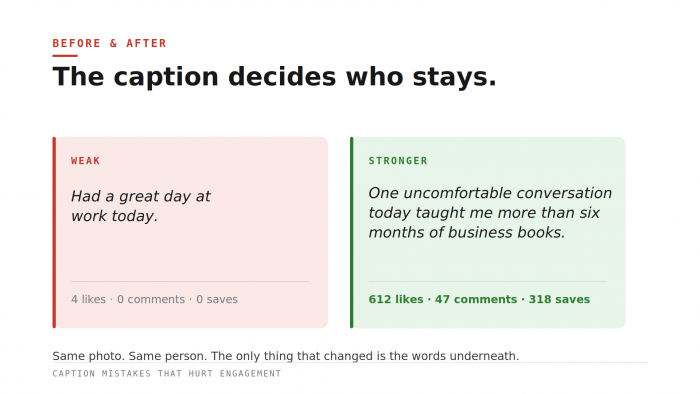
I once spent three hours on a single photo. The light was right, the moment was real, and I was sure the post would do well. I wrote one line under it: “Had a great day at work today.” It got four likes.
Two of them were from my mom.
That post taught me something I had ignored for years. The image gets people to stop scrolling. The caption decides whether they stay, react, or move on. Most of us pour our energy into the visual and then type the caption in the elevator on the way out.
Platforms read your caption as a signal of quality. They track how long someone lingers on your post and whether they tap to expand the words. A save tells the algorithm the post is worth keeping. A share tells it the post is worth passing on. A real comment tells it people want to talk. Weak captions send the opposite message, which is that your content is safe to skip, and the algorithm takes the hint.
This article is the field guide I wish someone had handed me back then. I went back through my own posts and the posts I study from creators I admire, and the same problems kept surfacing. Below are the twelve mistakes that do the most damage to engagement, each one shown with a weak caption next to a stronger rewrite, then the fix that closes the gap. Before we get to the mistakes, I want to show you how a caption actually moves the numbers, because once you see the mechanism, every fix later will make sense.
How Captions Actually Move Engagement
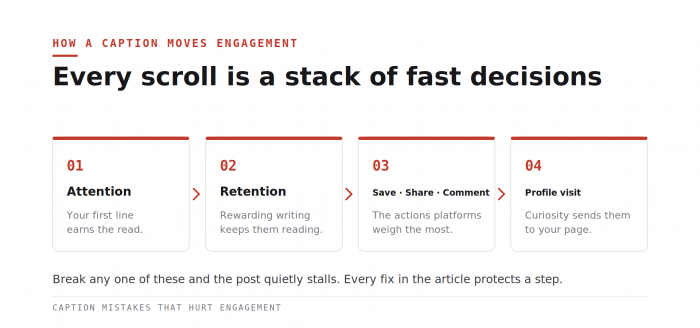
Engagement is not one thing. It is a stack of small decisions a reader makes in the first few seconds, and your caption nudges each one.
The first decision is attention. Your visual earns the stop, but your opening line earns the read. On most feeds, only the first sentence or two shows before the “more” button. If that line is flat, the reader never sees the rest of your work.
The second decision is retention, which is simply how long they stay. A caption that rewards reading keeps eyes on the post, and that dwell time is one of the clearest quality signals a platform has.
After retention comes the actions platforms weigh most heavily. A save means the reader wants this for later. A share means they will spend their own reputation to put it in front of someone else. A comment, when it is genuine and not a one-word reflex, signals a conversation worth surfacing. All three push your post into more feeds.
There is one payoff people forget about: the profile visit. A caption that makes someone curious about you sends them to your page, and the page is where a follower is won.
Every mistake in the next section breaks one or more of these decisions. Some kill attention before the reader even expands the caption. Others survive the first line but give the reader no reason to save, share, or respond. Hold this stack in mind as we go, because every fix ahead is a way to protect one of these steps.
The Psychology Behind Captions People Engage With
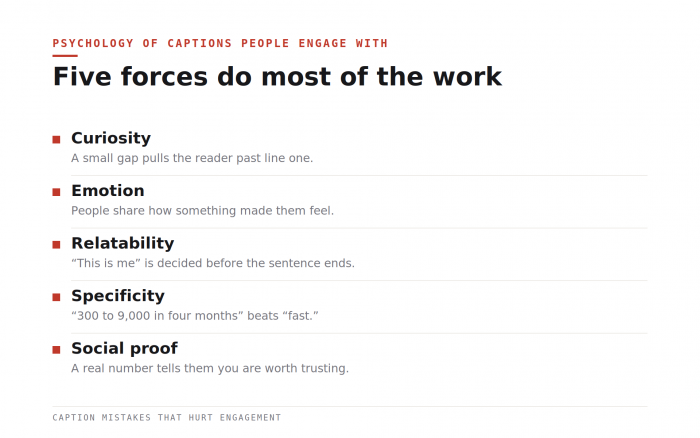
If the engagement stack explains what happens, psychology explains why. Five forces do most of the heavy lifting, and every strong caption I have written leans on at least one of them.
Curiosity is the engine of the open. A small gap between what the reader knows and what they want to know pulls them past your first line. You are not hiding the value. You are delaying it just long enough to earn the read.
Emotion is what turns a reader into a participant. People rarely share information. They share how that information made them feel, whether that feeling is seen, angry, relieved, or quietly understood.
Relatability is the quiet force. The second a reader thinks “this is me,” they have decided to engage before they reach the end of the sentence. Specific, lived detail does this far better than broad statements aimed at everybody.
Specificity separates a caption that sounds like everyone from one that sounds like you. “I grew my audience fast” fades on contact. “I went from 300 to 9,000 followers in four months by changing one habit” makes a reader stop and lean in.
Social proof lowers the cost of trusting you. A concrete number, or a small admission that you have stood exactly where the reader is standing, tells them you are worth listening to.
I will point back to these five forces all the way through the next section, because most caption mistakes are simply one of them gone missing. A weak hook is curiosity absent. A self-centered caption is relatability absent. Keep that lens handy as we walk through the twelve.
The 12 Caption Mistakes That Hurt Engagement Most
Here is where it gets practical. For each one I will show you a weak caption next to a stronger rewrite, then the fix. Many of these come straight from my own early posts, so do not feel called out. I have made every single one. They are ordered roughly the way a reader meets your caption, starting with the first line they read and ending with the habit that quietly caps your growth.
1. Starting With a Weak Hook
The first line is the only line most people read before they decide to expand or scroll past. A soft, throat-clearing opener wastes the most valuable real estate you have. This is curiosity going missing before the reader even gives you a chance.
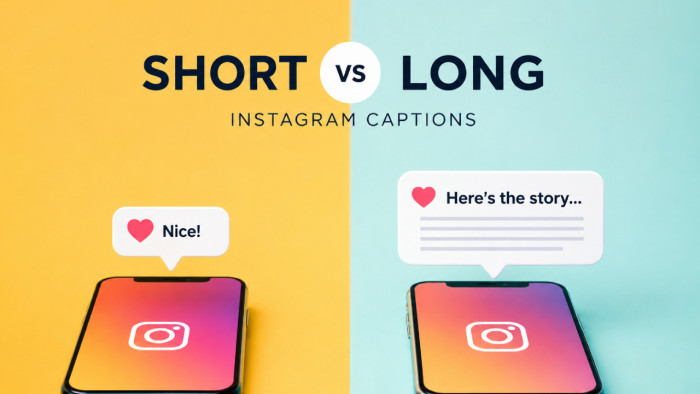
Weak: I wanted to share some thoughts about productivity today.
Stronger: I deleted every productivity app on my phone last month, and my output went up.
Quick fix: Cut your first sentence and read what is left. The second sentence is usually the real hook.
2. Writing a Wall of Text
A dense block with no breaks reads as work, and even good writing gets skipped when it looks like a paragraph lifted from a terms-of-service page. The eye needs somewhere to rest.
Weak: So today I was thinking about how growth actually happens and I realized that most of what people tell you about consistency and showing up and posting every day is only half the story because the other half is about paying attention to what lands and adjusting which nobody talks about and that took me way too long to figure out honestly.
Stronger: Most advice on growth stops at “just post consistently.” That is only half of it. The other half is watching what actually lands, then doing more of that. It took me far too long to learn the second half.
Quick fix: Break after your first line, then keep most lines to one or two sentences. White space is part of the writing.
3. Giving the Reader No Clear Takeaway
A reader should finish your caption able to name one thing they learned or felt. If they cannot, there is nothing to save and nothing to repeat to a friend, and the save is one of the strongest signals from the stack we covered earlier.
Weak: Reflecting on the year and everything that happened. Lots of ups and downs along the way.
Stronger: The biggest lesson from this year: the projects I said no to are what protected the one project that actually worked.
Quick fix: Before posting, ask what single sentence the reader will carry away. If you cannot answer, the caption is not finished.
4. Writing for Everyone, So You Land With No One
A caption built to offend nobody and speak to everybody ends up speaking to no one in particular. The reader needs to feel you are talking to them and their exact situation, including the thing they are quietly struggling with. This is relatability and specificity working together, and it is also why naming a narrow audience tends to widen your reach rather than shrink it.
Weak: Success takes hard work and dedication. Never give up on your dreams.
Stronger: If you freelance and you are scared to raise your rates, read this. I lost two clients the month I doubled mine. I also doubled my income.
Quick fix: Name the exact person you are writing to in the first line. The more specific the reader, the louder the resonance.
5. Making the Caption All About You
Readers scroll for themselves, not for you. A caption that only narrates your own wins gives them nothing to take home, and that is true even when the win is real and worth celebrating. The trick is to hand your story to the reader as their lesson.
Weak: Thrilled to announce I hit a major milestone and signed three new clients this quarter. Hard work pays off.
Stronger: I signed three clients this quarter after changing one line in my outreach. Here is the line, and here is why it worked for me.
Quick fix: For every sentence about you, earn it with a sentence the reader can use.
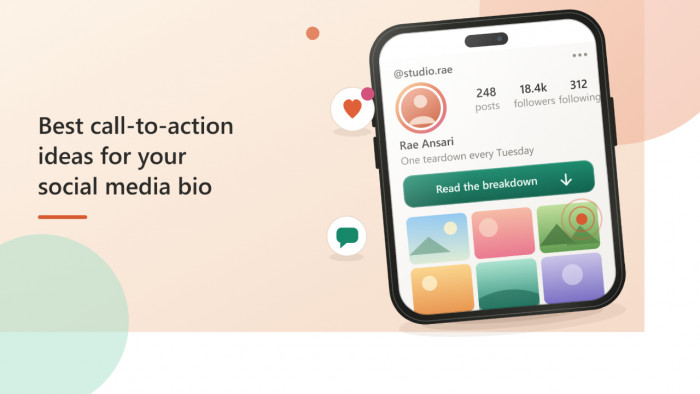
6. Skipping the Call to Action
A reader who finishes your caption feeling something will still scroll on unless you hand them a small, easy next step. Most people will not comment unless they are invited, and comments are part of what tells the platform a post deserves more reach.
Weak: And that is what I learned this week.
Stronger: That is what I learned this week. What is one thing you stopped doing that quietly made your work better?
Quick fix: End with one specific question that is easy to answer from experience, not a vague “thoughts?”
7. Fishing for Low-Quality Engagement
“Comment YES if you agree” and “tag three friends” can spike your numbers for an afternoon, but platforms have learned to separate shallow taps from real conversation. The bigger cost is that this kind of prompt trains your own audience to skim past you. Recall from the previous section that the comment only helps when it is genuine.
Weak: Double tap if you love coffee! Comment YES below!
Stronger: I cut from three cups a day to one and my focus got sharper, not foggier. What did your last attempt to cut back teach you?
Quick fix: Ask for a story or an opinion, never a reflex tap.
8. Drowning the Caption in Hashtags
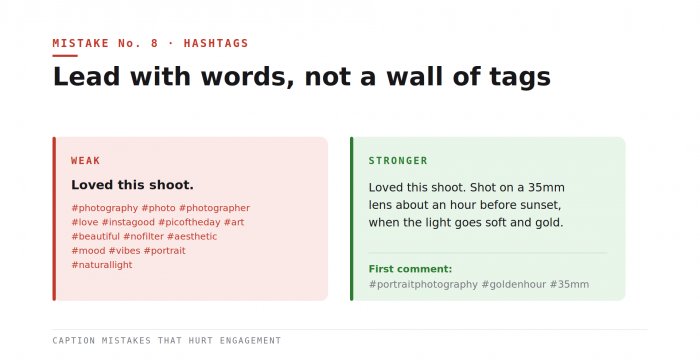
Thirty hashtags stacked at the top of a caption look like spam and shove your actual words out of sight. A small, relevant set does more than a wall of them, and where you place them matters as much as how many you use.
Weak: Loved this shoot. #photography #photo #photographer #love #instagood #picoftheday #art #beautiful #nofilter #aesthetic #mood #vibes #portrait #naturallight
Stronger: Loved this shoot. Shot on a 35mm lens about an hour before sunset, when the light goes soft and gold. (A handful of targeted tags tucked into the first comment.)
Quick fix: Lead with words, not tags. Move a small, relevant set to the end or the first comment.
9. Telling Instead of Storytelling
A flat statement of fact informs. A small story lets the reader live the moment with you, and lived moments are what people share. Even two sentences of narrative beat a paragraph of summary. This is emotion doing its job.
Weak: Consistency is important if you want to grow.
Stronger: I almost quit posting in month two. Nobody was watching, and it felt pointless. I kept going out of pure stubbornness, and month five is when it finally started to move.
Quick fix: Replace your main point with the exact moment you learned it.
10. Hiding Behind Jargon
Industry language makes you sound credentialed to a handful of peers and invisible to everyone else. The moment a reader has to translate your caption in their head, they stop reading, which quietly kills the retention we talked about up top.
Weak: Operationalizing best-in-class synergies to drive holistic stakeholder alignment across verticals.
Stronger: We changed how two teams share updates, and it cut our weekly meeting time in half.
Quick fix: Write the caption as if you were explaining it to a sharp friend who works in a completely different field.
11. Writing a Caption That Does Not Match the Visual
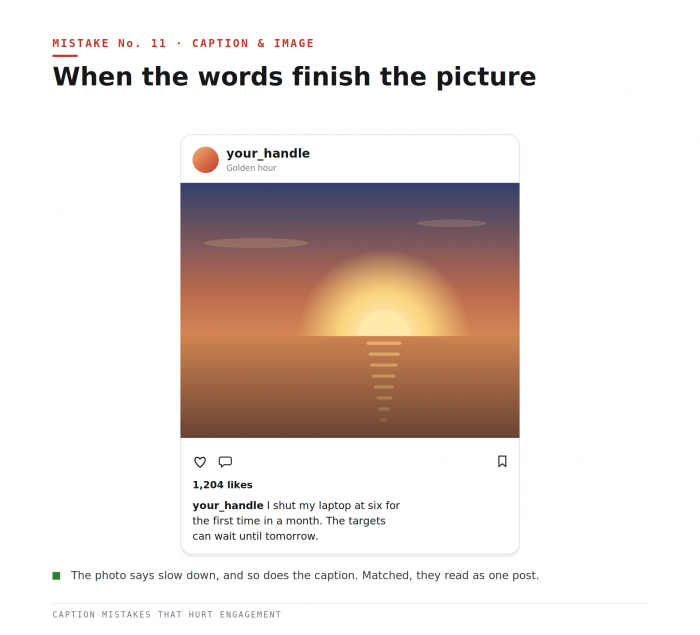
When the words and the image pull in different directions, the reader feels a small friction and scrolls. A caption should extend the visual or tell the part the photo cannot show on its own.
Weak: A photo of a quiet sunset, captioned: “Crushing my Q3 sales targets.”
Stronger: That same sunset, captioned: “I shut my laptop at six for the first time in a month. The targets can wait until tomorrow.”
Quick fix: Read the caption and look at the image together. If they feel like two different posts, the caption is the one to rewrite.
12. Never Testing Different Styles
The caption style that carried you last year may be tired now, and the only way to find out what your current audience responds to is to vary your approach and watch the numbers. Posting the same format on autopilot is the slowest possible way to learn anything about your own audience.
Weak: Posting the same “Here are 5 tips for X” format every week, no matter how it performs.
Stronger: Rotating between a short personal story, a single bold claim, a question-led post, and a quiet teardown of something that failed, then keeping whatever earns the most saves and shares.
Quick fix: Pick two caption styles you never use and try one of each this week. Let the numbers, not your habits, decide what stays.
Why Some Bad Captions Still Go Viral
By now you are probably picturing an account that breaks every rule above and still pulls enormous numbers. I have stared at those posts too, a little jealous. Four things usually explain the gap.
The first is a visual so strong it does the caption’s job by itself. A stunning photo or a video with a built-in hook can carry a lazy caption, because the stop and the emotion both land before anyone reads a word.
The second is an existing audience. A creator with a million loyal followers has people who engage out of habit and relationship, not because that day’s caption earned it. The caption is coasting on trust banked long ago.
The third is trend participation. Riding a sound or a format the platform is already pushing can lift a weak post on borrowed momentum. That momentum fades, and the reach fades with it.
The fourth is plain authority. When a well-known name posts, half the click is curiosity about the person, and the caption matters less.
Notice what all four have in common: none of them are the caption doing its job. They are other assets covering for a weak one. Most of us do not have a million followers or a viral-grade photo on tap, which is exactly why the fixes above matter more for the rest of us, not less. When you cannot lean on fame or a once-a-year shot, the words have to carry the post. That is what the next part is built to guarantee.
The SPARK Caption Framework
Everything above collapses into one pattern I run through before I hit post. I call it SPARK, because that is the effect a caption is meant to have on a scrolling thumb. Five steps, in order.
S, Snag attention. Open with the line that earns the read. This is your hook from the first mistake, and it is the single most important word choice in the whole caption.
P, Provoke a feeling. Make the reader feel something specific in the next line or two, using the emotion and the small-story idea we covered earlier. A fact informs; a feeling moves.
A, Add something useful. Give the reader a takeaway they can repeat to someone else. This is what earns the save.
R, Relate it to the reader. Turn your experience into something the reader sees themselves in, so the post quietly becomes about them. This is the relatability fix in action.
K, Kick off a response. Close with one easy, specific invitation to act, which is your call to action done well. Give the reader an obvious door to walk through.
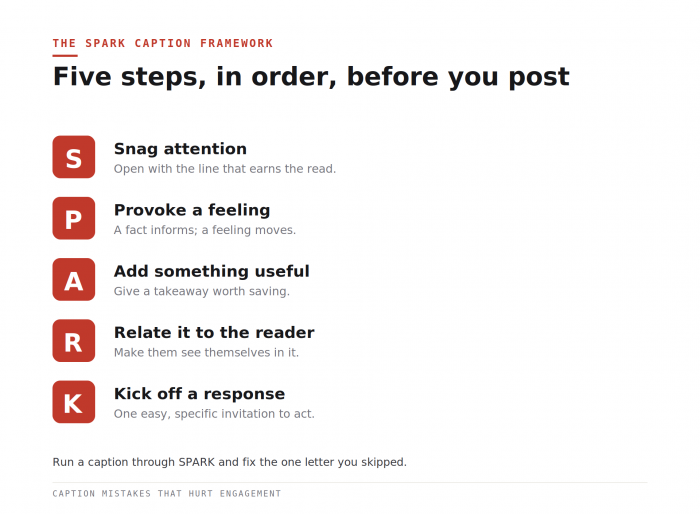
You will not hit all five letters every time, and you should not force it. A short caption might only Snag and Kick. A storytelling post might live almost entirely in Provoke. The point of the pattern is to catch what is missing before you post, so a caption never goes out flat the way mine did under that three-hour photo.
Try it on your next post. Write the caption the way you normally would, run it through SPARK, and find the one letter you skipped. Fix that single letter. In my experience that one edit is usually the difference between four likes and a comment section worth reading.