It’s almost 9 PM. You open Instagram, your thumb resting on the little plus sign, and you wait for an idea to show up.
It doesn’t.
You scroll your camera roll instead. A few decent photos, nothing that feels worth posting. You open your notes app, stare at it, switch back to the feed, watch three Reels, and close the whole thing. You’ll post tomorrow. You’re sure of it.
Except tomorrow turns into the weekend. The weekend turns into “I’ve been quiet too long,” and now there’s a small knot of guilt every time you open your own profile. So you post something just to break the silence. A quote you found. A photo with a caption you typed in fifteen seconds. It gets a handful of likes from the same loyal people who always show up, and somehow that makes the silence feel louder.
Meanwhile, somebody in your exact field posts almost every day. Their captions look easy. Their pages look alive. You assume they’re sitting on some endless supply of clever ideas you were never handed.
Here’s the part worth sitting with: give yourself a clear direction, and the “I’m bad at this” feeling tends to fade on its own.
Why this feels harder than it should
Somewhere along the way, most business owners absorbed a quiet rule about social media: every post has to be original and clever, ideally a little viral. So you sit down to “make content” the way a student sits for an exam nobody handed them a syllabus for, hoping the right answer floats up on its own.
It rarely does.
You wait for inspiration, and inspiration keeps strange hours. So you overthink a single caption for forty minutes and publish nothing. One ordinary post ends up carrying the weight of your entire brand, and that weight is exactly what freezes you.
The thing slowing you down was never your creativity.
The small shift that changes everything
You don’t have an idea problem. You have a structure problem.
The people you can’t help envying, the ones posting four or five times a week without breaking a sweat, are not more imaginative than you. They stopped inventing a brand-new concept every single day. Instead, they rotate through a short, familiar set of content types, the way a good restaurant runs a menu instead of cooking a different cuisine every night.
This is the part most “post more” advice skips. You were told to be consistent, but nobody told you what to be consistent about.
What you actually need is much smaller: five or six categories you can return to for the rest of your business’s life. Once those categories live in your head, the blank screen stops being a void and turns into a set of doors you already know how to open.
Your six content pillars
Think of your content as living inside six pillars. Forget memorizing a list of fifty things. You only have to learn six rooms, and every post you make lives in one of them.
- Educational posts teach something small and useful.
- Engagement posts pull your audience into a conversation.
- Authority posts show how you think and why you’re worth trusting.
- Social proof posts let your results and your clients speak for you.
- Behind-the-scenes posts make you feel like a person instead of a logo.
- Personal brand posts share the story and the values underneath the work.
Promotion has a place too, and we’ll fit it in near the end, in a way that won’t make you sound like a billboard.
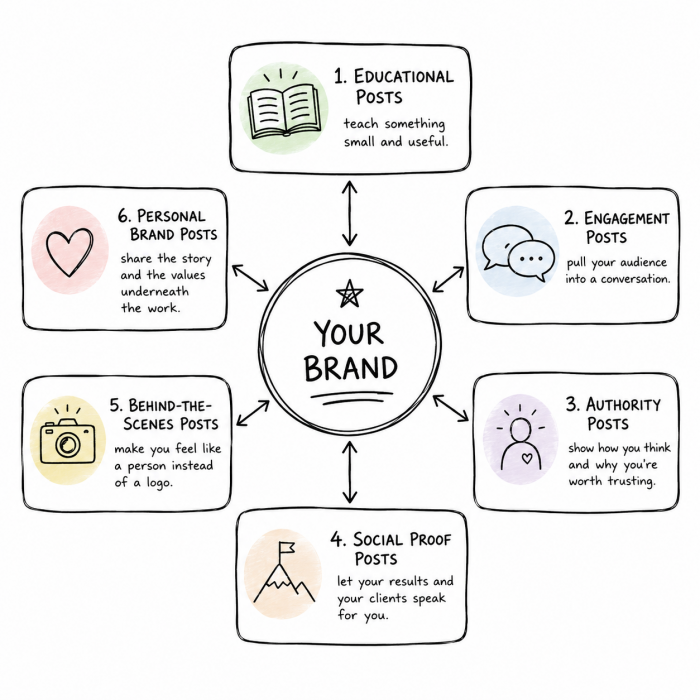
Sit with those six for a moment. Notice how organized your content suddenly feels. You stop asking the impossible question, “What should I post?” and start asking a smaller one: “Which room am I pulling from today?”
How to use the fifty ideas below
Everything below is sorted into those same six pillars. None of it is random. When you’re stuck, you don’t scan all fifty. You pick a pillar, then pull one idea from it.
Keep one rule in mind as you read. Every idea here is written to be general enough for any business and specific enough that you could act on it before lunch. Where you see “your industry” or “your customer,” swap in your real context. I’ll show you exactly how to do that swap a little later.
Educational content ideas
They teach. People follow accounts that make them a little smarter, so this pillar will quietly carry most of your value.
- The most common mistake your customers make before they ever find you, and the simple fix.
- A plain “how it works” breakdown of your service in three short steps.
- A myth in your industry, set beside what’s true.
- One small tip your audience can try the same day they read it.
- The question you get asked most often, answered in everyday language.
- A beginner’s starting point: “New to this? Start here.”
- A short checklist of things to sort out before hiring someone who does what you do.
- One confusing industry term, explained like you’re talking to a friend.
- What a problem looks like before you understand it, versus after.
- The thing most people in your audience don’t realize about your field.
Engagement content ideas
These start conversations. The platforms reward posts that make people stop and reply, so this pillar is your fastest way to wake up a quiet account.
- A “this or that” between two things your audience argues about.
- A direct question: “What’s the hardest part of ___ for you right now?”
- A two-option poll on something they deal with every week.
- A fill-in-the-blank: “The worst part of ___ is ___.”
- Your take on a trending topic, with an open invitation to disagree.
- A “caption this” using a photo from your world.
- A true-or-false about your industry that most people get wrong.
- A short scenario: “You’re in this spot. What’s your move?”
- A one-word prompt: “Describe ___ in a single word.”
- A simple question: “What do you want me to cover next?”
Authority content ideas
These show how you think. People buy the judgment of the person behind the service as much as the service itself.
- Three lessons your years in this field taught you.
- An honest, slightly unpopular opinion about your industry.
- What you’d do if you had to rebuild your business from zero tomorrow.
- The difference between how a beginner and an expert approach the same task.
- Where you think your industry is heading over the next year or two.
- The mistake you watch newcomers repeat again and again.
- The approach you’d pick if you were the customer, and why.
- Something you refuse to do in your own business, and what it protects.
- A breakdown of a past project: what worked, and what you’d change.
- The one piece of advice you’d hand someone starting today.

Social proof content ideas
These build trust without you having to claim it. Let the work and the people you’ve helped say it for you.
- A customer story: the problem they came in with, and the result they walked away with.
- A clear before-and-after, with enough context to make it land.
- A testimonial, plus a sentence explaining the situation behind it.
- A specific result: “Here’s what a client reached in their first few weeks.”
- A screenshot of real feedback, with your short note on why it mattered.
- A case study told like a story instead of a spreadsheet.
- A customer spotlight: how one person used what you offer.
- The result you were proudest to deliver recently, and what made it click.
Behind-the-scenes content ideas
These make you human. People connect to process and to faces, not to polished perfection.
- An ordinary day in your work, start to finish.
- The hidden steps behind delivering your service that clients never see.
- A quick tour of your workspace or setup.
- How you prepare before a project begins.
- A mistake you made mid-project, and the lesson you took from it.
- A small, real moment from your week building this thing.
Personal brand content ideas
These share the why. Over time, this pillar is what turns followers into people who actively root for you.
- The reason you started this business in the first place.
- A failure that stung, and what it rewired in how you work.
- Your path from day one to wherever you are now.
- A value you won’t bend on, even when it costs you.
- Something you’re working to get better at right now.
- What keeps you going on the days the motivation runs dry.
How to customize any idea in under a minute
Here’s the part that sets you free. Every idea above is a template, and the swap is always the same two moves: replace “your industry” with your real world, and replace “customer” with the specific person you serve.
Watch how idea number one, the most common mistake your customers make, bends to fit completely different businesses:
- A restaurant turns it into an ordering mistake that leaves people with a worse meal than they could have had.
- A freelance designer turns it into the brief mistake that quietly wrecks a project before it starts.
- A coach turns it into the belief their clients hold that keeps them stuck.
- An agency turns it into the thing clients do that sabotages their own results.
Same idea. Four completely different posts. Once you see that any of these fifty can be reshaped this way, the list stops being fifty posts and becomes closer to endless.
Turning an idea into an actual post
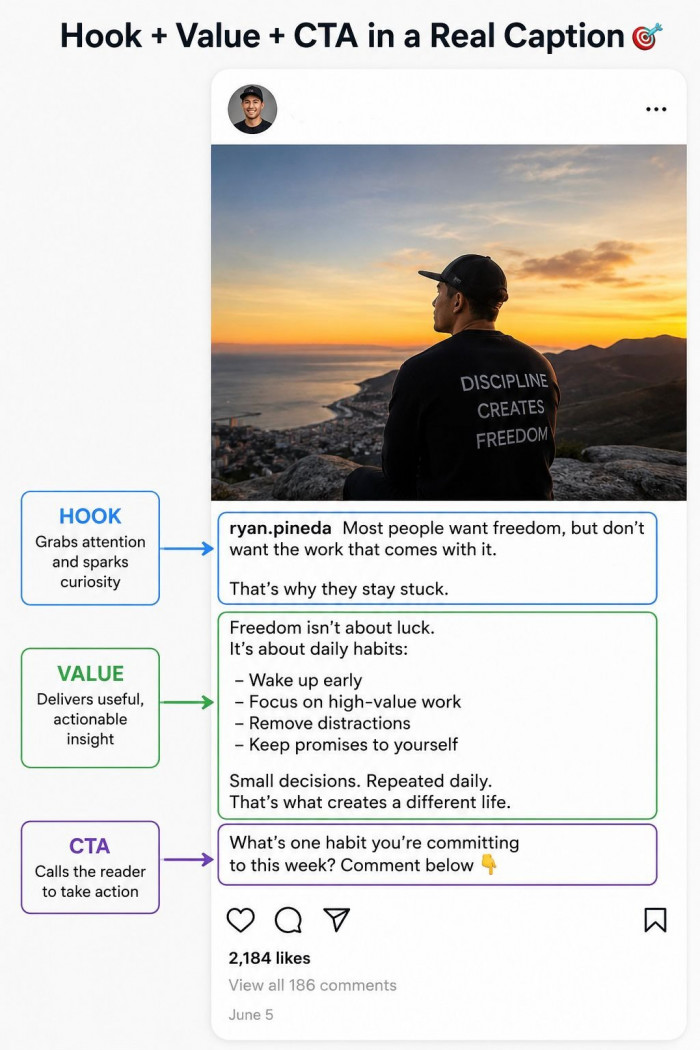
An idea isn’t a post yet. Plenty of people get this far, land on a good idea, then freeze again at the caption. So here’s the simplest structure I know, and it fits almost anything you’ll ever write: a hook, then value, then a clear call to action.
The hook is your first line, and its only job is to stop the scroll. After that comes the value, the middle stretch where you deliver on whatever the hook promised. Then you close with a call to action, telling the reader the one small thing to do next, usually leaving a comment or saving the post.
Take idea twenty-six, the mistake newcomers keep making.
Hook: “Most people lose customers in the first ten seconds and never notice.”
Value: a few lines on what the mistake is and how to fix it.
CTA: “Save this so you don’t make the same one this week.”
That’s it. The idea handed you the topic. The formula handed you the shape.
One idea is never just one post
This is where the math tips in your favor, and the fear of running out disappears.
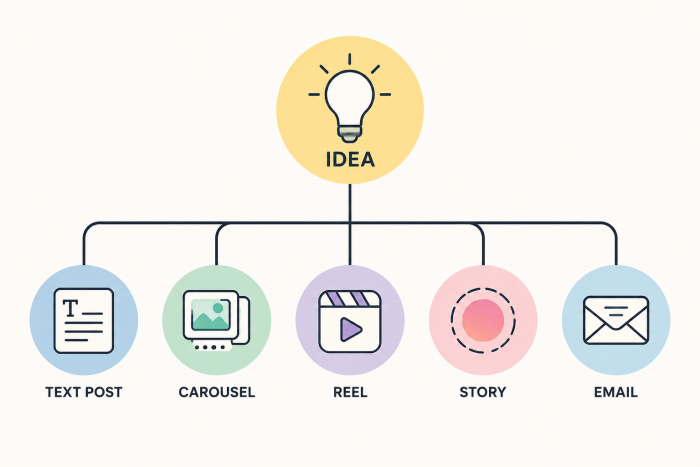
A single idea can become five posts without losing a thing. Take any one item from the list above and run it through different formats.
- Write it as a short text post.
- Expand it into a carousel that walks through each point.
- Record a thirty-second Reel saying it out loud.
- Trim one line into a quick Story with a poll.
- Send the whole thing to your email list.
One idea becomes five pieces of content across five different days. Do that with even half the list and you have months of posts already sitting in front of you.
The mix that keeps you from sounding like a sales pitch
Posting consistently is one thing. Posting a healthy balance is what builds a following that buys. If everything you publish sells, people tune out. If nothing ever does, they forget you offer anything at all.
A balance that works for most businesses looks roughly like this:
- 40% educational, the steady value that earns attention.
- 20% engagement, the conversations that keep you visible.
- 20% social proof, the trust that makes selling easier.
- 10% personal, the human thread that makes you memorable.
- 10% promotion, the asks you’ve now earned the right to make.
Notice that promotion is the smallest slice, and notice why that works. By the time you ask for the sale, you’ve already taught them and proven yourself several times over. The pitch lands soft because you set it up.
What to post when you’re completely stuck
Some days you won’t want a whole strategy. You’ll want one answer, fast. So keep this short emergency menu somewhere you can reach it.
If your engagement has gone flat, post a poll or one sharp question and let your audience do the talking.
If sales feel slow, reach for social proof. A single testimonial or a quick case study reminds people why others trusted you in the first place.
And if your mind goes blank, return to the two wells that never run dry: the questions customers ask you constantly, and the mistakes you watch them make. Your audience keeps refilling both for you, whether they mean to or not.
You won’t be stuck again, because “stuck” was only ever the absence of a system. Now you have one.
The real reason some businesses win online
I’ll leave you with the thing I wish someone had told me years ago.
The businesses that win on social media are the ones that kept showing up, in the same handful of categories, long after everyone else got bored and quit. Consistency beats brilliance, and a system beats inspiration every time, because a system still works on the days you don’t feel inspired.
So stop waiting to feel ready. Open the app, pick one room, and post the first thing that fits.