A copy-and-paste system I built after years of watching the same post win on one platform and sink on the other three.
Two years ago I wrote what I thought was the perfect post. I copied it into Instagram, Facebook, LinkedIn and X, hit publish on all four, then sat back to watch it take off. Instagram gave me a polite handful of likes. The other three did close to nothing. Same words. Same image. Four results that looked nothing alike.
That was the night I stopped treating my four accounts like one big megaphone.
I started building social media post templates instead, a repeatable skeleton for each platform that I could fill in within minutes. This article hands you that whole system, with copy-and-paste templates for Instagram, Facebook, LinkedIn and X, plus the real example posts I use to pressure-test them.
We start with why one post behaves so differently from feed to feed, then build the single framework every template shares. After that we go platform by platform. The section most guides skip comes near the end: turning one idea into four native posts without rewriting from scratch. Templates come first here, the reasoning sits underneath them.
Why One Post Behaves Differently on Every Platform
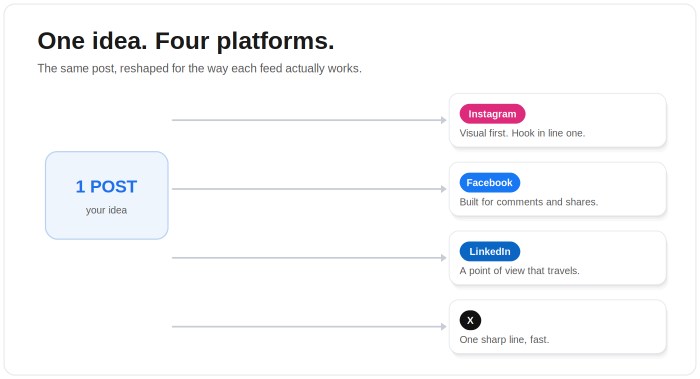
The reason my identical post got four different reactions is simple. Each platform was built for a different purpose, and over time it trains its audience to expect a certain kind of content. Fighting that with one-size-fits-all copy is how good ideas die quietly.
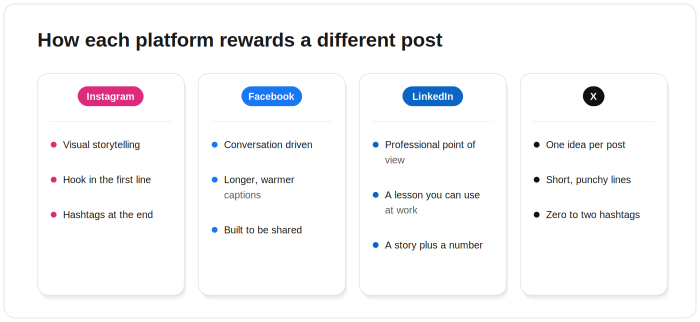
Instagram is a scroll-and-stop machine. The image stops the thumb, the first line of the caption decides whether anyone reads the rest. People open the app to feel something or to look at something they want.
Facebook still runs on conversation. Posts that earn comments and shares travel further than polished announcements, and captions that read like a friend talking usually beat clipped marketing copy.
LinkedIn rewards a clear point of view. The opening line decides whether anyone expands the post, and the writing that performs tends to carry a lesson the reader can use at work the next morning.
X moves in minutes. One sharp idea written plainly beats a paragraph of warm-up, and threads let a single thought stretch across several short posts.
So the same caption cannot pull equal weight everywhere. Writing four unrelated posts from scratch is exhausting, so I do the opposite. I keep one shared structure and reshape it for each audience.
Reshaping a post takes me about ten minutes now; writing four from zero used to eat an hour.
That shared structure is the next section, and every template after it is built on top of it.
The Skeleton Every Strong Post Shares: Hook, Value, Proof, CTA
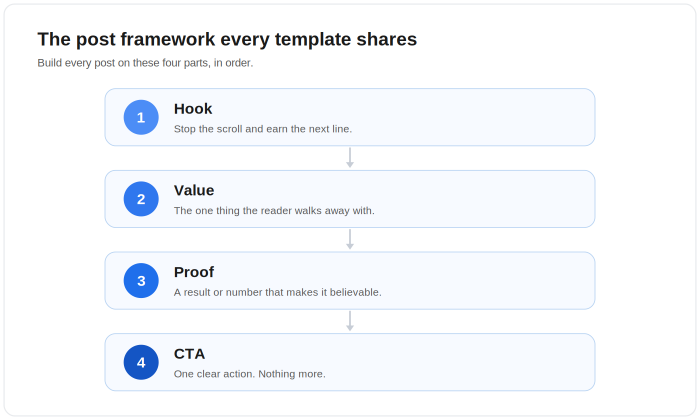
Before any platform-specific tweak, every post I publish hangs on the same four-part skeleton. I did not invent it. I found it the slow way, by studying which of my posts earned saves and replies and which sank without a trace. Four parts kept showing up in the winners.
Hook. The first line or two. Its only job is to stop the scroll and earn the next line. A question, a bold claim, a surprising number, a confession: any of these can do it. If the hook fails, nothing under it matters.
Value. The actual point, the thing a reader walks away with. This is where lazy posts go vague. Be specific enough that someone could act on it before lunch.
Proof. What makes the value believable. A result you got, a screenshot, a number you hit, an honest story from your own work. Without it, the value reads like an opinion.
CTA. What the reader should do next. One action, not five. Ask people to save the post, or to leave a comment, and stop there. Pick the single response you want and ask for it plainly.
Hold these four in your head. In the four sections that follow you will see this same skeleton dressed differently for each platform, and later we will use it to spin one post into four.
Instagram Post Template
Instagram leans hardest on the hook, because the caption loads collapsed and only a line or two shows before the “more” cut. Get that first line wrong and the rest is invisible. Here is the skeleton shaped for the feed.
INSTAGRAM TEMPLATE
[HOOK: line 1. The only line most people see before tapping “more.” Make it a question or a bold statement.]
[VALUE: 2 to 4 short lines, one idea per line, with space between them so the caption breathes on a phone.]
[PROOF: a quick result or an honest detail that earns trust.]
[CTA: one action, for example “Save this for later” or “Tell me your take below.”]
.
.
[5 to 10 hashtags parked at the bottom. Mix a couple of large tags with smaller niche ones.]
Two quick notes. Emojis here work as visual punctuation, one to break a line or mark a list, not sprinkled into every sentence. And hashtags belong at the end of the caption or in the first comment, never threaded through the middle where they snap the reading flow.
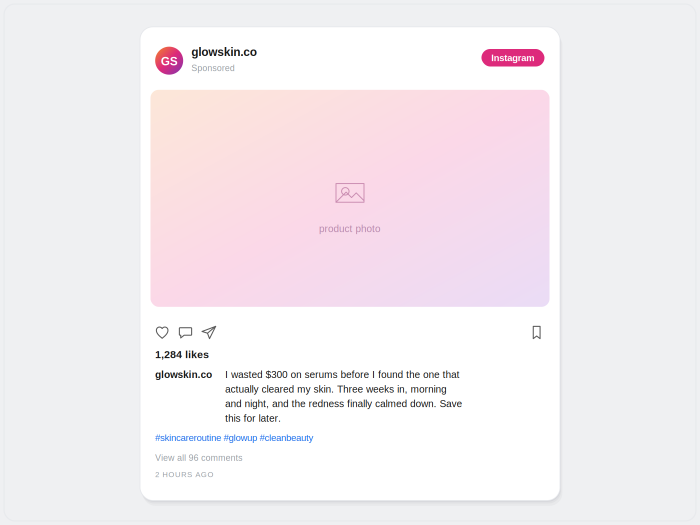
EXAMPLE: skincare brand launching a serum
I wasted $300 on serums before I found the one that actually cleared my skin.
Three weeks using it, morning and night.
No new breakouts.
The redness around my nose finally calmed down.
We made 40 bottles for our first batch. 31 are already gone.
Save this post so you can find it the next time your skin throws a tantrum.
.
.
#skincareroutine #glowup #cleanbeauty #skincaretips
Facebook uses the same skeleton, but it asks for more words and a warmer voice, which is exactly the next section.
Facebook Post Template
If Instagram wants you to stop the scroll, Facebook wants you to start a conversation. The reward here is the comment and the share, so the template loosens up and sounds more like a person telling a story at a kitchen table.
FACEBOOK TEMPLATE
[HOOK: a relatable opening line, often a small confession or a question your audience has asked themselves.]
[STORY: 2 to 3 short paragraphs written like you are talking to one friend. Set a scene, then land the point.]
[PROOF: what changed for you, or what you learned along the way.]
[CTA: ask for a reply, not a sale. Try “Has this happened to you?” or “Which side are you on?”]
Facebook still moves on shares. A post that makes someone think “my sister needs to see this” will travel further than anything you pay to boost. So I write at least one line built to be tagged or forwarded.
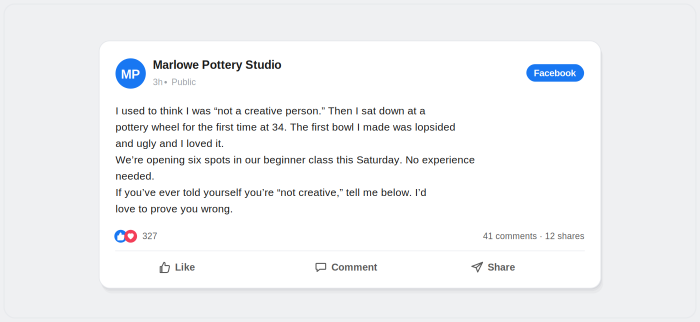
EXAMPLE: a pottery studio promoting a beginner class
I used to think I was “not a creative person.” Then I sat down at a pottery wheel for the first time at 34.
The first bowl I made was lopsided and ugly and I loved it. The second one was a little less lopsided. By the fourth, something clicked, and for two hours straight I forgot to check my phone.
We are opening six spots in our beginner class this Saturday. No experience needed. You walk out with two pieces you made with your own hands.
If you have ever told yourself you are “not creative,” tell me about it below. I would love to prove you wrong.
LinkedIn keeps the storytelling but trades the casual voice for a sharper point of view, which we turn to now.
LinkedIn Post Template
LinkedIn is where a clear opinion earns its keep. The first line shows above the “see more” fold and decides everything, and the posts that travel usually hand the reader something they can apply at work tomorrow. This template carries a little more weight than the others.
LINKEDIN TEMPLATE
[HOOK: a bold opinion or a counterintuitive insight in one line. This sits above the “see more” fold.]
[CONTEXT: a short professional story or situation, 2 to 4 short paragraphs with white space between them.]
[DATA OR EXPERIENCE: a number, or a hard-won detail from your work.]
[LESSON: the takeaway, stated plainly, the part a reader can use the next morning.]
[CTA: invite a conversation. Ask “What would you have done?” or ask people to share their own version.]
LinkedIn pays you for specifics over polish. “We grew revenue” gets scrolled past. “We grew revenue 22% in a quarter by killing two products” gets read and reshared. Numbers and honesty do the heavy lifting here.
EXAMPLE: a founder reflecting on a hiring mistake
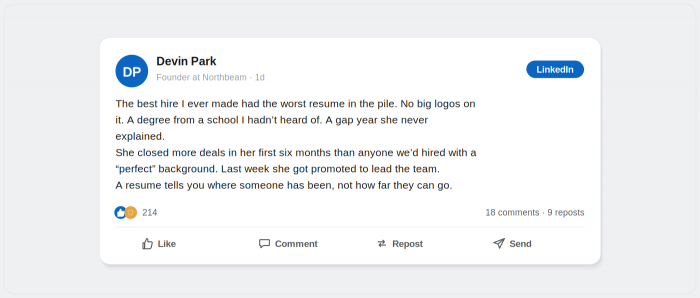
The best hire I ever made had the worst resume in the pile.
Two years ago I almost skipped her application. No big logos on it. A degree from a school I had not heard of. A gap year she never explained. My co-founder pushed me to interview her anyway.
She closed more deals in her first six months than anyone we had hired with a “perfect” background. Last week she got promoted to lead the team.
The lesson I keep relearning: a resume tells you where someone has been, not how far they can go. We have already changed how we screen because of her.
If you have ever hired someone who looked wrong on paper and turned out right, I would love to read that story below.
X strips all of this down to its smallest workable form, the last of the four templates.
X (Twitter) Post Template
On X, every extra word costs you. One idea per post. The hook does most of the work, and the lines stay short enough to read at a glance. This is the leanest template in the article.
X TEMPLATE (SINGLE POST)
[HOOK: the whole idea compressed into one line, or a line that makes scrolling past feel like a mistake.]
[PAYOFF: one or two short lines that deliver. Cut every word that is not carrying weight.]
[Optional CTA. Often none at all. Keep hashtags to 0 to 2 maximum.]
X TEMPLATE (THREAD)
Post 1: [the hook plus a promise of what the thread will hand the reader.]
Post 2 onward: [one idea per post, each able to stand alone if someone screenshots it.]
Final post: [a one-line wrap plus a soft CTA, for example “Follow for more like this.”]
Posts that spread on X usually say one true thing in fewer words than feel comfortable. Specific beats clever almost every time. If you can delete a sentence and keep the meaning, delete it.
EXAMPLE: a single post, then a thread opener
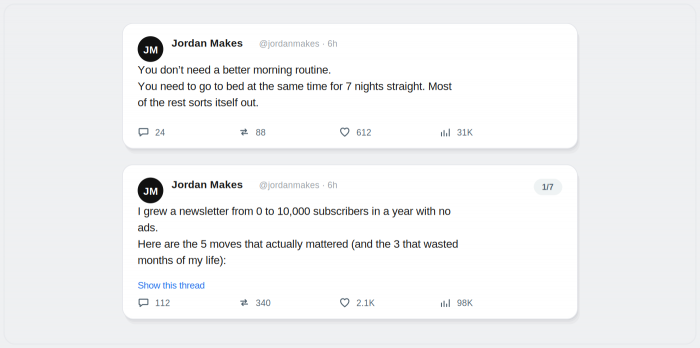
You don’t need a better morning routine.
You need to go to bed at the same time for 7 nights straight. Most of the rest sorts itself out.
Thread opener:
I grew a newsletter from 0 to 10,000 subscribers in a year with no ads.
Here are the 5 moves that actually mattered (and the 3 that wasted months of my life):
Those four templates cover the how. The next section covers the what, because the same skeleton bends depending on the job the post has to do.
Six Post Types and How the Template Bends for Each
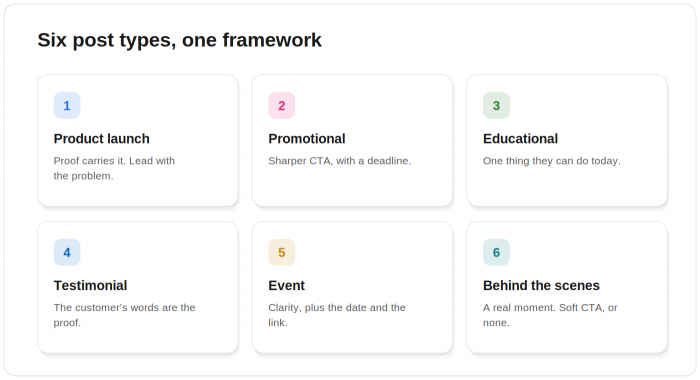
The same four-part skeleton serves jobs that look nothing alike. Here is how I shift the weight for the six post types I publish most often, each one still built on the hook, value, proof and CTA you already know.
Product launch. The proof carries the post, because people are wary of anything new. I open the hook with the problem the product solves and back the value with a real result or a limited batch number that creates a little urgency.
Promotional post. The CTA gets sharper and the offer gets a deadline. I keep the value short and give the reason to act now its own line, so nobody scrolls past it by accident.
Educational post. Value carries everything. I pick one thing the reader can do today and cut everything else. The CTA is a simple “save this,” and these earn me the most saves of any type.
Testimonial post. The customer’s words become the proof and my job shrinks to framing. I open with the result they got, then drop their exact quote in the middle. I close by inviting the reader to picture the same outcome for themselves.
Event announcement. Clarity beats cleverness here. The hook names the event, the value answers what the attendee gets out of it, and the CTA carries the date and the link. I also repeat the date once near the end on purpose, because people forget the one detail that matters.
Behind-the-scenes post. Proof and story merge into one. There is no pitch, just a real moment from the work, which is why these build more trust than any glossy announcement. The CTA can be soft, or you can skip it entirely.
Knowing the six types is useful on its own. It turns powerful the moment you stop writing each post fresh and start spinning a single idea into all four platforms at once, which is where we go next.
How to Turn One Idea Into Four Native Posts
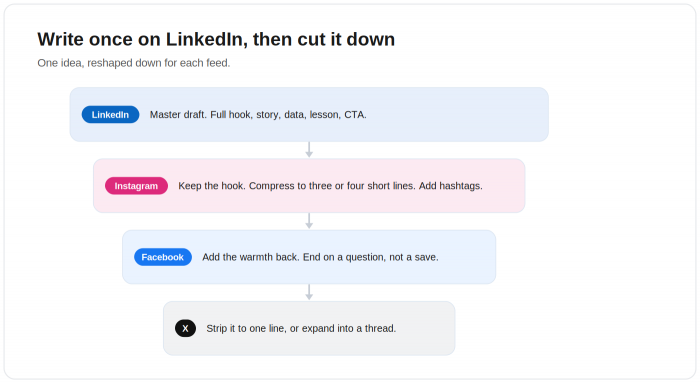
Remember the four-part skeleton from earlier. Because every template shares it, you can write once and reshape, instead of staring at a blank screen four separate times. I always draft on the platform that holds the most words, then cut downward from there.
Start on LinkedIn. Write the full version: hook, story, data, lesson and CTA. This becomes your master draft, because the long form forces you to think the idea all the way through before you trim it.
Cut it down for Instagram. Keep the hook almost word for word, compress the story into three or four short lines, hold on to your single strongest proof point, then swap the LinkedIn “let us discuss” close for a “save this.” Drop your hashtags at the bottom.
Warm it up for Facebook. Take the same story but add back a little conversational fat, the small asides and the friendliness you trimmed out for Instagram. End on a question instead of a save, because Facebook pays you in comments.
Strip it to the bone for X. Find the one line in your LinkedIn lesson that could stand completely alone, and post just that. If the idea is too big for a single post, the LinkedIn version becomes your thread, one paragraph per post.
Here is one idea, posting less but better, shaped four ways.
ONE IDEA → LINKEDIN
I cut my posting from daily to twice a week and my reach doubled.
For a year I forced out a post every single day. Most of them were filler. I was tired, and the numbers sat flat anyway.
So I stopped. Two posts a week, each one I actually cared about. Within two months my average reach had doubled and my comments had tripled.
Volume was never the lever. Caring about each post was.
How often are you posting, and is it helping you or just wearing you out?
ONE IDEA → INSTAGRAM
I cut my posting from daily to twice a week and my reach doubled.
For a year I posted every day. Most of it was filler.
I stopped and dropped to two real posts a week.
Two months later my reach had doubled.
Save this if you are posting daily and quietly burning out.
.
.
#contentstrategy #socialmediatips #creatorlife
ONE IDEA → FACEBOOK
For a whole year I made myself post every single day. Most of it was junk I pushed out at 11pm just to keep a streak alive.
Then I quit doing that. Two posts a week, each one I wanted to write. Two months later my reach had doubled and my comments had tripled.
Turns out nobody was handing me a prize for showing up exhausted. Are you posting every day right now? Be honest, is it helping, or is it just wearing you down?
ONE IDEA → X
I cut my posting from daily to twice a week.
My reach doubled.
Volume was never the lever.
That is the loop that hands you back hours. One idea, drafted once, living natively in four feeds. The last thing left is keeping the templates from turning your voice robotic, which is the real risk of any system like this.
Using Templates Without Sounding Like a Template
A template is a starting line, not a finish line. The fastest way to kill your own engagement is to fill in the same blanks the same way forever, until every post sounds machine-stamped and your audience tunes out.
Shift the voice, not the bones.
The skeleton stays the same on every platform. The tone should not. Talk the way you would in a client meeting on LinkedIn and the way you would at a friend’s kitchen table on Instagram, even when the underlying idea is identical.
Let your numbers pick your hooks.
I save every hook that beat its own average and quietly retire the ones that flopped. After a few months of that, you stop guessing which openings work and start knowing.
Guard your brand voice across all four feeds. Someone should be able to read a post with your name hidden and still know it is yours. Templates make that consistency easy. They also make sameness easy, so keep an eye on the line between the two.
Test one thing at a time. Change the hook or the CTA, never both at once, then read the results before you touch anything else.
And here is when I throw the template out completely. If a post is pouring out of you and refuses to fit any structure, write it raw and publish it anyway. The skeleton exists for the other 90% of days, the ones when inspiration does not bother to show up.
So here is what I would do tonight if I were you. Take the one idea you have been sitting on, drop it into the LinkedIn template above, and cut it down to the other three before you go to sleep. Your next four posts are already half-written.