I used to think good information was enough. I would spend an hour researching a topic I knew cold. I would write up everything in my head and post it. Then I would watch it sink. The data was right. The advice was sound. Almost nobody saved it, and even fewer sent it to anyone.
The problem was never the information. It was the order I served it in.
Once I started treating each post as a small lesson with a real arc, the same knowledge I had been giving away for months started getting saved and passed around. Nothing about my expertise changed. The packaging did.
This guide is the structure I wish someone had handed me three years ago. I will walk through the skeleton that works on every platform, show you the real examples I write from, then bend that skeleton to fit Instagram, LinkedIn, short video, and written threads. By the end you will have templates you can fill in tonight.
Why structure beats information
Here is the uncomfortable thing I had to accept. Your audience is not waiting to be educated. They are scrolling past you on the way to something else, and you get about a second to earn the next second. Information assumes attention you do not have yet. Structure is how you earn it.
Good structure does several jobs at once.
- It pulls a reader in before they decide to keep moving.
- It carries one idea cleanly, so the lesson actually lands and survives the scroll.
- It gives people a reason to save the post and a reason to send it to someone who needs it.
- It builds trust slowly, so the next time your name appears, people stop on purpose.
The psychology underneath
None of this is decoration. It runs on how attention and memory actually work. A strong opening exploits the curiosity gap, the itch you feel when a question gets raised but not yet answered. A single-idea post respects cognitive load, the plain fact that a brain juggling six concepts at once holds none of them well. A clear payoff at the end uses active recall, asking the reader to do something with what they just learned so it sticks past the scroll. I will point back to each of these as they show up.
Every step below is one of those principles wearing work clothes.
The structure, one step at a time
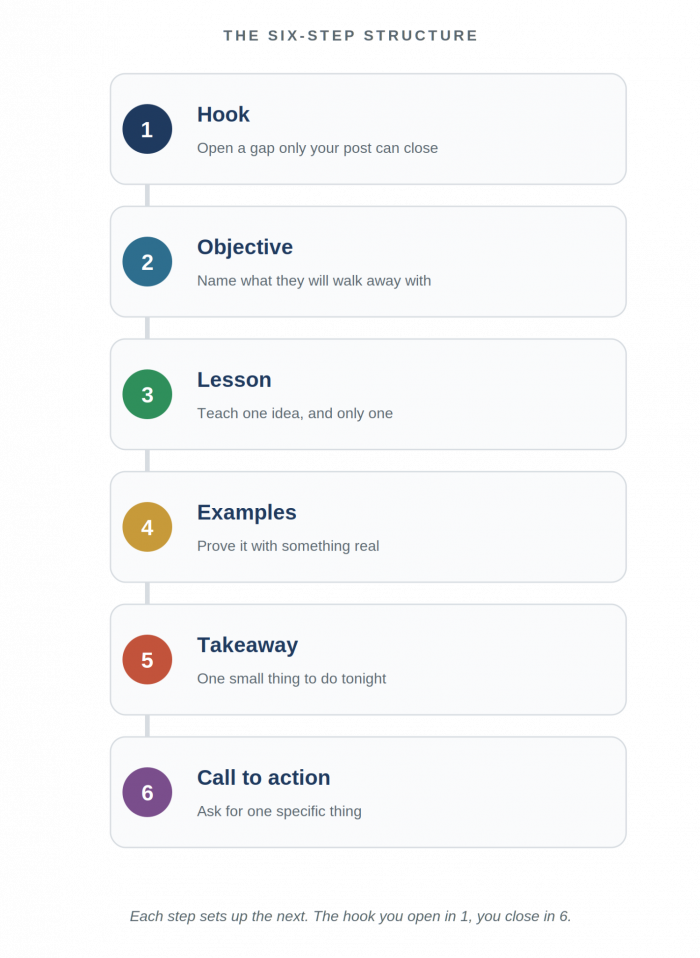
The skeleton has six parts, and they run in order for a reason. Each one sets up the next. Skip one and the post wobbles. I will take them one at a time, and you will see how the hook from Step 1 is the same thread you tie off in Step 6.
Step 1: Open with a hook that opens a gap
The first line is the whole ballgame. If it does not stop the scroll, nothing else you wrote exists. A hook works when it opens a small gap in the reader's mind that only your post can close.
Four kinds have never let me down.
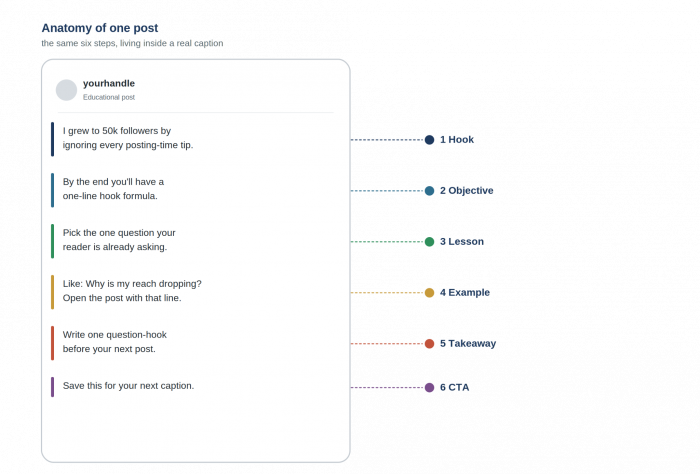
The curiosity hook promises a specific reveal. "I grew an account to 50,000 followers and ignored almost every posting-time tip you have read. Here is what actually moved the needle."
The problem hook names the pain before the fix. "You are posting every day and your reach keeps dropping. It is not the algorithm punishing you. It is one habit, and I had it too."
The contrarian hook pokes the thing everyone repeats. "Stop telling people to 'add value.' It is the most useless advice in marketing, and it is quietly killing your posts."
The data hook leads with a number too sharp to ignore. "Posts with a question in the first line got saved twice as often on my account. I tested it across 40 posts."
Two hook mistakes cost me the most. The first was being clever instead of clear, writing a line I was proud of that told the reader nothing about what they would get. The second was overpromising, opening with "this will change your life" and then teaching something ordinary, which trains people to distrust your first line forever. A hook writes a check. Step 6 is where you cash it, and everything in between has to be the money.
Step 2: Say what they will walk away with
Right after the hook, before you teach a thing, tell the reader exactly what they will be able to do when they finish. This feels redundant the first few times you write it. It is not. A reader who knows the destination is far more willing to ride along, because you have turned a vague scroll into a short trip with a reward waiting at the end.
It sounds like this. "By the time you finish reading, you will be able to write a hook in under a minute using one question." Or simply, "Here is the exact three-line opening I put on every carousel."
The hook earns the click. The objective earns the read.
Step 3: Teach one idea, and only one
This is the rule I break the most when I am excited, and it is the one that matters most. One post, one idea. If you catch yourself writing "and another thing," you have found your next post, not your next paragraph.
The reason ties back to cognitive load from the section above. When you teach a single concept, the reader can hold onto it and use it later. When you cram five concepts into ten slides, you feel generous and they feel buried, and buried readers do not save anything. They leave.
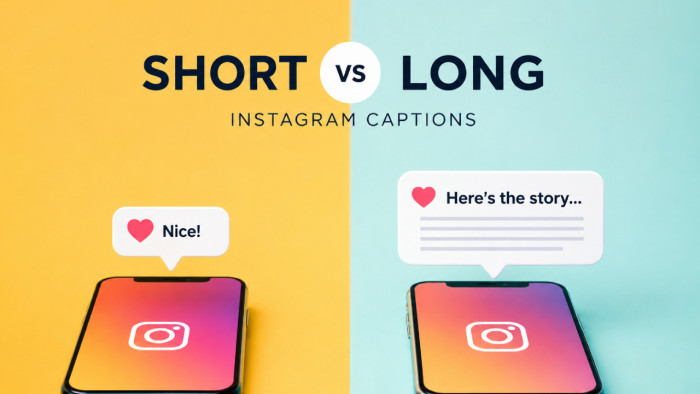
Inside that one idea, I lean on a tiny teaching frame that never gets old: name the problem, explain why it happens, then hand over the fix. Say the idea is that your captions are too long. The problem is that people decide to read or skip within the first two lines. It happens because writers front-load context instead of the point. The fix is to put your single most useful sentence first and explain afterward, so the reader gets the value even if they bail after line one.
Step 4: Prove it with an example they recognize
An idea told in the abstract floats away. The same idea attached to a concrete example sticks to the wall. This is the step most people rush, and I will be blunt about why it matters: generic advice on this topic is everywhere, so the example you pick is often the only part of your post that nobody else could have written.
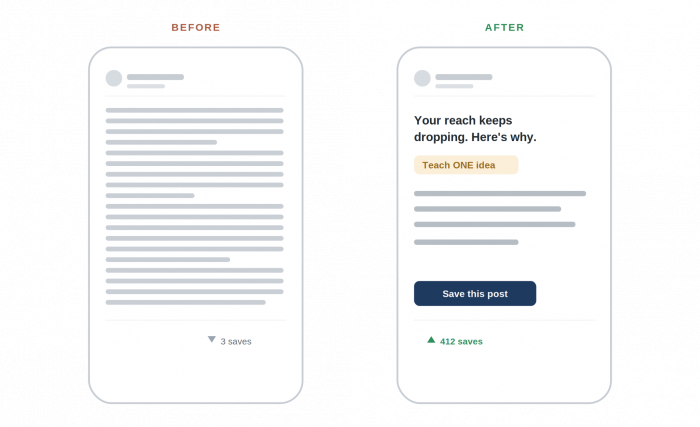
The examples that work come in a few shapes. A before-and-after shows the change in a single frame, like a rewritten caption next to the original. A real story from your own work carries more weight than a tidy hypothetical, because the reader can smell the difference. A screenshot or a hard number turns a claim into evidence.
I run every example down the same short path: pair the concept with the example that shows it, then add the outcome that example produced. The outcome is the part people forget. Show it, or the example is just a nice story.
Step 5: Give them one thing to do tonight
Up to here you have taught. Now make it usable. A reader who closes your post and immediately does something has crossed from "that was nice" to "this person helped me," and that crossing is where saves come from. People save what they plan to use.
The takeaway should be small enough to finish today. A one-line template they can copy. A single question to ask before they hit post. A two-minute audit of their last caption. The mistake is ending on inspiration instead of instruction, which leaves the reader nodding and empty-handed.
As I promised back in Step 2, you owe them a capability. This is where you deliver the exact thing you named, no more.
Step 6: Close with one clear ask
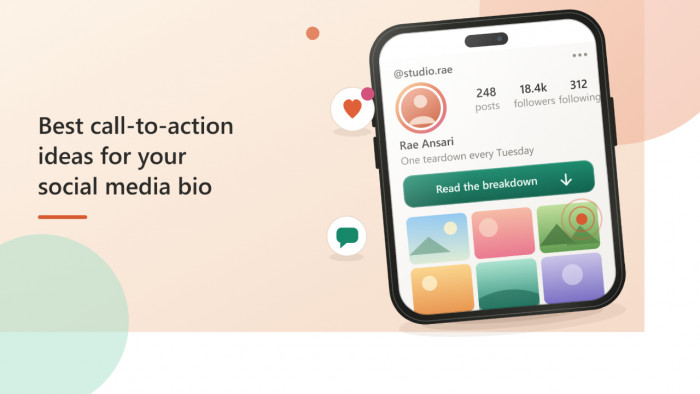
Every post should end by asking for one specific action, and only one. Two asks split attention and you land neither. This is where you finally cash the check the hook wrote in Step 1.
Match the ask to your goal. If you want reach, tell people to share the post with one person who needs it, and name that person for them: "Send this to the friend who keeps asking how you grew your account." If you want a soft signal of trust, ask them to save it for the next time they sit down to write. If you want conversation, ask a real question you actually want answered, not a limp "thoughts?"
The CTA mistakes are easy to spot once you know them. Stacking five calls to action at the end, which reads as desperate and converts on none of them. Asking "what do you think?" in a way so open that nobody bothers. Skipping the ask entirely and hoping, which is the most common one of all.
The part most guides skip: how it looks
The six steps give you the words. On social, words ride on top of design, and a brilliant lesson in an ugly layout still gets scrolled past. I learned this the hard way after a post I was proud of flopped, then doubled its saves when I reposted the identical text with better spacing and one bold line per slide. Same words. Different result.
A few visual habits do most of the work.
- One idea per slide or screen, with empty space around it. Crowded design signals effort to read, and effort is the thing people are avoiding.
- One bold phrase per slide that carries the meaning if someone reads only the big text. Most people read only the big text.
- High contrast and a font size you would be happy reading at arm's length on a small phone, because that is the real viewing condition.
- A consistent look across your posts, so a regular follower recognizes you in the feed before they read your name.
Design is not the wrapping on top of the lesson. It is how the lesson gets in.
Bending the skeleton to each platform
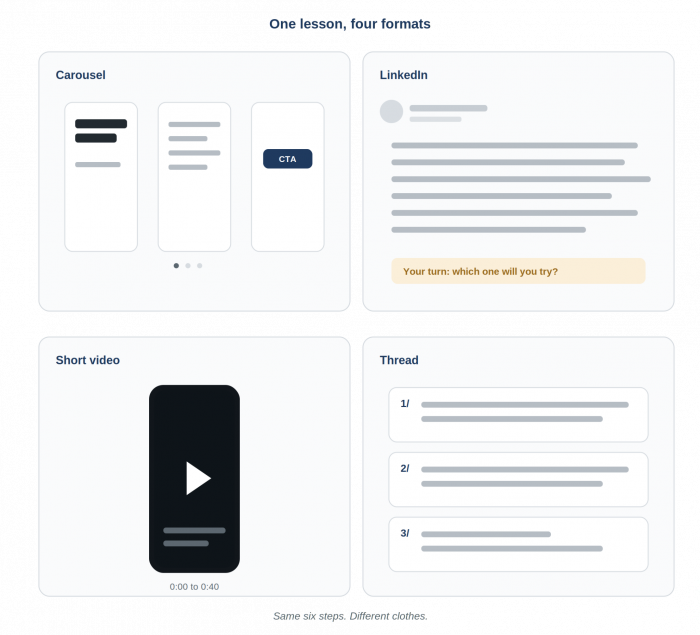
The six steps do not change from platform to platform. Their shape does. A carousel breathes across ten slides, while a short video sprints through the same arc in forty seconds. Below is how I map the structure onto the four places it earns the most for me. Keep the order from the framework in mind as you read, because every version is the same bones in different clothes.
Instagram carousels
The carousel is the format the six steps were practically built for, because each slide is its own beat. I use a ten-slide spine.
| Slide | What goes on it |
|---|---|
| Slide 1 | The hook. One line, big text, nothing else competing for the eye. |
| Slide 2 | The problem named, so the reader feels seen. |
| Slides 3 to 7 | The lesson, one teaching point per slide, with an example woven in. |
| Slide 8 | A one-slide summary they can screenshot. |
| Slide 9 | The takeaway, the single thing to do tonight. |
| Slide 10 | The ask, matched to your goal from Step 6. |
That screenshot-friendly summary slide is what drives most of the saves.
LinkedIn rewards a slower, more personal version of the arc. The hook becomes a confession or a small story. Instead of teaching cold, you teach through what happened to you. I open with the hook, tell a short true story, pull the insight out of it, state the lesson plainly, then end with a question that invites people to add their own version. The story is just the example from Step 4, moved to the front.
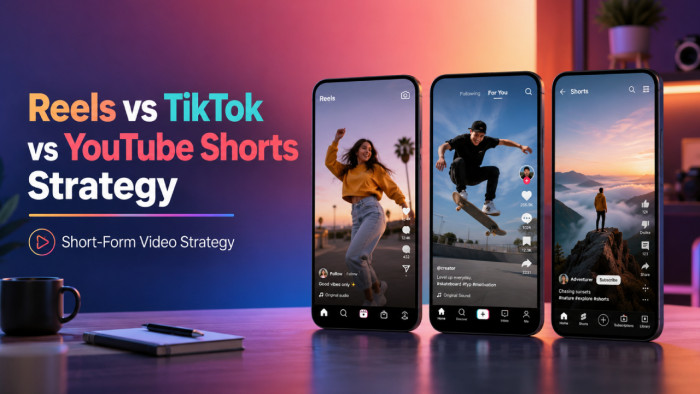
Short video: Reels and TikTok
Short video gives you no patience to spend. The same six steps survive, compressed hard. The first three seconds are the hook, and they have to land before a single word of setup. The next stretch names the problem fast. The middle delivers one idea with one example. The final few seconds are the ask. There is no room for a separate objective beat, so the hook and the objective fuse into one promise: "Here is how to fix your hook in fifteen seconds."
If your first three seconds need context to make sense, rewrite them.
Written threads
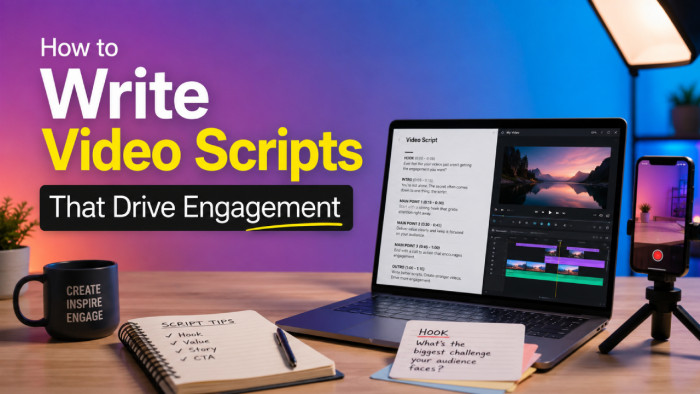
On a text thread, the opening post is your hook and your objective at once, and it has to stand on its own well enough that someone would stop even if they never expand it. Each post after that carries one point with its example, the way each carousel slide does. You close the thread the same way you close everything here, with a line worth quoting and one clear ask.
The mistakes that still catch me
A few traps do not show up inside the six steps, so they get their own mention here.
The first is writing for the version of you that already knows the topic. You drop a term or skip a step that feels obvious to you, and you lose the beginner who was your whole audience. Read your draft as someone who has never heard the idea. If a sentence needs a definition, give it the definition or cut the word.
The second is treating every post as a one-off. The single-idea rule from Step 3 has a happy side effect: each idea you split out becomes its own post, and a run of related posts becomes a series people start to follow on purpose. One post teaches a thing. A series builds an audience that waits for the next one. I ignored this for a year and left most of my growth on the table.
The third is rebuilding your structure every time the algorithm twitches. The format that earns saves outlasts the feed's mood.
Five templates you can fill in tonight
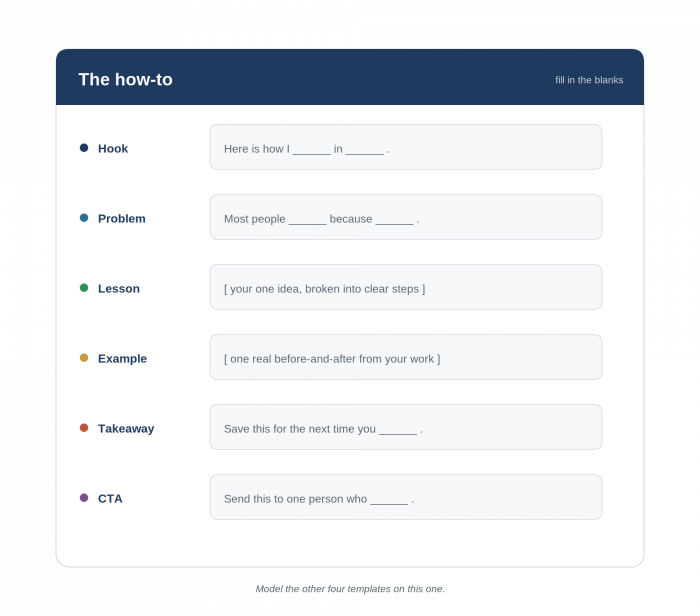
Everything above collapses into a handful of fill-in patterns. These are the five I reach for, each already shaped to the six steps. Drop your topic in and you have a draft.
The how-to. Hook with the result: "Here is how I [specific outcome] in [timeframe]." Name the problem it solves, walk through the steps as your one idea broken down, show a single example, then close with "Save this for the next time you [situation]."
The mistakes post. Hook on the cost: "[Number] mistakes that are draining your [thing]." Make each mistake a teaching point with a quick example of the fix, then ask people to share it with someone making mistake number one.
The framework post. Hook with the name: "The [memorable name] framework I use for [task]." Define the problem, lay out the framework as your one idea, show it applied to a real case, then hand over a one-line version to copy.
The case study. Hook with the headline number: "How [subject] went from [before] to [after]." Tell the story and pull out the single transferable lesson, then ask readers which part they would try first.
The myth-buster. Hook on the sacred cow: "Everyone says [common advice]. It is wrong, and here is what to do instead." Explain why the myth persists, give the better approach with proof, then ask who else needs to hear it.
Knowing whether it worked
You have published a structured post. Now read the right signals, because the obvious number lies. Likes feel good and tell you almost nothing about whether you taught anyone.
The metrics I actually watch tie straight back to the steps. Saves tell me the takeaway from Step 5 was worth keeping. Shares tell me the post was useful enough to risk a recommendation, which is the highest compliment a reader pays. On video, watch time and completion rate tell me whether the hook and the arc held, or where people dropped off. Profile visits tell me a single post made someone curious about everything else I do. Engagement rate measured against reach keeps all of it honest, since a small audience that saves and shares beats a big one that scrolls by.
If I had to watch one number, it would be saves. It is the closest thing to a reader saying "I will need this again."
Where this is heading
The structure is not going anywhere, but the surface it sits on keeps shifting, and a couple of changes are already here.
More creators are drafting with AI, which makes the structure more valuable, not less. When the words get cheap to produce, the thing that separates a post is judgment: which one idea, which example, which ask. A model can fill the template. Deciding what belongs in it is still yours.
Interactive formats are growing too, the polls and quizzes and posts that ask the reader to answer before the point gets revealed. Those lean straight on active recall from earlier, the principle that we remember what we are made to retrieve. The teaching frame stays the same. The reader just does more of the work, and remembers more of it because of that.
Platforms will keep renaming the formats and reshuffling the feed. A post that opens a gap and fills it with one well-shown idea, then asks for something specific, will keep working. It is built on how people pay attention, and that has not had an update in a long time.