The reason your captions get ignored has almost nothing to do with your writing.

The attention problem nobody talks about
I spent two hours on a caption once. I rewrote the opening line maybe nine times and checked every word before posting, certain I’d written something sharp. By the next morning it had pulled the same reach as a post I’d thrown up in thirty seconds while waiting for coffee. Same account. Same audience. Wildly different effort, identical result.
That stung enough to make me pay attention.
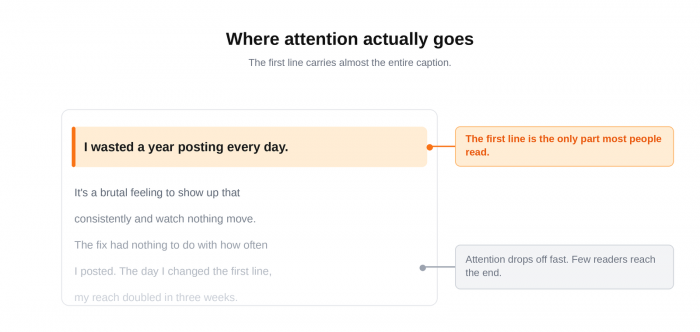
What I slowly worked out is the idea this whole article is built on. Most captions don’t fail because the writing is bad. They fail because of attention. People aren’t reading your caption and judging it weak. They’re deciding, in a fraction of a second, not to read it at all.
Open any feed and watch your own thumb. You’re not reading. You’re scanning, and your brain is making hundreds of tiny keep-or-skip calls before you’re even aware of them. A caption gets pulled into that same machinery. The first few words either earn a pause or get swept past with everything else.
This matters more now than it did a few years ago. Short-form video trained everyone to expect a payoff in the first second, and that expectation followed people back into every feed they touch. Your caption competes with that reflex.
Here’s what I want to hand you by the end. The psychology that decides whether someone stops. The exact hook patterns strong creators reuse without telling anyone. A formula I built for myself that turns all of it into something repeatable, plus a platform-by-platform breakdown so you know which version of a hook belongs on Instagram versus LinkedIn. We’ll also rewrite a stack of weak captions into strong ones so you can watch the moves happen.
We start with the failures, because once you can see why a caption dies, the fixes stop feeling like tricks and start feeling obvious.
Why most captions fail (the real reason)
When I went back through my flops, the same handful of habits kept showing up. None of them were about vocabulary or grammar. They were about what I put first and how soon.
The first habit was burying the hook. I’d open with the setup. Context. A little throat-clearing before the real point, something like “So over the past few weeks I’ve been thinking a lot about my morning routine and…” By the time the interesting part arrived, the reader was gone. Attention is front-loaded. Whatever sits first is the only thing most people will ever read, so spending that slot on warm-up is how you lose them.
The second was writing to sound clever instead of clear. I wanted lines that felt witty, so I reached for wordplay that needed a second read to land. A confused reader doesn’t give you that second read. They scroll. Clarity beats cleverness whenever someone’s in a hurry, and on a feed everyone is.
The third was opening with no emotion. A flat, factual first line gives the brain nothing to care about. “Here are five tips for better sleep” is information. It’s also forgettable. Nothing in it tugs.
The fourth was explaining too much, too early. I’d answer the whole question inside the first line, which feels helpful and quietly kills the reason to keep reading. If the opening already tells you everything, the rest is just confirmation, and confirmation doesn’t hold anyone.
The fifth, and the one that took me longest to see, was leaving no gap. No open question. No reason to believe the next line was worth reaching. Without that pull, even a clean, well-ordered caption stalls.
Two smaller habits rode along with these. I crammed several ideas into one caption, so none of them landed with force. And I overwrote, padding lines that would’ve hit harder cut in half.
The pattern underneath all of it is simple. Captions don’t fail at the writing level. They fail at the attention level. You can fix every grammar issue in a weak caption and it’ll still die, because the problem was never the prose. Once that clicked, I stopped editing for polish and started editing for attention, which meant I had to understand what makes a person stop.
The psychology behind scroll-stopping captions
Stopping a scroll is a physical act you’re trying to trigger in someone else’s body. To do it on purpose, it helps to know what the brain responds to. Four forces do most of the work.
Pattern interrupt comes first. A feed is a rhythm, and the brain loves rhythm because rhythm lets it run on autopilot and save energy. A scroll is that autopilot in motion. Anything that breaks the expected beat forces a half-second of conscious attention, and that half-second is your whole opportunity. A caption that sounds like every other caption gets absorbed into the pattern. One that contradicts an expectation, or opens mid-thought, snaps the reader awake.
The second force is the curiosity gap, and it has real science under it. In the 1920s a psychologist named Bluma Zeigarnik noticed that waiters remembered unpaid orders in sharp detail and forgot them the moment the bill was settled. Open loops stay loud in the mind. Closed ones go quiet. That finding, now called the Zeigarnik effect, is the engine behind every caption that makes you need the rest of it. When your first line opens a loop the reader can’t close on their own, their attention stays snagged until they get the answer.
Closely tied to this is our need for closure, a drive the psychologist Arie Kruglanski studied in depth. People carry a built-in discomfort with open questions. We want them resolved, and we’ll keep reading to make that happen. A good caption uses that discomfort on purpose. It raises a question early, then makes you move down the page to quiet the itch.
The fourth force is emotion, and in the opening moment it outranks information. Before anyone weighs whether your content is useful, they feel something or they feel nothing. Nothing means they scroll. The emotions that reliably stop people come from a small set of sources. A pain the reader recognizes. A desire they hold quietly. The pull of identity, the sense that this is about people like them.
These four are the levers. Pattern interrupt buys you the half-second. The curiosity gap and the need for closure keep the reader moving once they’ve stopped. Emotion decides whether they care at all. Every hook that works is one or more of these being pulled on purpose, which is exactly what the next section breaks down.
The five core hook triggers
Once I started seeing captions as levers instead of sentences, the good ones sorted themselves into a small number of repeating shapes. Five of them do most of the heavy lifting across every platform I’ve tested, and each one pulls on a force from the section above.
Before the five, one rule sits over all of them. The opening words carry almost the entire weight. Most people decide whether to keep reading inside the first three to seven words, before they’ve consciously processed the sentence. Put the tension there. A brilliant line in position eight is a line nobody reaches.
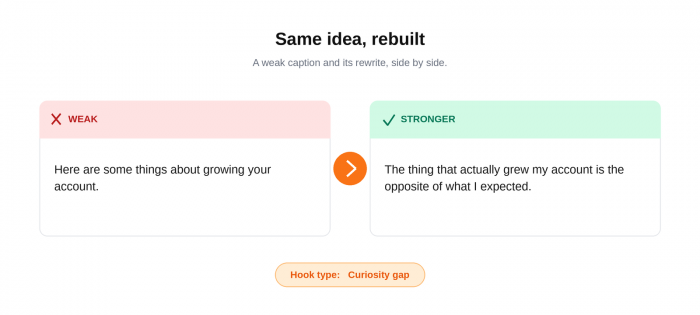
The curiosity hook opens a loop and refuses to close it right away. “Nobody talks about this part of growing an account.” You now want to know which part. Weak version: “Here are some things about growing your account.” Strong version: “The thing that actually grew my account is the opposite of what I expected.” The second one leaves a gap your brain wants filled.
The identity hook speaks straight to who the reader thinks they are. “If you’re trying to grow online and feel invisible, read this.” A specific person feels personally addressed and stops. Weak version: “Growth tips for everyone.” Strong version: “For the creator who posts consistently and still hears crickets.” The narrower the mirror, the harder it grabs whoever’s looking into it.
The contradiction hook attacks an assumption the reader holds. “Consistency is overrated.” That collides with advice they’ve heard a hundred times, and the collision is pattern interrupt firing. Weak version: “Consistency matters, but so does quality.” Strong version: “I posted every day for a year. It did almost nothing.” Tension forces a reaction, and a reaction means they’ve stopped.
The pain amplification hook names a frustration the reader already feels and presses on it. “This is the reason your posts get ignored.” It stings in a way that’s hard to scroll past, because the reader needs to know whether they’re guilty of it. Weak version: “Some posts get less engagement than others.” Strong version: “Your captions are losing people in the first line and you can’t see it happening.” Specific pain beats vague observation.
The transformation hook promises a journey from where the reader is to where they want to be. “How I went from posting into the void to my first ten thousand followers.” Before-and-after is hard to resist because it offers proof the gap is crossable. Weak version: “My growth journey.” Strong version: “Eight months ago nobody saw my work. Here’s what changed.” The reader sees their own possible arc inside yours.
Notice that every strong rewrite does something mechanical, not magical. It opens a loop or breaks an expectation. The hooks are interchangeable parts, which raises an obvious question. How do you assemble them into a full caption that holds up past the first line? That’s the formula I promised, and it’s next.
The scroll-stopping caption formula
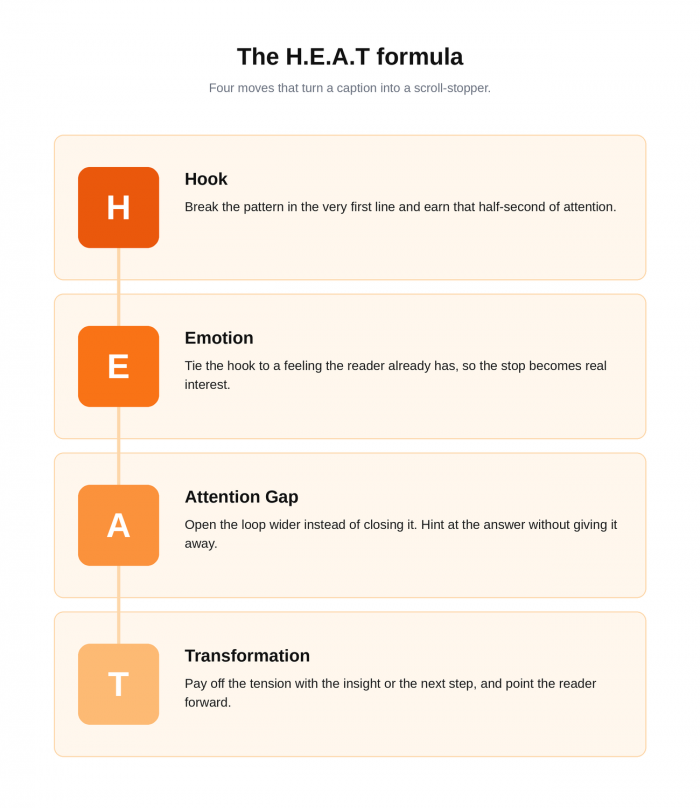
I needed something I could run on a tired Tuesday with no inspiration, so I reverse-engineered the captions that worked for me into four moves. I call it the H.E.A.T formula, partly because the name is easy to remember and partly because heat is exactly what a caption needs in its first second.
H is for Hook. The first line breaks the pattern. It uses one of the five triggers above to buy that half-second of attention. This is the most important line in the whole caption, and it deserves more of your editing time than everything else combined.
E is for Emotion. Right after the hook lands, the second beat makes it personal. It ties the disruption to something the reader feels, so the stop turns into real interest instead of a passing glance.
A is for Attention Gap. Here you widen the loop rather than close it. You hint at the answer without handing it over, which keeps the reader moving down toward the payoff.
T is for Transformation. The close delivers. It pays off the tension with the insight or the next step, so the reader leaves feeling the time was worth it and ties that feeling to you.
Stacked together, the four moves look like this in a real caption:
“I wasted a year posting every single day. [Hook, contradiction.] It’s a brutal feeling to show up that consistently and watch nothing move. [Emotion, pain and identity.] The fix had nothing to do with how often I posted. [Attention gap, the loop widens.] The day I started writing the first line for the scroll instead of for myself, my reach doubled in three weeks, and here’s the exact change. [Transformation, payoff plus a reason to read on.]”
Read it without the labels and it flows as one natural thought. That’s the point. The structure disappears, and what’s left feels effortless, which is the tell of a caption that was engineered.
The four moves hold everywhere, but the way you play them shifts from platform to platform, which is where we go next.
Platform-specific hook strategy
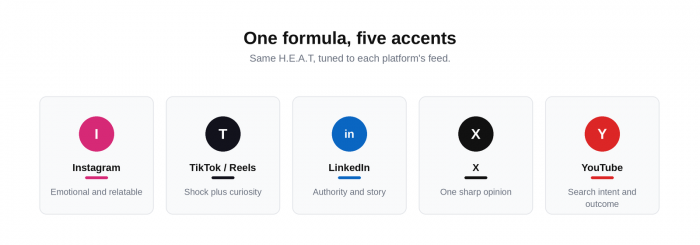
The formula stays constant across platforms. The flavor of each move changes, because each platform trains its audience to scroll a little differently. Same H.E.A.T, different dial settings.
Instagram. The hook leans emotional and relatable here, and identity does a lot of the lifting. People move quickly and respond to captions that sound like a friend talking, so a first line naming a shared feeling beats a clever one. “I almost deleted this post three times” holds more people than a polished thesis statement.
TikTok and Reels. The caption supports a hook that has to fire in the first second of the clip itself. Curiosity with a touch of shock works best, and the boldest honest claim you have belongs up front. Tension in the opening beat isn’t optional, because the platform hands your video to the next creator the instant attention dips.
LinkedIn. The register shifts toward authority and earned insight. The pain points are professional, tied to careers and credibility, and the strongest hooks open a short story from lived experience. “I got rejected from the job I now interview people for” stops a professional feed cold, because it pairs vulnerability with authority.
X. The winning hook is usually an opinion stated with conviction. Contrarian takes travel well here, and one sharp line outperforms a paragraph. The platform rewards a stance, so a caption that hedges gets ignored while one that plants a flag gets quoted.
YouTube. The hook bends toward search intent and a clear outcome. People often arrive with a problem already in mind, so framing the caption and the title around that problem and the result they want pulls them in. “How I edit a video in half the time” promises a specific outcome to someone already looking for it.
Same four moves, five different accents. To make the difference concrete, the next section takes weak captions apart and rebuilds them, platform by platform, so you can watch the dials turn.
Swipeable examples
Theory holds up only when you can watch it move. Below are captions I’ve written or watched others post, weak versions next to the rewrite, grouped by where they live. Read the weak line first and feel your attention slide off it. Then read the rewrite and notice the pull.
Weak: “Excited to share my new morning routine with you all!”
Stronger: “I changed one thing about my mornings and stopped dreading 6 a.m.”
Weak: “Here are my thoughts on productivity.”
Stronger: “I was busy for years and got almost nothing real done. Here’s what finally changed.”
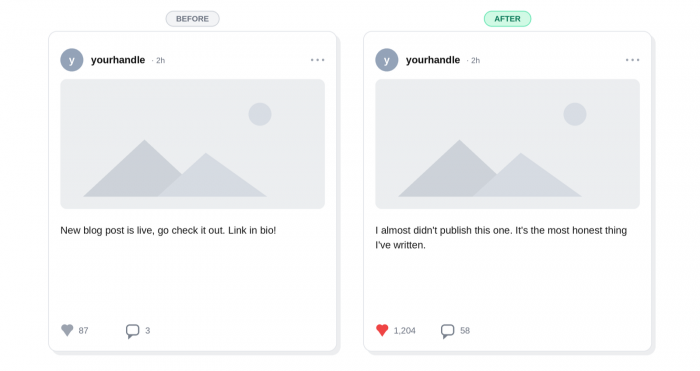
Weak: “New blog post is live, go check it out.”
Stronger: “I almost didn’t publish this one. It’s the most honest thing I’ve written.”
TikTok and Reels
Weak: “Tips for editing your videos faster.”
Stronger: “You’re wasting hours editing. One setting fixes it.”
Weak: “A day in my life as a creator.”
Stronger: “Everyone thinks this job is glamorous. Watch what it actually looks like.”
Weak: “Some lessons I learned over my career.”
Stronger: “I got fired once. It taught me more than any promotion ever did.”
Weak: “Happy to announce I’ve joined a new company.”
Stronger: “Two years ago I was unemployed and doubting everything. Today I started a role I once thought was out of reach.”
X
Weak: “I think consistency is somewhat important for growth.”
Stronger: “Consistency is the most overrated advice in this entire space.”
Weak: “Here’s a thread about writing better.”
Stronger: “Most writing advice quietly makes you worse. A short thread.”
One more layer separates a caption that earns a stop from one that gets read all the way through. The hook earns the pause. Something else keeps the reader moving line after line, and that’s the last piece.
The micro-rewards that keep people reading
A hook gets someone to stop. It doesn’t get them to finish. The captions that hold people all the way down do something quiet after the opening. They pay out in small installments.
Think of attention as something you rent one line at a time. Each line has to earn the next. You do that by giving a partial answer that satisfies a little and opens a little more, then doing it again. These small hits of satisfaction are part of how reward learning works, and you can feel it in any caption you read to the end without deciding to. You kept going because each line handed you a tiny payoff and a fresh reason to continue.
This is the grown-up version of the curiosity gap from earlier. Instead of one loop opened at the top and closed at the bottom, you stack several small loops down the length of the caption. Answer part of the question. Raise a slightly bigger one. Resolve it. Point at something better just ahead.
There’s a line you shouldn’t cross. Withholding the payoff forever, or promising something the caption never delivers, is clickbait, and readers feel cheated fast. The goal is generosity with a thread of tension running through it.
All of this still serves one goal, the one you came here for, and that’s where this ends.
Attention is the real algorithm
Here’s the part that ties a caption to the thing you wanted the whole time, which was never captions. You want reach. You want the post to travel.
Every platform measures attention and feeds more of it to whatever holds attention. Watch time and the seconds before someone scrolls past are signals the platform reads constantly. A caption that stops the scroll and holds it isn’t a decoration on top of good content. It’s a direct input into how far that content spreads. When you make someone pause and read, you send the platform a message that says show this to more people.
So the work you put into a first line pays off far past the line itself. It compounds. A better hook earns a longer read, a longer read earns wider distribution, and wider distribution earns the views you were chasing all along. The caption is the smallest lever with the longest reach.
Which is why the real skill here was never writing. It’s attention. You sit down to engineer the first second of someone else’s experience, and the line is just the tool you do it with. Get that first second right, and the algorithm stops being something you fight and turns into something that carries you.