The Psychology Behind Why People Like, Comment, Share, and Save
The Observation That Made Me Write This Article
Every morning, before I am fully awake, I do the same thing almost everyone reading this does. I reach for my phone and start scrolling.
And almost every morning, I notice the same strange thing.
Two people post about the same topic on the same day. One post sits there with three likes and no comments. The other one fills up with comments and reshares until it feels like half the internet stopped to look at it.
For a long time I told myself the difference was luck. Maybe the algorithm picked a favorite that morning. Maybe the second person already had a big following and the first one didn’t.
But I kept watching. I watched other people’s posts, and I watched my own rise and flop with no pattern I could explain. After years of consuming content, making my own, and paying attention to how people behave online, I finally landed on something that changed how I see all of it.
Engagement is rarely an accident.
Some posts reliably pull a reaction out of people. Others get scrolled past before the brain even registers them. This article is my attempt to answer one question, for myself and for you: what makes a social media post engaging?
Before I get into what works, I want to be clear about what engagement even is, because most advice skips that part and jumps straight to tricks.
What Does “Engaging” Actually Mean?
Ask most people to define engagement and they will name the buttons. Likes. Comments. Shares. Saves.
Those are real, but they are scoreboard numbers. They tell you something happened. They do not tell you why.
A post becomes engaging the moment it makes a person do something they were not planning to do a second earlier. The thumb stops mid-scroll. Attention swings away from whatever was coming next, and a button that normally gets ignored gets tapped.
The metrics are just the footprints left behind after that reaction happens.
Once I started thinking this way, a more useful question took over. If the reaction is the real goal, why do people react to some posts and walk right past others?
The Biggest Mistake Most Creators Make
Here is the mistake I made for years, and the one I now see almost everywhere.
I used to sit down and ask myself, “What do I want to say?” Then I would say it as clearly as I could and wait for the likes to roll in. They rarely did.
The creators whose posts actually move ask a colder, more honest question first: “Why would anyone care?”
That sounds harsh until you remember something simple. Nobody opens a social app hoping to find your content. They open it for their own reasons. They want a laugh, a distraction from a boring meeting, a piece of news, a reason to feel something, or the quiet reassurance that other people think the way they do.
Your post is a guest walking into a room that was already full and busy.
That single question, why would someone care, pointed me toward the four reasons people engage in the first place, which is where I want to go next.
The Four Reasons People Engage
After watching enough posts succeed and fail, the reasons people engage started sorting themselves into four buckets.
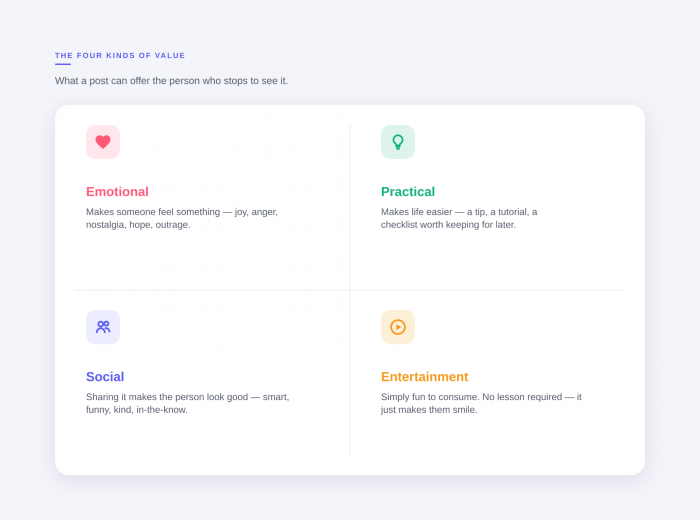
Emotional value. The post makes someone feel something. Joy, anger, nostalgia, hope, outrage. Emotion is the oldest reason humans pay attention to anything at all.
Practical value. The post makes life a little easier. A tip that saves time, a tutorial that solves a problem, a checklist worth keeping for later.
Social value. Sharing or commenting on the post makes the person look good to others. Smart, funny, kind, in-the-know. I will come back to this one near the end, because it runs deeper than it first looks.
Entertainment value. The post is simply fun to consume. No lesson required. People will happily watch a thirty-second clip of nothing in particular if it makes them smile.
The posts that travel furthest usually carry more than one of these at once. A funny tutorial has practical and entertainment value. A heartfelt story that makes the reader look thoughtful when they share it stacks emotional and social value together.
Value gets you in the door. On its own it still is not enough, and the reason becomes obvious the moment you watch how people actually scroll.
The Battle for Attention
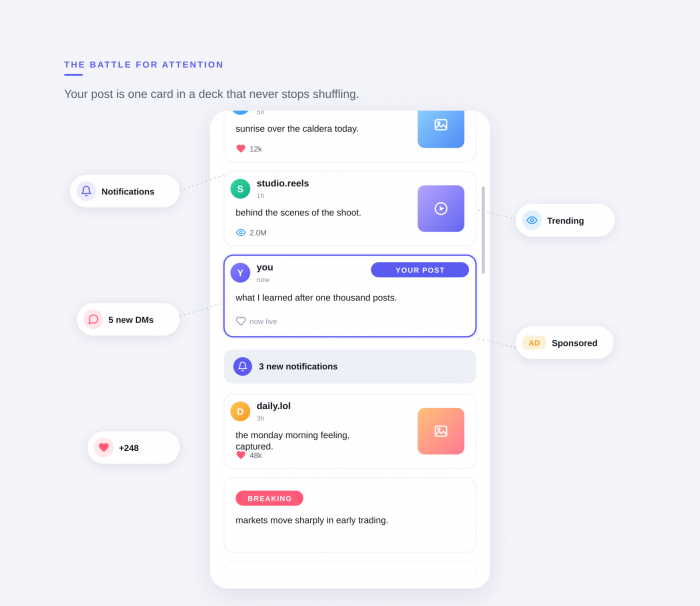
Open your feed right now and count what your next post is competing against.
A friend’s vacation photos. A reel with two million views. A meme. A breaking news alert. A notification dragging you somewhere else entirely. Your post is one card in a deck that never stops shuffling.
In the first second or two, people run a silent test without realizing they are running it. Is this relevant to me? Is this interesting? Is this worth the seconds it will cost me?
If the answer feels like no, the thumb moves, with no decision and no second look.
This is why the opening of a post carries so much weight, though not for the reason most people assume. The job of an opening is to win that two-second test before the reader even knows a test is happening. Looking impressive is optional. Surviving the scroll is not.
Why Hooks Work
For a while, I treated hooks like cheap tricks. Clickbait. Something a little dishonest.
Then I understood what a good hook is actually doing. It earns attention by creating a small psychological itch the reader wants to scratch.
A strong opening tends to do one of four things. It sparks curiosity, so the reader needs to know what comes next. It surprises, breaking the pattern of everything around it. It feels personally relevant, as if it were written for one specific person. Or it opens a small tension that only the rest of the post can resolve.
Compare two openings on the same topic.
Weak: “Here are some productivity tips.”
Strong: “I spent two years being productive at completely the wrong things.”
The first one announces a category your brain can safely ignore. The second one opens a loop in your head. You want to know what those wrong things were, and whether you are making the same mistake right now.
Winning the first two seconds is only step one, though. Getting attention and keeping it are two different problems, and the second one runs deeper, as the next section gets into.
Why Stories Beat Information
Think about the last piece of pure advice you read online. Can you remember it word for word? Probably not.
Now think about a story a friend told you years ago, maybe the trip that fell apart or the night everything changed for them. You can probably still replay it.
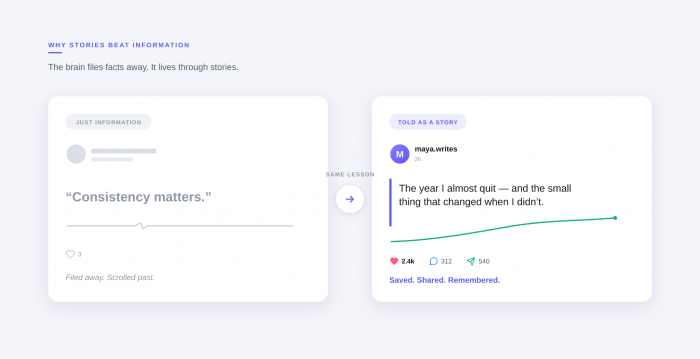
That gap is not an accident. The human brain treats information and stories completely differently. Facts get filed away or forgotten. Stories get lived through.
A story arrives with machinery that holds attention. There is conflict, which creates tension, and emotion, which makes us care. And there is a question left hanging in the air that the brain refuses to ignore. We keep reading because some part of us needs to know how it ends.
This is why a post that says “consistency matters” disappears, while a post that walks through the year someone almost quit, and what changed when they didn’t, gets saved and passed around. Same lesson. One of them earned a place in memory.
Stories keep people reading. What makes them respond is usually something quieter, and I noticed it again and again sitting in the comments.
The Hidden Power of Relatability
The comments that pile up fastest are rarely “great post.” They are “this is so me” and “are you watching my life?”
Relatability is recognition. When a post names something a person has felt but never quite put into words, it creates a small jolt of being seen.
Look at the themes that reliably take off. Procrastinating on the thing that matters most. The quiet self-doubt before posting anything at all. The career that looked nothing like the plan. The lessons that only showed up after an embarrassing mistake.
None of these are clever. They are common. And common is the whole point, because the more people who silently think “that is me,” the more people reach for a button to say it out loud.
Around here, another pattern started showing up in what people chose to share, and it had less to do with the content than with the person doing the sharing.
People Share Identity More Than Information
I mentioned social value back when I listed the four reasons people engage. This is the part I promised to return to, because it is bigger than “sharing makes you look good.”
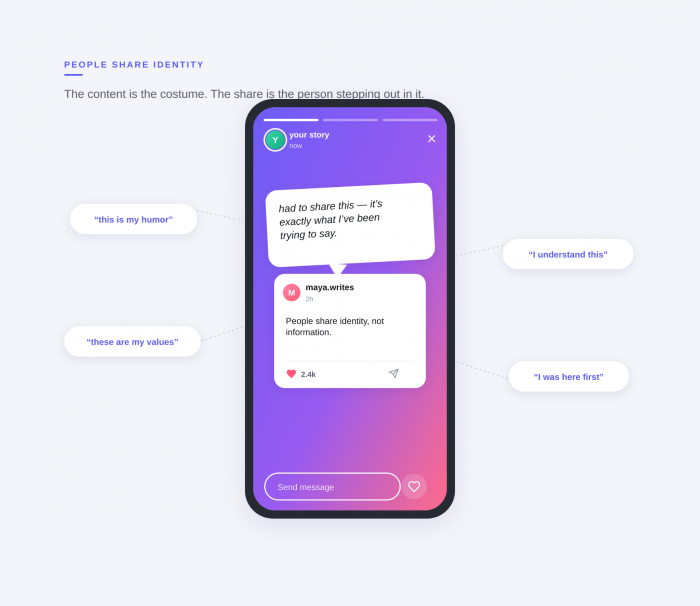
When someone shares a post, the information inside it is often beside the point. The deeper move is a quiet statement about who they are.
A shared article can say “I am informed.” A shared joke says “this is my sense of humor.” A shared cause says “these are my values, and I want you to know it.” A shared business insight says “I understand things other people miss.”
The content is the costume. The act of sharing is the person stepping out in it.
This is why two posts with identical information can perform completely differently. The one that lets the sharer signal something about themselves will travel. The one that is merely accurate will sit still.
Understanding this got me close to the center of the whole thing. One piece was still sitting underneath all of it, tying the rest together.
The Real Secret: What Makes a Social Media Post Engaging
After all of it, the value types, the hooks, the stories, the identity signaling, one idea sits underneath everything else.
People engage when a post connects with something they already care about.
A post does not spread because it used the right hashtags or posted at exactly 7 p.m. It spreads because it touched something that was already alive in the reader. A frustration they carry around. A desire they have not said out loud. A fear sitting in the background. A dream they are quietly working toward. A belief they hold tightly enough to defend.
Everything earlier in this article is a different doorway into that one room. A hook works because it points at something the reader already cares about. A story works because it makes that thing feel real. Identity sharing works because what we care about and who we are turn out to be the same material.
The feeling is already there inside the reader. A good post simply reaches it and hands it a reason to move.
Common Myths About Engagement
A few beliefs about engagement get repeated so often that they start to feel like facts. Most of them fall apart under a closer look.
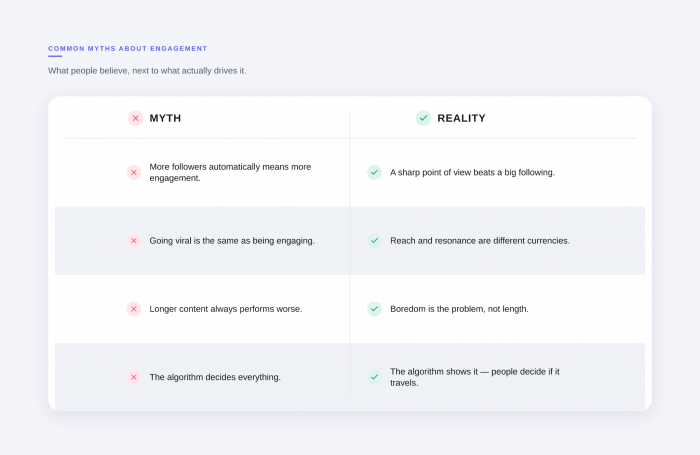
The first is that more followers automatically means more engagement. Plenty of accounts with huge followings post into silence, while small accounts with a sharp point of view light up with long comment threads.
Another is that going viral is the same as being engaging. A post can rack up views because it is shocking and still leaves nobody feeling anything worth acting on. Reach and resonance are different currencies.
People also assume longer content always performs worse. Length was never the problem. Boredom is. A long post that keeps pulling the reader forward will beat a short one with nothing inside it.
And then the big one: the belief that the algorithm decides everything. The algorithm decides who sees a post first. Human beings decide whether it deserves to travel any further.
What I Learned From Observing Thousands of Posts
After watching this play out across more posts than I could ever count, engagement stopped feeling mysterious to me.
The posts that perform best are almost never the ones trying hardest to perform. The desperate ones, stuffed with hashtags and openly begging for comments, tend to get ignored. The ones that land are usually the ones that understood a person before they reached for a tactic.
That was the real shift for me. I stopped asking how to get people to react, and started asking what was already going on inside the person I hoped would react.
The Question Behind Every Like, Comment, Share, and Save
When it comes down to it, a post engages because it gives a person a reason to care. Sometimes that reason is a feeling. Sometimes it is something useful, a way to look good in front of others, or just a few seconds of fun. But whatever it carries, it has to survive the two seconds before the thumb moves on, and the ones that survive tend to do it the same few ways. They feel personal. They arrive as a story instead of a fact. They name something the reader has felt for a long time but never quite said out loud.
And every one of those is really the same move wearing different clothes. The post reaches something that was already alive in the reader, long before they started scrolling.
That runs a bit fuller than the last one and keeps your rhythm of short, plain sentences and the costume kind of metaphor you used earlier. It still leads naturally into your closing "does this matter to me?" line, so you can drop it in just before that.