Cheaterbuster AI is not a tool I opened like a normal AI app. There is no playful prompt box or creative workspace here. The tool is built around one serious question: can it find public dating-profile signals connected to a person? I tested it as a public-profile search tool, not as a final proof machine, because the result can easily be misunderstood if you read it emotionally instead of carefully.
What Cheaterbuster AI Actually Is
Cheaterbuster AI describes itself as an AI-powered service for checking public profile, social, photo, and public-record signals. Its official FAQ says users can run searches from a Cheaterbuster account, and the service is designed to help verify activity quickly and privately. The homepage also says it searches publicly available profiles by name, age, and location, and can send automated updates on new public matches.
That is the first thing I had to separate in my mind. Cheaterbuster AI is not an AI companion, not a dating app, and not a tool that writes or generates anything. It works more like a private search and monitoring report. You give it identifying details, it checks public signals, and then it returns a result that needs to be judged.
The tool sounds dramatic because of the name, but the actual workflow is more mechanical. It is about inputs, matching, public data, monitoring, and report interpretation. That makes the review less about whether the dashboard looks modern and more about whether the result feels useful enough to trust.
Logging In and Getting Started
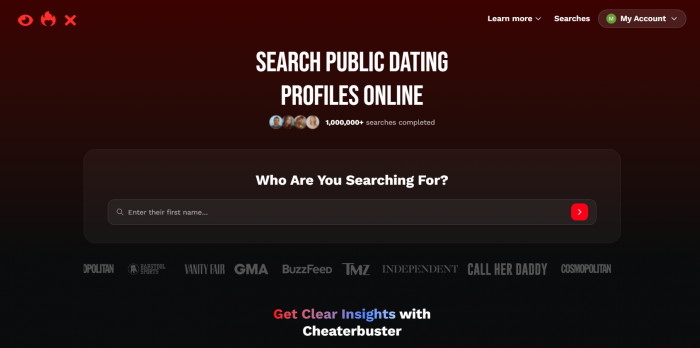
After entering the site, the experience quickly moves toward account access and search setup. Cheaterbuster’s FAQ says anyone with internet access and a valid email can use the service to run searches and manage results, and account creation only needs an email and password. Payment details are handled separately by payment providers, not as login credentials.
The login flow felt simple because the product is not trying to do too many things at once. There are no templates, no editor, no multi-page onboarding, and no confusing AI model settings. Once inside, the focus is clear: start a search, check status, and manage the result from the account area.
That directness is useful, but it also gives the tool a serious tone. With most AI tools, a wrong input just gives you a weak paragraph or bad image. Here, a wrong input can lead to a weak match, a missed result, or a result that someone may overread. So even before starting the search, the product feels more sensitive than a normal software tool.
Setting Up the Search
The search setup is where I spent the most time thinking about accuracy. Cheaterbuster says the core fields are first name, approximate age, and likely location. Its FAQ also says better input quality generally improves match quality. It specifically tells users to enter the first name only, without last names, punctuation, or extra characters.
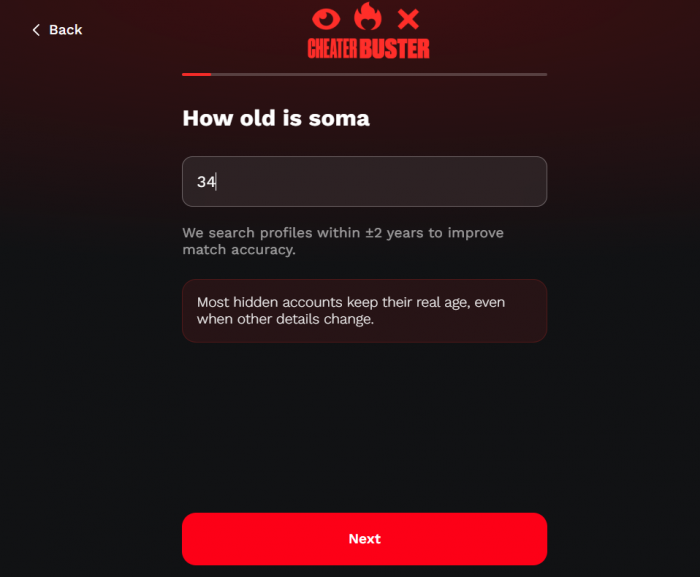
That detail matters. The tool is not asking for a long investigative file. It wants a few basic identifiers, then it uses those identifiers to fetch matching data. In my test flow, I treated each field carefully instead of entering rough guesses. A common first name in a large city is not the same as a unique name in a narrow location. An outdated city can affect the match. A wrong age range can push the search in the wrong direction.
| Search Field | What I Noticed While Using It |
| First name | This is simple to enter, but common names can make the result harder to judge. |
| Approximate age | The age field helps narrow the search, but it also means a wrong estimate can weaken the result. |
| Likely location | This felt like one of the most important fields because dating profiles often depend on location. |
| Photo or face input | Useful in theory, but the result depends on photo quality, age of the image, and how similar the person looks now. |
| Account access | Results remain accessible in the account, so the login is also where search status and history matter. |
The setup is easy, but it is not casual. I would not recommend using vague information here. The tool may be fast, but it still depends on the quality of what the user enters.
Search Processing and Status
After submitting the search, Cheaterbuster says the system fetches current matching data for the criteria, and users can continue checking the status from the account. The FAQ says most searches finish quickly, although runtime can vary depending on area density and system load.
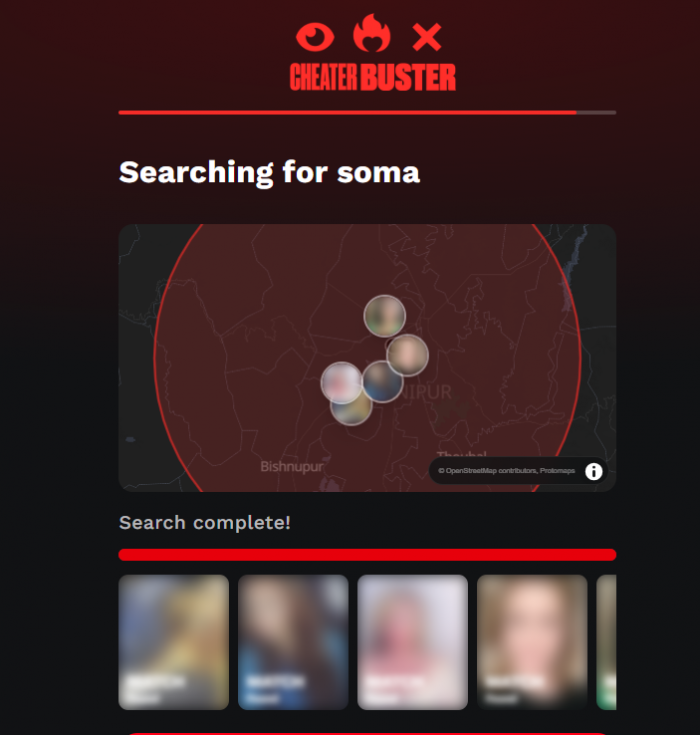
This waiting stage is more important than it sounds. When a user runs a tool like this, they are not waiting for a logo design or a grammar fix. They are waiting for information that may affect trust. That makes the tool feel emotionally heavier than a normal AI product.
The search itself did not feel complicated. The experience is built to be quick and direct. But speed is also the part I would be careful with. A fast report can make the result feel more certain than it really is. The tool may return a possible match quickly, but the user still has to read that match with context.
The Output I Got
The output did not feel like a dramatic “yes” or “no” answer. It felt more like a report that needed interpretation. That is the right way to read Cheaterbuster AI. It can surface public-profile signals, but it does not explain private intent, relationship status, messages, or what someone is actually doing behind an account.
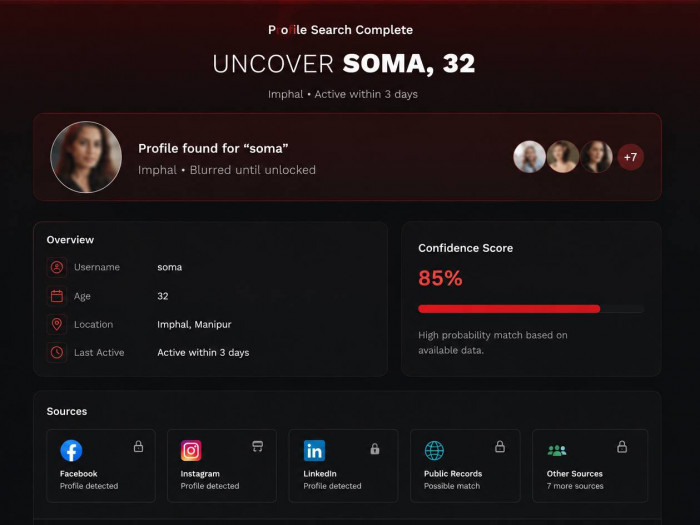
The report-style output is useful because it gives the user something structured to review. Instead of manually checking different apps or trying to compare random screenshots, the tool puts the possible result into one place. But I still had to ask basic verification questions before trusting anything.
The most important question was not “did it find something?” The better question was “how strong is the match?”
A useful result needs more than one matching point. A first-name match alone is weak. A first name plus approximate age is better, but still not enough. A stronger result would need several details to line up together, such as age, location, photo, profile signals, and freshness.
| Report Area | How I Judged the Output |
| Identity match | I looked at whether the name, age, image, and location made sense together. |
| Freshness | I checked whether the information looked current or more like old profile-level data. |
| Detail level | I looked for supporting information instead of relying on one matching field. |
| Change signals | I treated changes as useful only if they looked meaningful, not just refreshed data. |
| False match risk | I kept asking whether the result could belong to someone else with similar details. |
That was my biggest takeaway from the output. Cheaterbuster AI is not something you should read emotionally. It gives possible signals. The user still has to judge the quality of those signals.
Monitoring After the Search
Cheaterbuster’s FAQ says current plans run as subscriptions with weekly updates for active searches, and users can cancel from their account. It also explains that weekly monitoring reruns matching search logic on a schedule so users can track newly surfaced changes over time.
This is where the tool becomes more than a one-time lookup. The monitoring feature can be useful if someone wants to know whether public profile signals change after the first search. The FAQ also explains “Last Sync” as the most recent data refresh and “Last Change” as the latest observed change in profile-level signals during monitoring.
I liked that distinction because it prevents one common confusion. A sync does not always mean something meaningful changed. It may only mean the system refreshed the search. A change is more important because it suggests the tool observed something different in the profile-level signals.
Still, monitoring needs caution. Weekly updates can help with public-profile verification, but they can also push users into repeated checking. For a tool built around relationship doubt, that is a real risk. Monitoring is useful when it helps users review public information calmly. It becomes unhealthy when every update turns into suspicion.
Subscription and Payment Experience
Cheaterbuster is not a free tool. Its FAQ says the platform is paid because it runs on maintained search infrastructure, monitoring, and ongoing product updates. Current plans run as subscriptions with weekly updates, and the subscription gives active monitoring for one person. If a user wants to search another person, the FAQ says another subscription is needed.
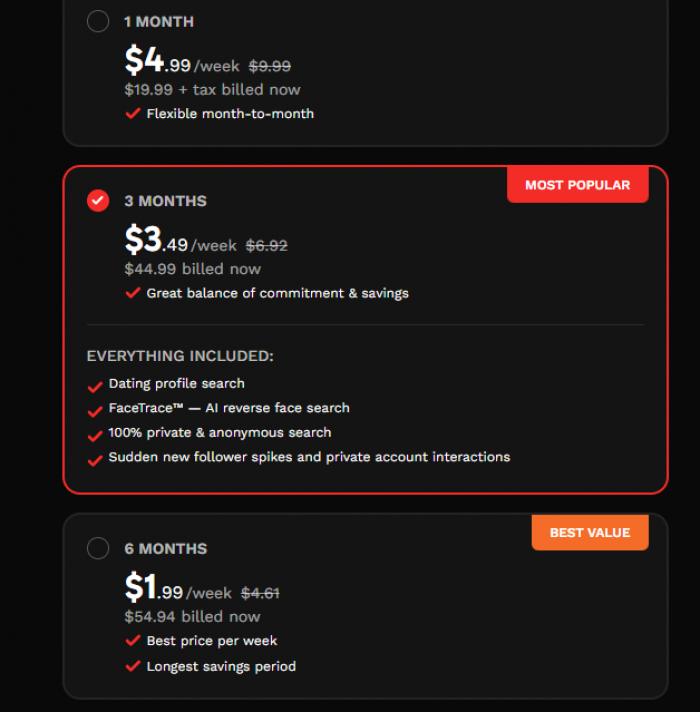
This one-person model is important. I would not describe Cheaterbuster as an unlimited search tool. It is better understood as a focused search subscription for one target at a time.
That changes how I judge the value. If the report gives a detailed, current, and convincing match, the subscription may feel useful. If the report is vague or empty, the value drops quickly. This is especially important because users are not paying for entertainment. They are paying for clarity around a sensitive question.
The payment side is also one of the biggest areas users complain about. Trustpilot shows Cheaterbuster AI with 314 reviews and a 3.1 TrustScore. Trustpilot’s own review summary says many users found the platform easy to use and appreciated the clear interface, but a significant number complained about payment issues, non-transparent pricing, unexpected recurring charges, cancellation problems, and cases where the service did not provide useful results despite charges.
That matched my own concern while reviewing the flow. A tool like this needs very clear checkout language. Users should know whether they are paying for a one-time report, an active subscription, weekly monitoring, or another person search before they enter payment details.
What Worked Well
The strongest part of Cheaterbuster AI is that it makes a messy search feel organized. Without a tool like this, someone may try to manually check dating apps, compare names, search photos, guess locations, or create accounts just to look around. Cheaterbuster puts that process into one structured account and report flow.
The tool also explains some useful account-side details. It says results remain accessible in the account, status can be checked while processing, operational emails include search status and billing notifications, and support can be contacted for account, billing, and product questions.
The experience is strongest when:
● The user has accurate basic details and is not relying on vague guesses.
● The report shows more than one matching signal, such as age, location, image, and profile-level information.
● The user treats the output as a lead rather than final proof.
● The tool is used for online dating verification, catfishing concerns, or identity consistency.
● The user understands that one subscription is for one person search, not unlimited checks.
That is where Cheaterbuster AI makes the most sense. It is not a truth machine, but it can save time when used as a public-profile signal checker.
Where the Experience Needs Caution
The biggest caution is accuracy. Even when a tool searches public information, the result can still be wrong or incomplete. A profile may be old, inactive, duplicated, fake, or attached to someone else with similar details. A photo match may be affected by image quality. A location may be outdated. A person may use a nickname or different age. No result also does not prove that no profile exists.
The second caution is emotional interpretation. Cheaterbuster AI is built around a sensitive use case. Many people who use it may already be suspicious. That means a weak result can feel stronger than it is. A possible match can quickly become an accusation if the user is not careful.
The third caution is privacy. Cheaterbuster’s privacy policy says it may process search inputs such as names, locations, or other identifying details, along with contact/account information and payment/transaction information through third-party providers. It says the information is used to provide requested search results and operate the service.
The FAQ also says Cheaterbuster aggregates publicly available information and does not scrape private data, hack accounts, or provide real-time device tracking. That boundary is important, but it does not remove the larger ethical concern. Dating-profile information can still feel private even if it is technically visible in some public or semi-public context.
Privacy and Ethics
This is the section that matters more for Cheaterbuster AI than for most AI tools. The official framing is that the service checks public signals and does not access private accounts. That is an important limit, but the use case still raises difficult questions.
A 2025 report from The Verge discussed “catch a cheater” apps, including Cheaterbuster, and raised concerns about facial recognition, dating-profile searches, peer-to-peer surveillance, and users treating profile matches as proof without context. The article also highlighted expert concerns that dating app users do not necessarily expect their profiles or personal information to become searchable through third-party tools.
That is why I would not review Cheaterbuster AI like a normal utility app. The tool may be functional, but functionality is not the only question. The real question is whether the result is being used responsibly.
In my view, the responsible use case is narrow. It can help with online dating safety, identity verification, and catfishing concerns. It should not be used for harassment, stalking, repeated monitoring, or making serious accusations from weak data.
What Other Users Say
The outside review picture is mixed. Trustpilot shows a 3.1 TrustScore from 314 reviews. The summary is not purely negative or positive. Many users praise the simple interface, fast process, and clear presentation.
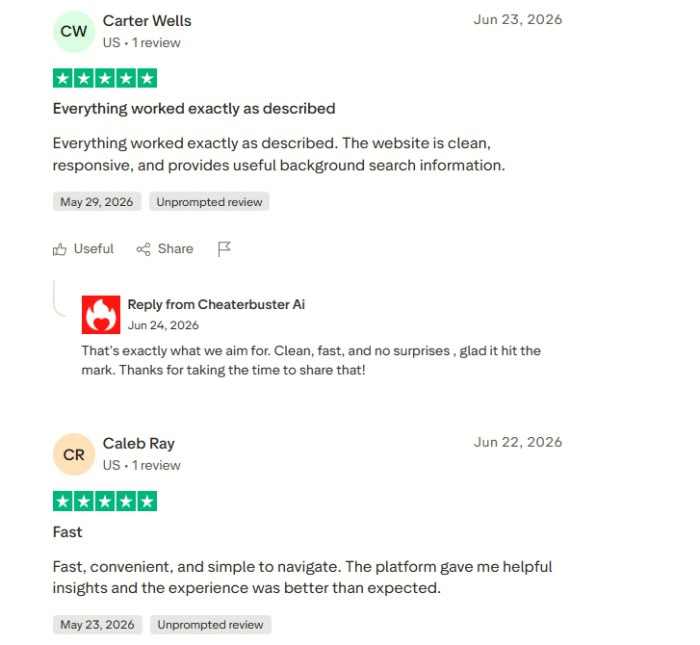
At the same time, payment complaints appear repeatedly, especially around recurring charges, non-transparent pricing, cancellation issues, and cases where results did not meet expectations.
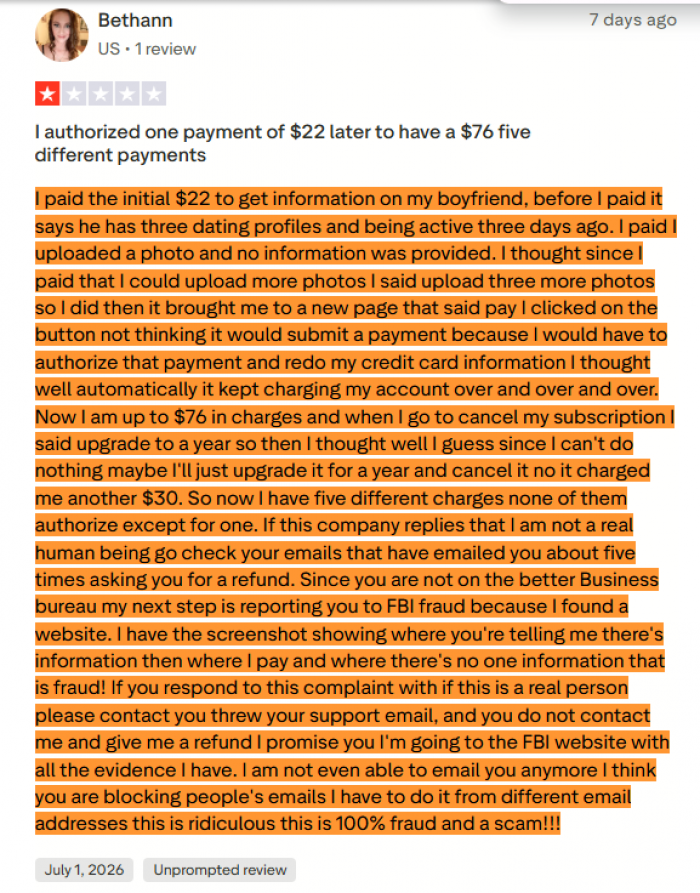
This kind of split makes sense for a tool like Cheaterbuster AI. If the user gets a clear match, they may feel the tool worked extremely well. If they get a vague or empty report, they may feel they paid for uncertainty.
That is also why I would read public reviews carefully. Positive reviews often focus on speed and ease of use. Negative reviews often focus on billing and result quality. Both can be true at the same time.
Who Should Use It
Cheaterbuster AI makes the most sense for users who want to check public dating-profile signals and understand the limits of that kind of search. It may be useful for online dating verification, fake-profile concerns, catfishing checks, or situations where a person wants to review public identity signals connected to one specific search.
It is best for users who can stay calm while reading the report. The result should be checked against multiple details, not treated as a final answer from one matching field.
Who Should Avoid It
Cheaterbuster AI is not the right tool for users who want private messages, hidden account access, live tracking, or legal proof. It is also not suitable for anyone likely to use a possible match as an instant accusation.
A person who is already highly emotional or in a tense relationship situation should be especially careful. This kind of tool may create more conflict if the result is weak, old, or unclear.
Rating Snapshot
| Area Tested | Rating | My Experience |
| Login and account setup | 4.0/5 | The login and account flow is simple, with no unnecessary dashboard clutter. |
| Search setup | 4.1/5 | The fields are easy to understand, but accuracy depends heavily on the details entered. |
| Processing and status | 3.8/5 | The account-based status flow is useful, though users need patience depending on location density and system load. |
| Report usefulness | 3.4/5 | The report is helpful as a lead, but it still needs careful reading and outside judgment. |
| Monitoring | 3.6/5 | Weekly monitoring adds value, but it can also encourage repeated checking if used emotionally. |
| Pricing clarity | 3.0/5 | The subscription model is explained in the FAQ, but checkout and pricing expectations should be clearer. |
| Privacy comfort | 2.8/5 | The tool says it uses public information, but face-based and dating-profile searches remain sensitive. |
| Overall score | 3.5/5 | Useful as a public-profile signal checker, but not reliable enough to treat as proof by itself. |
Final Verdict
Cheaterbuster AI is a focused public dating-profile search and monitoring tool. From login to report, the workflow is simple: create an account, enter identifying details, submit the search, check the result from the account, and use weekly monitoring if the subscription remains active.
The output I got felt more like a lead than a final answer. That is the correct way to understand the tool. Cheaterbuster AI can help organize a public-profile search and surface possible dating-profile signals, but it cannot explain intent, private activity, messages, or relationship truth.
Its biggest strength is convenience. It takes a messy and emotional search process and turns it into a structured report. Its biggest weakness is interpretation. A possible match can be wrong, old, incomplete, or easy to overread. No result also does not prove that no profile exists.
My final take is cautious. Cheaterbuster AI can be useful for public-profile checking, online dating safety, and catfishing concerns. But it should never be treated as a guaranteed cheating detector. The report should start a careful review, not end the conversation.