Instagram has become more than a social platform. For creators, agencies, brands, and curious observers, it is now a live behavioral feed, one that reveals who people follow, what they like, where they comment, and how their interests shift over time. Dolphin Radar is built around that exact idea. It doesn’t try to be another social media scheduler or an all-purpose analytics suite. Instead, it focuses on one thing: turning public Instagram activity into a trackable, searchable, and highly interpretable stream of signals.
That makes it intriguing, but also complicated. A tool like this can be genuinely useful when used for competitor research, audience analysis, or influencer monitoring. It can also drift into ethically murky territory when the same features are used to watch individuals too closely. That tension is what makes Dolphin Radar worth reviewing properly. It is not just a feature-rich tracker. It is a product that sits at the intersection of analytics, privacy, and intent.
What Dolphin Radar really does
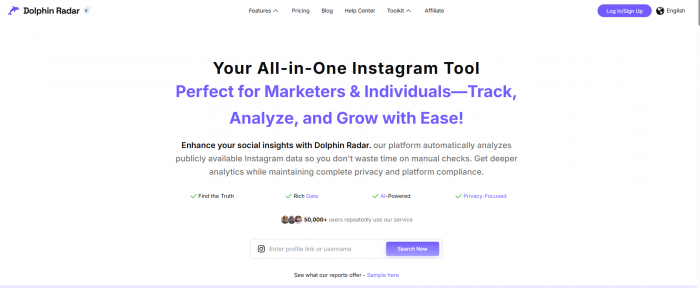
Dolphin Radar is essentially an Instagram intelligence layer for public accounts. You enter a public handle, let the platform monitor visible activity over time, and receive structured insights about follows, unfollows, mutuals, likes, comments, stories, and broader behavioral patterns. It does not ask for your Instagram password, and it does not claim to break into private accounts. Its value comes from collecting public activity over time and organizing it better than a human ever could manually.
That positioning matters. This is not a magic surveillance tool, nor is it a standard native analytics dashboard. It sits in a middle space: more ambitious than a simple story viewer, but far narrower than a general social media suite. In practical terms, it is best understood as a public-data monitoring product that helps users track patterns rather than just isolated moments.
How it works in practice
The workflow is fairly simple on the surface. A user signs up, chooses a plan, adds the public Instagram account they want to track, and lets the platform build a historical picture over time. The platform then scans public-facing signals and converts them into dashboards, reports, and downloadable data files.
What makes the tool different from a casual Instagram viewer is continuity. Dolphin Radar is designed to become more useful the longer it runs. The platform itself emphasizes that AI Insights improve as more data is collected, and some of its higher-level reports only become meaningful after weeks or months of tracking rather than a few quick checks. That makes it a poor fit for instant gratification, but a stronger fit for long-term monitoring and pattern detection.
A quick look at the practical flow:
● Add one public Instagram account per subscription and let the platform track visible activity over time.
● Review dashboards for follows, likes, comments, stories, and broader AI-generated pattern analysis.
● Export reports as CSV when you want raw activity data rather than just dashboard summaries.
The features that actually matter
Dolphin Radar is packed with utilities, but not all of them carry equal weight. The strongest parts of the product are the ones tied directly to trackable public behavior. That includes follower changes, mutual networks, public post activity, and the export layer that allows users to move from “interesting dashboard” to actual analysis.
Follower tracking and account movement
This is one of the most practical parts of the platform. Dolphin Radar tracks recent follows, unfollows, mutual connections, and changes in the following network of a public account. For marketers, that can reveal who a competitor is testing, what creator networks they are entering, or which accounts suddenly become relevant around campaigns. For individuals, it can feel more personal than the tool probably intends.
The strength here is clarity. Follower changes are concrete and easy to understand. The limitation is equally clear: this only works on public accounts, and one subscription covers only one tracked profile at a time.
Engagement activity and interaction trails
The second major value layer is engagement tracking. Dolphin Radar logs public likes, comments, posts, and recurring interaction patterns to show where attention is going and which accounts are repeatedly in the orbit of the profile being tracked. That is often more revealing than follower counts alone because it shifts the focus from static audiences to active behavior.
For creators and agencies, this can be useful in a very grounded way. If a competitor is regularly engaging with certain creators, audiences, or themes, that may signal partnerships, testing behavior, or a shift in content strategy. For casual users, though, this is also the point where interpretation can run away from the data. A pattern is not the same thing as a conclusion.
| Feature area | What it does well | Where it falls short |
| Follower tracking | Tracks follows, unfollows, mutuals, and recent account movement clearly. | Public accounts only; one tracked account per plan. |
| Engagement tracking | Surfaces likes, comments, and recurring interaction patterns over time. | Easy to overinterpret social behavior as intent. |
| Data exports | Lets users download CSV reports for deeper analysis. | More useful for analysts than casual users. |
Stories, highlights and the “anonymous” layer
Dolphin Radar also pushes heavily into anonymous viewing. It offers story and highlight tracking for users on higher plans and frames this as a way to watch public content without exposing your identity. From a functionality standpoint, that is appealing. For competitive research, it lets you keep an eye on creators or brands without showing up in their view lists. For personal use, it is the feature most likely to raise eyebrows.
This is where the product starts to feel split between legitimate business utility and social surveillance. The technical side is clever. The use case depends entirely on who is using it and why.
AI Insights: useful layer or overconfident interpretation?
Dolphin Radar’s most ambitious move is AI Insights. Quarterly plans unlock four modules MBTI, persona snapshot, lifestyle indicators, and location while annual plans unlock nine, adding interests, notable patterns, engaged accounts, discussion topics, and public locations mentioned. The promise is attractive: instead of merely seeing activity, you get a narrative interpretation of what that activity says about a person.
That is also where caution becomes necessary. Raw data like follows and comments is tangible. AI-generated inferences about personality and lifestyle are softer, more interpretive, and easier to misuse. Used carefully, they can act as directional signals for marketing or audience understanding. Used carelessly, they can give a false sense of certainty about people who are, in reality, far more complex than their public Instagram behavior suggests.
Pricing and value
Dolphin Radar is relatively inexpensive at entry level, but it is not one of those products where the cheapest plan tells the whole story. The monthly tier gives basic tracking, while the more interesting AI-driven layers appear only on quarterly and annual plans.
Here is the current pricing structure:
| Plan | Price | Effective monthly cost | What you get |
| Monthly | $4.49 | $4.49 | Basic tracking for one public account; no AI Insights. |
| Quarterly | $10.99 | $3.66 | One account plus 4 AI Insight modules, including MBTI and lifestyle indicators. |
| Annual | $32.99 | $2.75 | One account plus 9 AI Insight modules and the deepest insight package. |
The value question depends almost entirely on use case. For a marketer tracking one key competitor for months, the annual plan is cheap enough to feel almost disposable. For a casual user who is merely curious about one account, even the monthly fee can be wasted if the tool is being used out of impulse rather than purpose.
There is also a structural limitation worth noting: every subscription tracks only one account. That keeps the sticker price low, but it also means the cost climbs quickly if you want to monitor multiple creators, competitors, or campaigns at once.
Trust, transparency, privacy, and ethics
Dolphin Radar is more transparent than many tools in this category. Its pricing, plan differences, AI module tiers, update cadence, and cancellation mechanics are all described in reasonably plain language. It also says subscriptions can be canceled anytime from the dashboard and that billing ends with the next cycle rather than forcing hidden renewal traps.
On privacy, the platform makes two important claims: it does not require users to log in with Instagram credentials, and it works only with publicly visible data. Those are meaningful positives. A lot of the security risk attached to social tracking tools comes from handing over passwords or granting questionable app permissions. Dolphin Radar avoids that particular problem.
Still, privacy and trust are not identical. The platform also stores data over time to build “memory,” histories, and AI insights, then says that this retained data is cleared after cancellation. That sounds reassuring, but it remains a company claim rather than an independently verified control. There is no visible outside audit, certification, or third-party privacy validation attached to the product from what is publicly available.
Ethically, the platform occupies a gray but familiar territory. It is defensible as a public-data intelligence tool for creators, brands, and researchers. It becomes difficult to defend when it is used to interpret private emotional lives through public crumbs. That is less a technical flaw than a product reality and it should shape how readers think about the tool.
What real users are saying
User sentiment around Dolphin Radar appears to lean more positive than many social tracking tools, but the tone depends heavily on who is using it and why. The most favorable responses usually come from people treating it as a research tool rather than as a personal surveillance product.
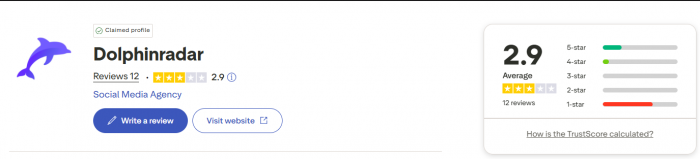
A recurring positive theme is value for money. Users who approach it from a marketing or competitive-research angle tend to appreciate that it can pull together public account behavior without needing an Instagram login, and that it becomes more useful over time rather than trying to wow people in the first five minutes. That longer-term logic also appears in the platform’s own positioning, which emphasizes that meaningful understanding often takes months rather than days.
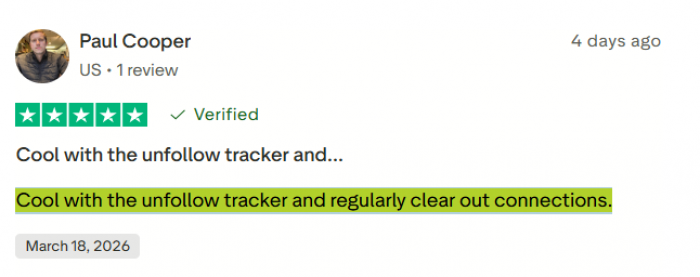
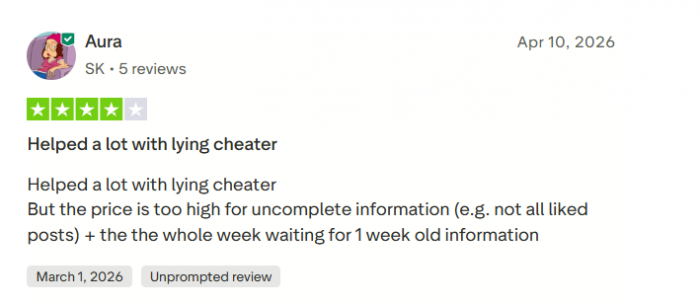
The skepticism tends to cluster around interpretation rather than basic mechanics. Some users and commentators find the tracking useful but are less convinced by the more inferential AI modules, especially personality-style readings.
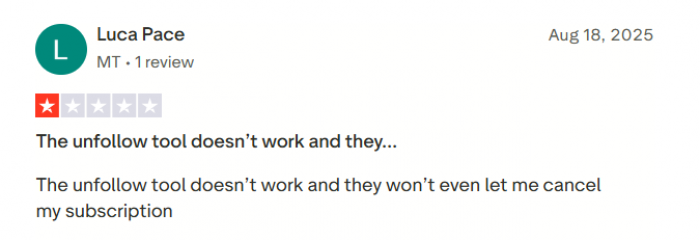
Others are uneasy not because the tool is broken, but because it is easy to imagine it being used in ways that feel invasive or obsessive rather than analytical.
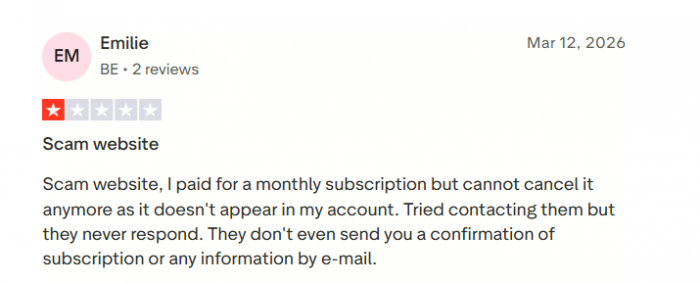
A balanced reading of the user voice would look something like this:
| Platform | Overall tone | What users focus on |
| Trustpilot | Generally positive but use-case dependent. | Value, public-account tracking, and whether the insights justify longer plans. |
| Reddit and marketing communities | Mixed but thoughtful. | Useful for competitor research, questionable in personal contexts. |
That split is important. Dolphin Radar is not attracting backlash because it fails to work. It attracts hesitation because it works well enough to force users to think about how far public-data monitoring should go.
Where Dolphin Radar feels genuinely useful
This is not a useless novelty product. In the right hands, Dolphin Radar can be very practical. Agencies can use it to monitor competitor behavior, spot creator overlap, and build cleaner outreach lists. Brands can use it to understand which public accounts are entering the orbit of competitors. Creators can use it to observe how peer accounts are growing and what kind of audience interaction actually clusters around them.
It is also useful when manual tracking has become messy. Many teams already do a rough version of this work through screenshots, spreadsheets, and instinct. Dolphin Radar simply turns that process into a system. That is why the tool works best as a workflow upgrade rather than a standalone miracle.
The strongest fit usually looks like this:
● Competitor tracking for social media teams and agencies.
● Influencer and audience research for campaigns and partnerships.
● Long-term monitoring of public profiles where pattern detection matters more than one-off snapshots.
Where it starts to feel questionable
Every review of Dolphin Radar should spend time here, because this is where the product becomes more than “just analytics.” The platform says it uses only public data, and technically that is true. But public data can still be used in ways that feel invasive, especially when it is converted into persistent tracking, personality inference, and behavioral interpretation.
That does not make the tool inherently unethical. It does mean the ethics shift from the platform’s claims to the user’s intent. Watching a competitor brand is very different from tracking a partner or ex-partner for months and reading AI-generated “persona” modules like evidence. One use case looks like market intelligence. The other starts to resemble outsourced suspicion.
The line is not hard to spot:
● Business use, public figure monitoring, and competitor research sit in the defensible zone.
● Romantic surveillance, emotional overreading, and pseudo-detective use sit in the ethically shaky zone.
That distinction should be part of any honest review because it affects not just how the tool is perceived, but whether the reader should use it at all.
Alternatives worth considering
Dolphin Radar is not the only tool in this niche, and comparing it properly helps clarify where it fits. Some alternatives are better for anonymous viewing, some are more narrowly focused on follower behavior, and some are safer simply because they are first-party analytics rather than third-party tracking layers.
| Alternative | Best for | How it differs |
| Snoopreport | Lightweight public-activity tracking | Simpler and more focused on activity summaries than broad dashboard depth. |
| Peekviewer | Anonymous story and content viewing | More viewing-centric, less analytics-heavy than Dolphin Radar. |
| Instalab AI | Export-heavy Instagram analysis | Stronger data-export and analysis orientation for growth work. |
| Native Instagram insights | Tracking your own account performance | Safer and first-party, but limited to accounts you manage directly. |
Dolphin Radar sits somewhere in the middle of that landscape. It is more ambitious than a simple anonymous viewer, but less “enterprise analytics” than platforms built around full social data operations. That middle position is part of its appeal: it feels advanced without becoming too expensive or too technical for everyday use.
Who should use it and who probably shouldn’t
Dolphin Radar is a good fit for users who think in patterns, not impulses. If the goal is to understand public audience behavior, map competitor activity, or monitor creator networks over time, the tool is reasonably compelling and priced low enough to justify testing. It is strongest when used with patience and professional intent.
It is a much weaker fit for users looking for certainty in personal situations. The platform can collect signals, but signals are not truth. A few follows, likes, or comments can quickly become overinterpreted when the emotional stakes are high. In those cases, the tool can amplify anxiety more than understanding.
The cleanest practical split is this:
● Best fit: marketers, agencies, creator teams, influencer researchers, and analysts.
● Weak fit: anyone hoping public Instagram traces will answer private emotional questions definitively.
Final verdict
Dolphin Radar is more useful than a basic Instagram tracker, especially for follower monitoring, engagement mapping, anonymous viewing, and long-term public activity analysis. It can help marketers, creators, and researchers spot patterns that would be hard to track manually.
Its main weakness is interpretation. AI-based lifestyle or personality readings can sound convincing, but they are still guesses based on public behavior, not facts. The tool is useful for professional research, but ethically risky when used for personal monitoring. In the right hands, Dolphin Radar is a smart public-data tool. In the wrong context, it can turn ordinary Instagram activity into uncomfortable surveillance.