
Glaadvoice.com presents itself as a broad digital media website covering news, business, health, technology, fashion, education, finance, law, and digital marketing. At first glance, it looks like a standard multi-category blog made for readers who want quick updates across different topics.
But when we look at the site more critically, the problem becomes clear. Glaadvoice has the outer structure of a digital publication, but it does not show enough editorial depth, author authority, sourcing transparency, or ownership clarity to fully support that role. The site is not necessarily unusable, but it should be read with caution, especially in categories where accuracy matters.
What Glaadvoice.com Claims to Be
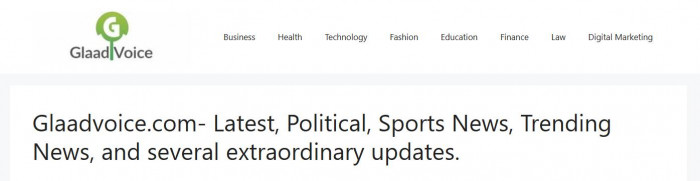
Glaadvoice positions itself as a digital blogging platform that publishes news, insights, and trending stories across a wide mix of subjects. Its public-facing language suggests that it wants to be a one-stop information hub for readers interested in politics, technology, business, finance, health, lifestyle, entertainment, education, law, and more.
That positioning is important because the site is not presenting itself as a small personal blog with one clear niche. It is trying to look like a general digital publication. That comes with a higher responsibility. A broad publication needs more than categories and regular posts. It needs a visible editorial system behind the content.
For a site like this, readers should ideally be able to find:
● Who owns or operates the website
● Who edits the articles
● What qualifies the writers
● How sources are selected and checked
● How mistakes are corrected
Glaadvoice shows some basic publishing structure, including categories, posts, author names, an About Us page, and policy pages. But it does not clearly show the deeper editorial machinery. Readers can see what the site publishes, but not enough about who is accountable for it.
That gap between appearance and accountability is the main issue running through the website.
Writing Style: Clear, Simple and Search-Oriented
Glaadvoice’s writing style is simple and accessible. The site uses easy explanations, familiar phrasing, and a beginner-friendly tone. For casual readers, this can make the content easy to scan and understand.
The weakness is that the writing often feels search-oriented rather than expertise-oriented. It uses broad confidence-building phrases such as reliable information, real-time updates, neutral reporting, and well-researched content. These phrases sound reassuring, but they do not prove quality by themselves.
The writing does not usually carry the sharpness of original reporting or expert commentary. It explains topics in a general way, but it does not strongly show investigation, source comparison, specialist insight, or editorial judgment. That makes the content easier to read, but not necessarily easier to trust.
The best way to describe the style is this: Glaadvoice is readable, but not strongly authoritative. It explains more than it verifies. It simplifies more than it investigates. That is acceptable for casual browsing, but weak for serious topics.
Content Depth: Broad Surface Area, Limited Editorial Proof
The content depth on Glaadvoice is limited by the site’s very wide subject range. It covers business, health, technology, fashion, education, finance, law, digital marketing, entertainment, sports, and other general-interest areas. That gives the website a large search footprint, but it also creates a clear expertise problem.
A finance article needs current figures, regulatory awareness, and careful wording. A legal explainer needs disclaimers and qualified review. A health article needs medical accuracy, credible sources, and update discipline. A fashion or entertainment article carries less risk, but still needs originality if the site wants to stand out.
Glaadvoice does not clearly prove that each category is handled by someone with relevant subject knowledge. As a result, the site may work for surface-level reading, but it struggles to prove deeper authority.
| Area | What Glaadvoice Shows | What It Does Not Prove |
| Topic range | Wide coverage across many categories | Clear editorial specialization |
| Writing style | Easy, simple, accessible language | Strong reporting or expert analysis |
| Author names | Visible bylines on posts | Credentials or category expertise |
| About page | Basic mission and site description | Ownership, editors, process, accountability |
| Trust level | Usable for casual reading | Reliable enough for serious decisions |
This table captures the core issue. Glaadvoice does have a functioning content structure, but the visible evidence behind that structure is thin. The site can introduce a topic, but readers should not treat it as a final source for health, finance, law, insurance, politics, or business decisions.
Category Analysis: Too Many High-Trust Topics, Too Few Authority Signals
Glaadvoice’s category structure is one of the strongest signs that the site operates as a broad SEO-style content hub. It is not built around one clear specialty. It moves across business, health, technology, fashion, education, finance, law, digital marketing, entertainment, games, and sports.
That range may help the site attract search traffic, but it also weakens its identity. A reader is left asking whether Glaadvoice is a news site, a lifestyle blog, a finance explainer, a legal information site, a digital marketing platform, or a general guest-post-style content hub.
The concern becomes sharper because several categories are high-trust areas. Health, law, finance, and politics are not casual content lanes. Readers may use information from those sections to understand money, rights, claims, insurance disputes, medical choices, or public issues. That requires stronger proof of expertise.
| Category | Critical Reading |
| Health | Needs medical sources, expert review, disclaimers, and update discipline. Without those, trust stays limited. |
| Finance | Requires accuracy around loans, insurance, banking, taxes, and money decisions. General writing is not enough. |
| Law | Needs legal caution and qualified review. Otherwise, articles should be treated only as basic explainers. |
| Business | Can work as general commentary, but stronger articles need data, case examples, and source links. |
| Technology | Acceptable for explainers, but fast-moving topics need current facts and product-level accuracy. |
| Fashion | Lower risk, but often becomes generic if there is no original taste, sourcing, or product insight. |
| Education | Needs care if covering exams, admissions, courses, or official programs. |
| Digital Marketing | SEO-friendly category that may attract guest posts, brand mentions, or backlink-focused content. |
| Sports and Entertainment | Good for traffic, but they make the site’s identity even broader and less focused. |
A broad category structure is not automatically a flaw. Major media sites cover many subjects because they have editorial departments, specialist writers, editors, fact-checkers, and standards. Glaadvoice does not clearly show that kind of support. That makes its categories feel less like well-developed editorial desks and more like content buckets designed to capture many kinds of search queries.
The issue is not that Glaadvoice covers many topics. The issue is that the site does not show enough authority to cover them all convincingly.
Author Structure: Two Names Cannot Carry Every Category
One of the most important credibility signals on Glaadvoice is the repeated appearance of two author names: Ethan Wilson and Devin Haney. Named authors are better than anonymous publishing, but bylines alone do not prove expertise.
The question is not only who wrote the article. The more important question is why the reader should trust that person on that specific subject.
This becomes a problem when the same small author pool appears across many unrelated categories. If Ethan Wilson and Devin Haney are attached to content across finance, law, health, business, technology, fashion, education, and entertainment, readers need more context. Are they journalists, editors, general writers, subject experts, contributors, or publishing profiles? Without detailed author bios, Glaadvoice does not answer that clearly.
The author structure raises three main concerns:
● It limits subject-level authority because two names appear across too many different fields.
● It weakens accountability because the site does not clearly explain author qualifications.
● It makes the publication feel centralized and content-driven rather than specialist-led.
For a narrow website, two authors can be enough. A two-person blog about AI tools, fashion, gaming, or digital marketing can build trust if both writers show clear experience in that area. But a two-author structure across health, law, finance, politics, business, lifestyle, and entertainment creates a much higher trust burden.
The weakness is not simply that Glaadvoice has only two visible authors. The weakness is two authors across too many serious categories without enough visible credentials.
Glaadvoice has authorship. What it does not clearly show is author authority.
About Us Page: A Mission Statement, Not a Transparency Page
Glaadvoice does have an About Us page, but it does not function like a strong trust-building page. It describes the site’s purpose, lists the topics it covers, and says the platform aims to provide clear, independent, reader-focused content. It also states that the site is not affiliated with external organizations with similar names, which is useful because the name could create confusion.
But the page still leaves major credibility questions unanswered.
A proper About Us page for a broad publishing site should not only explain what the website covers. It should explain who is behind it and how the content is produced. This is especially important when the site covers health, finance, law, politics, and business.
| About Us Element | Glaadvoice’s Position |
| Basic site description | Present |
| Mission statement | Present |
| Independence claim | Present |
| Founder or owner details | Not clearly shown |
| Editorial team | Not clearly shown |
| Writer qualifications | Weak or missing |
| Editorial policy | Not properly explained |
| Corrections process | Not clearly visible |
| Expert review process | Not clearly visible |
| Contact identity | Limited, with Gmail-style contact signal |
The About Us page uses trust language, but trust language is not the same as trust evidence. A site can say it is independent, reliable, and unbiased. Readers still need to see who owns it, who edits it, how articles are reviewed, and how corrections are handled.
This matters because Glaadvoice is not only publishing low-risk lifestyle content. It also covers categories where wrong or shallow information can affect real decisions. A thin About Us page may be acceptable for a casual personal blog. It is much weaker for a site trying to operate across high-trust categories.
Trust Signals: Functional Website, Weak Accountability
Glaadvoice has several basic website trust signals. It has navigation, category pages, named authors, an About Us page, a Contact page, a Privacy Policy, Terms and Conditions, and DMCA information. These elements show that the website is not just an empty domain or unfinished project.
But basic website setup is not the same as editorial credibility. The deeper trust signals are weaker.
The site does not clearly show:
● A newsroom or editorial hierarchy
● Ownership or company identity
● Detailed author credentials
● Source and citation standards
● Corrections or fact-checking process
● Expert review for health, finance, or legal content
The contact setup also feels lightweight. A Gmail-style email address does not automatically make a website unreliable, but it does suggest a small publishing operation rather than a mature editorial brand. For a general blog, that may be acceptable. For a site covering law, health, finance, politics, and business, it is a weak signal.
There is also a commercial layer to consider. The site’s language around brand promotion and traffic exposure suggests that Glaadvoice may have advertising or promotional value beyond standard publishing. That does not prove individual articles are paid or biased, but it does mean readers should watch for guest-post-style content, brand-led topics, and SEO-driven editorial choices.
The trust issue is therefore not technical. The site works. The issue is accountability. Readers can access the content, but they cannot easily verify the editorial process behind it.
Claim vs Reality
The clearest way to judge Glaadvoice is to compare what the site claims with what it visibly proves.
| Website Claim | Critical Reality |
| Provides reliable information | Reliability is claimed, but not strongly proven through sourcing, credentials, or editorial process |
| Covers many important categories | The range is wide, but the expertise behind each category is not clearly shown |
| Offers clear and useful content | The writing is easy to read, but often lacks deeper analysis |
| Operates independently | Independence is stated, but ownership and editorial accountability remain limited |
| Serves readers across many topics | The site may serve casual readers, but serious topics need stronger trust signals |
This does not mean every article on Glaadvoice is wrong. That would be an unfair claim without checking every article individually. The more accurate judgment is that the site asks for more trust than it currently proves.
The website’s claims are broad, but the support behind those claims is limited. That is the core credibility gap.
Who Should Use Glaadvoice?
Glaadvoice can be useful for casual browsing, simple explainers, and early-stage topic discovery. If a reader wants a quick overview of a general topic, the site’s simple language may be enough.
But the site should not be treated as a final authority for serious topics. Any article related to health, legal issues, finance, loans, insurance, taxes, business obligations, or political claims should be checked against stronger sources.
| Use Case | Reliability Level |
| Casual reading | Acceptable |
| Basic topic discovery | Useful with caution |
| Lifestyle or entertainment browsing | Lower risk |
| Health information | Needs verification |
| Finance and insurance topics | Should not be relied on alone |
| Legal explainers | Treat only as general information |
| Politics or public issues | Cross-check with established sources |
The safest way to use Glaadvoice is as a starting point, not as a decision-making source. It can help readers understand what a topic is about, but it should not replace official sources, professional advice, or established publications.
Final Verdict
Glaadvoice.com is a readable multi-category blog, but it does not show enough expertise, editorial transparency, or accountability to be treated as a highly authoritative publication.
Its main weakness is the combination of signals. The site covers too many unrelated and high-trust categories. Only two author names, Ethan Wilson and Devin Haney, appear across a wide range of topics. The About Us page gives a broad mission but not a clear editorial identity. The writing is accessible but often general. The trust language is stronger than the visible proof behind it.
For casual readers, Glaadvoice may be useful as a starting point. For serious topics, especially health, law, finance, insurance, politics, or business decisions, it should be treated carefully and cross-checked with official sources or qualified experts.
Bottom Line : Glaadvoice.com is not a fake-looking site, but it is not a strong authority site either. It is best understood as a broad SEO-style content blog with readable articles, limited transparency, weak author authority, and an unclear editorial structure. To become more trustworthy, it would need detailed author bios, ownership disclosure, stronger sourcing, expert review for sensitive categories, a corrections policy, and a clearer editorial standard.