GoralBlue.com presents itself like a multi-category information site, but its actual behaviour tells a more complicated story. It has the structure of a broad online publication, with sections for business, education, entertainment, finance, health, real estate, technology, and travel. Yet several of those sections are thin, some appear empty, and the site gives limited information about who runs it, how content is reviewed, or why readers should trust it on serious topics.
This article looks beyond the domain name and surface design. It examines what GoralBlue.com appears to be, how its categories behave, what its content structure reveals, where the trust gaps are, and who may still find it useful.
The First Impression

At first glance, GoralBlue.com looks like a standard multi-niche blog. The layout is familiar: a homepage, category menu, archive section, article pages, and a broad mix of informational posts. The site is not built around one clear product or service. It does not behave like an e-commerce store, SaaS platform, agency site, or community forum. Its main purpose appears to be publishing articles across different search-friendly topics.
That is not a problem by itself. Many readers use general blogs for quick explanations. But GoralBlue’s issue begins when its structure promises more depth than the site appears to deliver. The menu suggests a full digital publication. The content base suggests a smaller, thinner, less mature blog.
A serious look should therefore not ask only, “What topics does it cover?” The better question is, “Does the website have enough content, expertise, and transparency to support the topics it claims to cover?”
The Category Map
The category structure is the strongest signal on GoralBlue.com. A category is not just a navigation label. It is a commitment. When a site creates a Real Estate category, readers expect property-related content. When it creates a Finance category, readers expect money-related guidance with some level of care. When it creates a Health category, readers expect responsible information.
GoralBlue has a broad category menu, but the content behind that menu appears uneven. You noticed that Entertainment and Real Estate are empty, while other categories have only around three or four posts. That changes the entire reading of the website. It means the site is not operating like a fully developed publication. It is operating more like a content shell with some areas partially filled and others left as placeholders.
| Category | Current Behaviour | What It Says About the Website |
| Business | Some content appears present | The site has started building this section, but it does not yet feel deeply developed |
| Education | Light informational coverage | Works for basic explainers, but not enough to establish strong education authority |
| Entertainment | Appears empty | Looks like a placeholder category rather than an active section |
| Finance | Some finance or tax-related content appears present | A serious category that needs stronger sourcing and expertise than the site visibly shows |
| Health | Some health or wellness content appears present | Sensitive topic area where the site needs better review signals |
| Real Estate | Appears empty | Weakens the credibility of the site’s broad category promise |
| Technology | Some technology content appears present | Fits the general blog model, but still appears thin |
| Travel | Appears thin | More like a small content cluster than a real travel vertical |
| Online gaming posts | Present in the wider content mix | Makes the site feel scattered when Entertainment itself is not developed |
This table is important because it shows the difference between website structure and website substance. GoralBlue has the structure of a broad site, but not enough category depth to behave like one.
The Empty Category Problem
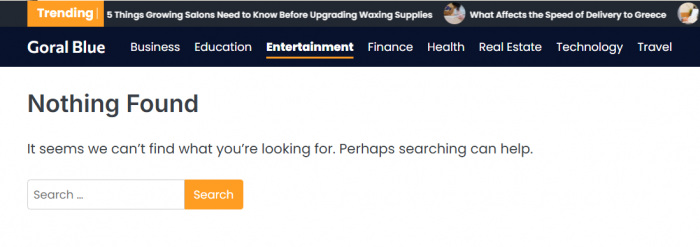
Empty categories are not harmless. They tell readers that the site may have been designed before its editorial strategy was ready.
An empty Real Estate category is especially noticeable because real estate is a high-value, trust-sensitive topic. Readers searching for property advice expect market knowledge, legal awareness, location relevance, buying and selling guidance, or at least practical experience. If the category exists but has no real content, it weakens the site’s authority.
The same applies to Entertainment. The site has online gaming content, yet Entertainment appears empty. That creates a structural mismatch. If gaming content is being published, it should help build an entertainment or gaming section. Instead, it appears disconnected from the category system.
This pattern suggests one of three possibilities:
● The site is still in an early build-out stage.
● The categories were added for future SEO coverage.
● The website is publishing scattered articles without a tight editorial plan.
None of these automatically makes the site unsafe or useless. But they do make it hard to describe GoralBlue.com as a mature publication.
Thin Sections Tell a Bigger Story
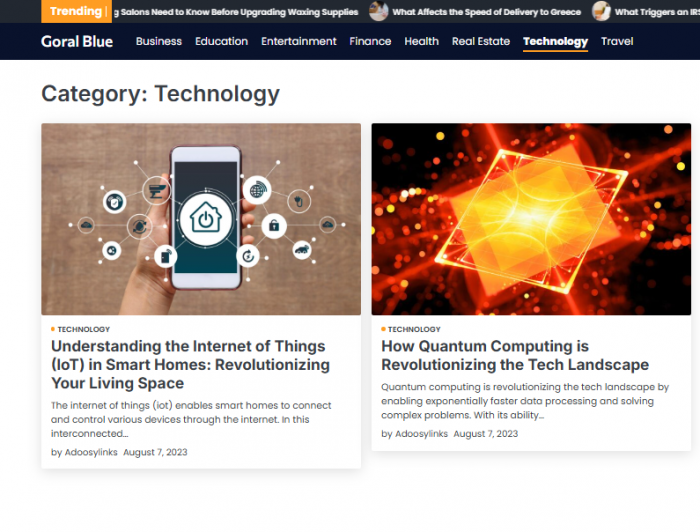
A category with three or four posts is not automatically bad. Every website starts somewhere. The issue is that GoralBlue has several broad categories at once, and many of them appear lightly populated. That makes the site feel wider than it is deep.
A mature content site usually builds topical authority by publishing many connected articles within a subject. For example, a strong Finance section might include budgeting guides, tax explainers, business finance articles, market updates, comparison pieces, and risk disclaimers. A strong Technology section might include product explainers, digital safety guides, AI coverage, smart home analysis, and software comparisons.
GoralBlue does not yet appear to have that kind of depth. Its sections look more like small content pockets than established verticals.
| Website Signal | What It Usually Means |
| Many categories with few posts | Broad positioning without enough editorial depth |
| Empty sections | Category planning is ahead of content production |
| Scattered topics | Possible keyword-led publishing |
| One author profile | Limited visible editorial diversity |
| Weak About page | Low transparency about ownership and mission |
| Archive section | Standard blog structure, but not proof of maturity |
The main point is simple: GoralBlue.com may be active in some areas, but it does not yet look strongly developed across the categories it displays.
The Archive Clue

The archive section is worth mentioning because it gives a date-wise view of publishing activity. On a mature publication, an archive can show consistency: regular posts over months or years, steady editorial output, and an active publishing rhythm.
On GoralBlue, the archive should be read more carefully. The existence of an archive does not automatically prove that the site is active or authoritative. Most blog themes generate archive sections by default. The real question is whether the archive shows consistent content development or short bursts of publishing.
If a site has an archive but thin categories, the archive becomes a diagnostic tool. It helps readers see whether the website is steadily growing or whether content has been added irregularly. In GoralBlue’s case, the thin and empty categories make the archive feel less like a sign of editorial maturity and more like a basic blog feature.
The Writing Style
GoralBlue’s writing style appears simple, explanatory, and built for quick reading. That can work for general users. A reader who wants a basic introduction to a topic may find the site easy to understand. The articles do not appear to demand technical knowledge or specialist background.
But simplicity can also become a limitation. A site covering finance, health, real estate, business, technology, and education cannot rely only on easy language. These categories require accuracy, context, and sometimes professional review. If the content does not show deeper sourcing, expert input, examples, case context, or updated information, it remains at the surface level.
This is where GoralBlue feels more like a general SEO blog than a specialist publication. The content may answer basic questions, but it does not strongly show why readers should treat it as a reliable authority.
One Author Across Too Many Lanes
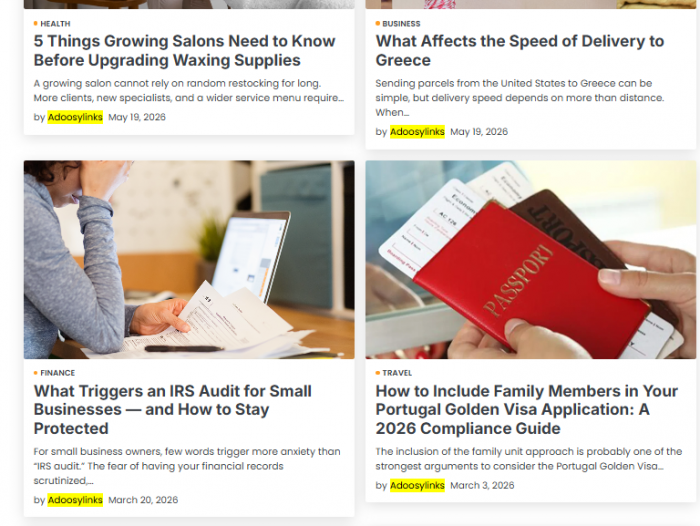
The one-author pattern is one of the most important credibility issues. If most or all visible content sits under one author profile, the site becomes easier to question, especially when the categories are unrelated.
A one-author blog can be excellent when the author has a clear niche. For example, a personal finance expert writing only about budgeting, tax, and investing can build trust. A travel writer publishing first-hand destination guides can also build trust. But one profile covering health, finance, technology, education, real estate, entertainment, travel, and gaming creates a different impression.
It raises questions such as:
● Is the author personally knowledgeable across all these categories?
● Are there editors or contributors behind the scenes?
● Is any health or finance content reviewed by specialists?
● Are posts original, guest-submitted, rewritten, or broadly sourced?
● Does the site have a content-checking process?
The problem is not the existence of one author. The problem is the combination of one visible author, many categories, thin content, and weak transparency. Together, those signals make the website feel less authoritative.
The Missing About Page
A proper About Us page is essential for a site like GoralBlue. It should explain who owns the website, what its mission is, what topics it covers, who writes the articles, and how information is checked.
If the site does not have a proper About Us page, that weakens reader trust. This is especially important because GoralBlue covers areas where people may act on the information they read. Health, finance, tax, real estate, business, and legal-adjacent topics need more context than casual lifestyle posts.
A weak or missing About page does not prove the content is wrong. But it does make the site harder to evaluate. Readers cannot easily judge whether the site is run by subject specialists, guest contributors, SEO publishers, or a single content manager.
| Trust Area | What Readers Need | What the Current Signal Suggests |
| Ownership | Clear identity behind the website | Not strongly visible |
| Editorial mission | Why the site exists and what it covers | Not clearly explained |
| Author expertise | Relevant background for each category | Hard to verify |
| Review process | How sensitive content is checked | Not clearly shown |
| Accountability | Contact, corrections, transparency | Limited visible clarity |
| Content standards | Rules for sourcing and updates | Not strongly presented |
This is one of the biggest weaknesses of the site. A broad blog needs a stronger identity page because broad coverage creates more trust questions.
The Gaming Content Signal

The online gaming posts are not a problem on their own. Gaming is a valid topic. The issue is what they reveal about the site’s content behaviour.
If GoralBlue had a strong Entertainment or Gaming section, gaming articles would make sense. They would support a clear content vertical. But when Entertainment appears empty and other sections are thin, gaming posts feel more like isolated content pieces than part of a planned editorial system.
This suggests the website may be publishing around available keywords rather than building strong category authority. That is a common pattern on broad content blogs. It can bring traffic, but it can also make the site feel scattered.
For readers, this matters because scattered publishing reduces confidence. A site that jumps between tax topics, health topics, smart home technology, travel, education, and gaming needs strong editorial framing. Without that framing, the domain begins to feel like a collection of articles rather than a clear publication.
What GoralBlue Does Well
GoralBlue.com is not without value. Its biggest strength is that it appears easy to access and simple to read. It may help casual readers who want quick introductions to general subjects. The blog layout is familiar, and the category system makes browsing simple even if the categories themselves are uneven.
| Strength | Why It Matters |
| Simple article style | Good for readers who want quick explanations |
| Broad topic mix | Useful for casual browsing |
| Standard blog layout | Easy to navigate without learning a new interface |
| Archive section | Helps readers check post history |
| Some active content areas | The site is not completely empty |
| Beginner-friendly tone | Better for general awareness than technical research |
These strengths make the site usable. They do not make it authoritative.
Where It Falls Short
GoralBlue’s weaknesses are not about one small issue. They form a pattern. Empty categories, thin sections, a single author profile, no proper About Us page, scattered gaming posts, and broad topic coverage all point in the same direction.
The site looks like it wants to be a multi-topic publication, but it has not yet built the content depth or transparency needed to support that identity.
| Weakness | What It Says About the Domain |
| Empty categories | The site’s structure is ahead of its content |
| Thin sections | Topical authority is weak |
| One author profile | Expertise is difficult to verify |
| No proper About Us page | Ownership and editorial purpose are unclear |
| Gaming posts feel scattered | Category strategy is not fully coherent |
| Serious topics covered broadly | Trust standards should be stronger |
| Archive alone is not enough | Publishing history needs consistency and depth |
The issue is not that GoralBlue cannot be useful. The issue is that it should not be overtrusted.
Who Should Bookmark It?
GoralBlue.com is best for casual readers who want quick, simple explanations across general topics. It may be useful for browsing light informational content, especially if the reader understands that the site is not a specialist source.
It may be useful for:
● General readers looking for basic explainers
● People browsing broad lifestyle or informational topics
● Readers who want quick orientation before deeper research
● Users who do not need expert-level analysis
It is not ideal for readers making serious decisions around health, finance, tax, legal issues, real estate, investment, or business risk. For those areas, GoralBlue should be treated as a starting point only. Readers should verify the information through stronger, specialist sources.
Final Verdict
GoralBlue.com is a functional multi-niche blog, but not a mature authority site. It has a broad category structure, simple content style, and standard blog features such as archives and category pages. For light reading, that may be enough.
But the deeper signals are weak. Empty Entertainment and Real Estate categories make the site feel unfinished. Thin sections suggest limited topical depth. The one-author pattern raises expertise questions. The missing proper About Us page weakens transparency. Gaming content appears in a way that makes the editorial structure feel scattered. Together, these details show a domain that is still underdeveloped.
The fairest conclusion is that GoralBlue.com can be useful for casual browsing, but it should not be treated as a trusted expert source. It has the skeleton of a broad publication, but not yet the editorial muscle to support its full category promise.
Overall Personal rating: 5.1/10
| Review Area | Rating | Reason |
| Readability | 6.5/10 | Easy to understand and casual-reader friendly |
| Category depth | 3.5/10 | Empty and thin sections weaken the site |
| Editorial clarity | 3/10 | No proper About Us page or clear review process |
| Expertise signal | 3.5/10 | One author profile across many topics is weak |
| Content usefulness | 5.5/10 | Helpful for basic reading only |
| Site maturity | 4/10 | Looks underdeveloped as a publication |
| Trust level | 4/10 | Needs stronger transparency and sourcing |
| Overall | 5.1/10 | Useful for light browsing, weak as an authority source |