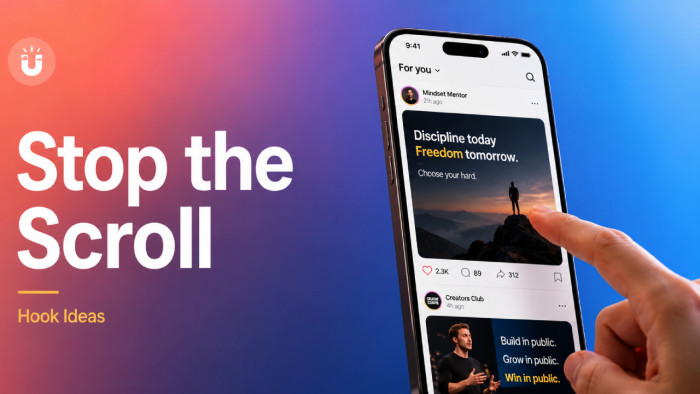
The first line does not just introduce your content. It decides whether the content gets a chance at all.
On Reels, Shorts, and social posts, attention is rented in seconds. People do not open your content hoping to be convinced slowly. They are scanning, judging, and moving. A strong hook gives them a reason to stop. A weak one tells them they can keep scrolling without missing anything. That is why writing better hooks is not a cosmetic skill. It is a distribution skill.
This article breaks down how hooks actually work, how they change across short video and text formats, what formulas consistently pull attention, where most creators go wrong, and how to write hooks that feel sharp, clear, and worth reading instead of loud and generic.
What a hook actually does
A hook is the opening idea that creates enough curiosity, relevance, tension, or promised value to earn the next few seconds of attention. In short-form content, it is not just the first sentence. It can be the first spoken line, the first on-screen text, the first visual contrast, or the first claim.
The best hooks do one simple job: they make the audience feel that continuing is the smart choice.
That usually happens through one of five triggers. The hook promises a useful result, reveals a surprising truth, opens a knowledge gap, creates emotional recognition, or frames a problem the viewer already feels. Most strong hooks use at least one of these. Great ones often combine two.
A lot of creators think a hook must be dramatic. It does not. It must be specific. Specificity is what turns vague content into scroll-stopping content. “Social media tips” is forgettable. “Why your Reels die after 300 views” is far more magnetic because it names a concrete frustration.
Why hooks matter more on Reels, Shorts, and posts than almost anywhere else
Short-form platforms reward content that wins the first test quickly. Before your editing quality, storytelling, or insight can matter, your opening has to buy enough time for the rest of the content to work.
That is especially true because audience behavior is different on each format, even when the attention problem is the same. On Reels and Shorts, the user is in motion. They are swiping fast, often with sound off for the first second. On static posts, the user may pause slightly longer, but the competition is denser because every post is also fighting with carousels, memes, comments, and algorithmically recommended content.
A hook is what creates that pause. Once you understand that, writing hooks becomes less about being clever and more about engineering attention.
The core ingredients of a strong hook
Before looking at templates, it helps to understand what strong hooks are built from.
| Ingredient | What it does | Example |
| Specificity | Makes the idea feel concrete and believable | “3 words that make captions more clickable” |
| Curiosity gap | Opens a question the viewer wants resolved | “Most creators are making this hook mistake” |
| Relevance | Signals that this is for a particular audience or pain point | “If your Shorts get views but no followers…” |
| Tension | Creates contrast, conflict, or surprise | “Good content often fails for a boring reason” |
| Promise | Suggests a useful payoff | “Here’s a hook formula you can use in 10 seconds” |
| Speed | Gets to the point immediately | “Stop opening videos like this” |
If your opening line is missing most of these, it will usually feel flat. A hook does not need to sound polished. It needs to create motion in the mind. The viewer should instantly feel, “I need to see where this is going.”
The biggest mistake creators make with hooks
The most common mistake is confusing introductions with hooks.
An introduction says what the content is about. A hook gives the audience a reason to care about it now.
Compare these:
| Weak opening | Why it underperforms | Stronger alternative |
| “In this video, I’m going to talk about hooks” | Too broad and predictable | “If people skip your content in the first second, this is probably why” |
| “Here are some Instagram tips” | Low tension and low specificity | “These caption openers quietly kill engagement” |
| “Today I want to share my thoughts on content strategy” | Slow and self-focused | “Most content strategies fail before the post is even written” |
| “Let’s discuss how to grow on YouTube Shorts” | Feels generic | “Your Shorts may not have a content problem. They may have an opening problem” |
Viewers do not need a polite setup. They need an immediate reason to stay.
Another major mistake is trying to sound viral instead of sounding useful. Hooks packed with empty hype often get ignored because audiences have seen too many versions of the same exaggerated phrasing. Lines like “This will blow your mind” or “You won’t believe this” are weak unless the content that follows earns that intensity immediately. Modern audiences are better at spotting recycled hook language than many creators realize.
The three jobs your hook can do
Not every hook needs the same goal. In practice, most strong hooks fall into three categories.
1. The problem hook
This works when the audience already feels pain, friction, confusion, or frustration. It names the issue fast and makes the viewer feel seen.
Examples:
● Why your Reels get views but no saves
● Your posts are not boring. Your opening line is
● If people stop watching after two seconds, fix this first
Problem hooks work especially well in marketing, productivity, fitness, education, money, and creator content because people are already searching for solutions.
2. The outcome hook
This works when the result is attractive enough to create instant interest. It leads with what the audience wants.
Examples:
● A simple hook formula for posts that get more comments
● How to open a Reel so people actually stop scrolling
● A better way to write Shorts hooks in under a minute
Outcome hooks perform well when the promise is clear and credible. The more practical the result, the better.
3. The surprise hook
This works by breaking expectation. It introduces a counterintuitive idea, challenge, or tension that makes people curious.
Examples:
● The best hooks usually do not sound clever
● More views often come from simpler opening lines
● Most creators are fixing the wrong part of their content
Surprise hooks are powerful because they create a mental gap. The audience wants to resolve the contradiction.
How hook writing changes across Reels, Shorts, and social posts
The principles stay the same, but the execution changes because the medium changes.
| Format | What matters most | Hook style that works best | Common mistake |
| Instagram Reels | Fast visual-text alignment and strong first line | Emotional pain points, transformation, identity-based hooks | Taking too long to reveal the point |
| YouTube Shorts | Clear value and strong verbal setup | Search-friendly how-to hooks, curiosity, practical claims | Overly vague or cinematic openings |
| Social posts | First sentence readability and emotional relevance | Strong statements, relatable tension, sharp opinion, practical promise | Starting with context instead of the main idea |
On Reels, the hook often has to work visually and verbally at the same time. If the first on-screen text, facial expression, and spoken line are disconnected, the opening feels muddy. You do not just need a better sentence. You need a sharper first moment.
On Shorts, clarity matters even more. A lot of Short viewers are trained by years of YouTube behavior to expect a quick payoff. If your opening sounds too abstract, they leave. Strong Shorts hooks often feel like compact search results: highly direct, clear about the problem, and fast to promise value.
For text posts, the first line has to do more heavy lifting because there is no motion helping you. A good text hook often reads like a clean opinion, a sharp truth, or a statement with tension. It should invite the second line naturally.
A practical framework for writing better hooks
A reliable hook usually comes from combining four elements:
Audience + problem/outcome + tension + specificity
That sounds technical, but it becomes easy once you start using it deliberately.
Here is the framework in action:
| Audience | Problem or outcome | Tension device | Finished hook |
| Small creators | Low watch time | Hidden reason | “Small creators often lose views for one invisible reason” |
| Coaches | Weak post engagement | Direct challenge | “Your advice is fine. Your first line is the problem” |
| Ecommerce brands | Low conversions from social | Contrast | “Beautiful product videos still fail when the hook is weak” |
| Students | Low attention in study content | Promise | “A better opening can make educational content far more watchable” |
| Freelancers | Weak personal brand posts | Counterintuitive claim | “The best authority-building posts usually start less formally” |
This is one reason hook writing improves so quickly with repetition. You do not need endless originality. You need structured variation.
Hook formulas that work repeatedly
The following formulas are useful because they can adapt across niches without sounding identical every time.
The direct pain formula
If you are [struggling with X], do not start your content like this
Examples:
● If your Reels get ignored, do not open them this way
● If your posts get views but no comments, fix this first
The mistake formula
Most people are doing [X] wrong
Examples:
● Most creators are writing hooks like introductions
● Most Shorts fail before the value even starts
The outcome formula
How to get [result] without [obvious pain]
Examples:
● How to write hooks that stop the scroll without sounding clickbait
● How to make posts more engaging without rewriting everything
The truth-reveal formula
The real reason [bad result] happens
Examples:
● The real reason your audience skips your videos
● The real reason good content still underperforms
The contrast formula
You think it is [A], but it is actually [B]
Examples:
● You think your content needs better editing, but it needs a stronger opening
● You think hooks need hype, but they usually need clarity
The identity formula
For people who are [identity/problem], here is [useful shift]
Examples:
● For creators tired of weak engagement, this hook structure is easier to repeat
● For brands with good products and low attention, start here
Examples of weak hooks vs better hooks
Below is where many creators start, and how those openings can be sharpened.
| Weak hook | Better hook |
| “Here are some tips for better content” | “Better content often gets ignored for one simple reason” |
| “How to write captions” | “Most captions lose people in the first line” |
| “My thoughts on Instagram growth” | “Instagram growth gets harder when your openings sound like everyone else” |
| “Three ways to improve your videos” | “If people scroll past your videos, fix these three opening mistakes” |
| “I learned this after posting for months” | “After months of posting, one lesson changed how I open every video” |
The improved versions are not louder. They are sharper. They frame a real issue, create movement, and promise a clearer reward.
How to write hooks for different content goals
Not every post is trying to do the same job. A hook for education should not sound exactly like a hook for storytelling or selling.
| Content goal | Best hook angle | Example |
| Educational | Lead with a problem or shortcut | “The easiest way to write a stronger first line” |
| Storytelling | Lead with tension or contrast | “I thought the content was good until the numbers proved otherwise” |
| Personal brand | Lead with insight or challenge | “The way most people write online quietly weakens their authority” |
| Promotional | Lead with outcome and friction reduction | “A faster way to create better hooks without overthinking every post” |
| Community engagement | Lead with recognition or opinion | “Unpopular opinion: most weak content is actually weak positioning” |
This matters because the wrong hook can create the wrong expectation. If your opening sounds like a rant but the content is a tutorial, people may leave. If it sounds like a tutorial but becomes a pitch too quickly, trust drops.
A simple process to generate hooks faster
Most people struggle with hooks because they try to write the perfect first line from scratch. A better approach is to generate in layers.
Start with the core value of the content in one plain sentence. Then identify the strongest pain point or desired result connected to it. After that, write 10 to 15 opening variations using different angles: problem, surprise, mistake, outcome, contrast, confession, and challenge. Finally, choose the one that creates the strongest tension without becoming misleading.
For example, say your content teaches better caption writing. Your plain sentence might be: “This post explains how to write better caption openings.” That is not a hook yet. But from there you can build:
● Most captions fail before the second line
● If your captions feel flat, this is usually why
● Better caption hooks are simpler than most creators think
● Stop opening captions with context nobody asked for
● This one shift can make posts easier to read
Once you do this often enough, hook writing stops feeling mysterious. It becomes selection, not struggle.
How to test whether your hook is actually strong
A good hook should pass four quick tests.
| Test | Question to ask |
| Clarity test | Can someone understand the value or tension instantly? |
| Specificity test | Does it feel concrete rather than generic? |
| Curiosity test | Does it naturally pull the next second or line? |
| Alignment test | Does the content deliver what the hook suggests? |
That last point matters more than many creators think. Strong hooks attract attention, but mismatched hooks damage trust. If the opening feels bigger than the actual content, people may watch the first few seconds but still leave unsatisfied. That weakens long-term performance.
The goal is not just clicks or pauses. The goal is qualified attention.
Common hook mistakes that quietly hurt performance
A lot of underperforming hooks fail in subtle ways. They are not awful. They are just not strong enough to interrupt behavior.
One problem is overexplaining too early. Another is leading with yourself instead of the audience. “I wanted to share” and “In this video, I’m going to” almost always weaken the opening because they prioritize the creator’s process over the viewer’s interest.
Another mistake is making the hook too broad. “Content creation tips” could mean almost anything. The audience has no reason to stop because the promise feels soft.
A third issue is trying too hard to sound viral. Hyperbolic wording often reduces trust unless paired with truly exceptional substance. The strongest hooks today often sound controlled, precise, and grounded.
Finally, many creators forget that hooks are not only verbal. On Reels and Shorts, the opening visual must support the claim. If the first line says “Stop doing this” but the screen is cluttered or slow, the message loses impact. Your first second is a system, not just a sentence.
A reusable hook cheat sheet for Reels, Shorts, and posts
Use these as starting points, not copy-paste lines.
| Hook type | Template |
| Problem | Why your [content/result] is not working |
| Mistake | Most people ruin [result] by doing this first |
| Outcome | How to get [result] with a better opening |
| Contrast | It is not your [common assumption]. It is your hook |
| Confession | I thought [belief] until I saw what actually worked |
| Challenge | Stop writing hooks like introductions |
| Identity | If you are a [type of creator], this will help |
| Curiosity | One small hook change can change the whole post |
These templates work best when you replace abstract nouns with real outcomes, frustrations, or behaviors.
Final thoughts
Hook writing is not about tricking people into watching. It is about respecting how attention works.
Reels, Shorts, and posts all punish vague openings. They reward clarity, tension, and relevance. The creators who consistently win attention are often not the loudest or the most dramatic. They are the ones who understand exactly how to frame value in the first moment.
If you want stronger content performance, stop treating the hook as the final decorative step. It is the entry point to everything else. A strong idea with a weak opening often disappears. A strong idea with a sharp, specific hook gets the chance it deserves.
The fastest way to improve is simple: study your weak openings, rewrite them with more specificity and tension, and test multiple versions before publishing. Over time, better hooks stop being luck. They become part of how you think.