
There is something oddly disorienting about browsing SimplifyDiggs.com for more than a few minutes.
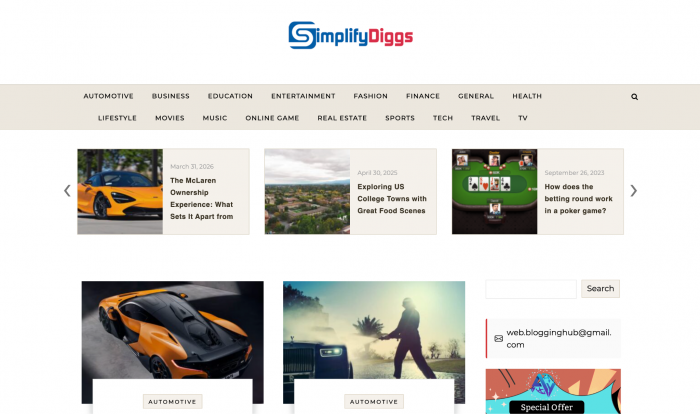
The website itself does not look suspicious at first. In fact, compared to many modern content-heavy platforms, it appears relatively polished. The layout is clean, the homepage is organized properly, and the categories are presented in a way that initially feels structured and professional. Nothing about the interface immediately signals low-quality publishing.
The confusion starts once the content begins overlapping.
Within a short browsing session, the platform moves from luxury supercar ownership stories to beginner poker strategies, then suddenly into enterprise technology explainers and generic business advice. The transitions feel abrupt enough that the site stops resembling a publication and starts feeling more like an algorithm testing different traffic opportunities simultaneously.
That unusual inconsistency ends up becoming the defining characteristic of SimplifyDiggs.com.
The Website Does Not Behave Like a Real Editorial Brand
Most established digital publications develop some kind of recognizable identity over time. Even broad lifestyle websites usually maintain a consistent audience focus, writing philosophy, or industry direction.
SimplifyDiggs never really establishes one.
The platform spreads itself across automotive content, gaming, entertainment, technology, travel, finance, lifestyle, sports, and business categories without creating any meaningful connection between them. The issue is not diversification alone. The problem is that the content categories feel assembled rather than curated.
A reader can move from a McLaren ownership article into cloud software pricing guides without any sense of editorial continuity. The website behaves less like a publication making deliberate coverage decisions and more like a search-oriented system expanding into every niche capable of generating traffic.
Eventually, the browsing experience starts feeling transactional instead of informative.
The Luxury Car Content Feels Strategically Engineered
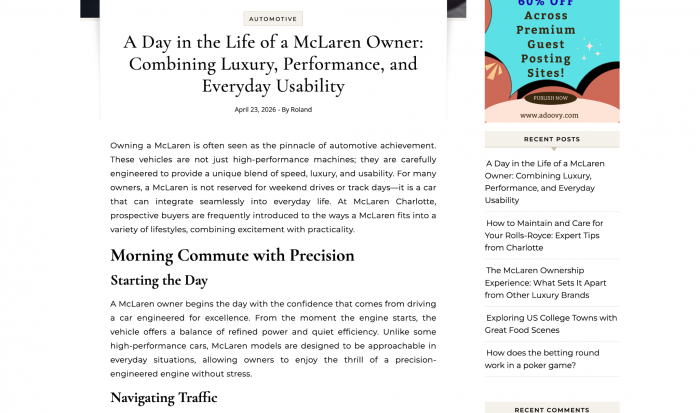
The automotive section is where the platform becomes especially interesting.
Several articles focus heavily on luxury vehicles, particularly McLaren ownership experiences and dealership-related discussions tied to McLaren Charlotte. The writing style in these pieces changes noticeably compared to the site’s older technology content. The tone becomes smoother, more aspirational, and carefully refined to create a premium atmosphere.
At first, the articles seem impressive enough. But after reading multiple entries, the pattern becomes difficult to ignore.
The content rarely discusses luxury car ownership with realistic balance. Maintenance concerns are softened, practical inconveniences barely exist, and every driving experience is described with cinematic enthusiasm. The articles often read more like emotional branding exercises than independent automotive analysis.
Repeated dealership references make this even more noticeable.
Nothing directly confirms sponsorship, but the writing consistently feels commercially aligned. That creates an awkward middle ground where the content presents itself as editorial while quietly behaving like promotional material.
The lack of transparency is what weakens credibility here, not the existence of marketing influence itself.
Older Articles Reveal What the Site Was Probably Built For

While the automotive section attempts to create a premium identity, the older technology articles expose a much more familiar publishing formula underneath.
Posts discussing subjects like wireless sensor networks, Cloudflare pricing, and data visualization software follow an extremely common SEO structure. The headlines target searchable long-tail phrases, the explanations remain intentionally broad, and the articles stretch basic information into extended content pieces without offering much technical depth.
These articles are not completely unreadable. Most are functional enough for beginners. But they rarely demonstrate firsthand expertise or unique analysis.
Instead, the writing feels engineered around discoverability.
Large portions of the content rely on predictable formatting:
● generalized introductions
● broad informational summaries
● repetitive explanations
● search-friendly subtopics
● lightweight conclusions
After enough reading, the platform begins feeling less like a knowledge source and more like a scalable publishing system optimized around ranking opportunities.
One Author Appears to Be an Expert in Everything
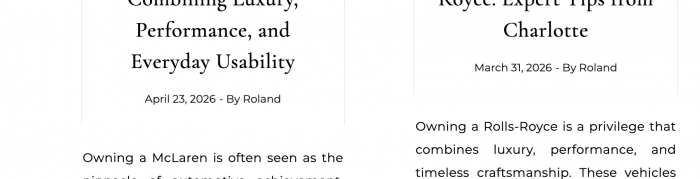
Another detail that quietly damages the site’s credibility is the overwhelming dependence on a single recurring author identity.
A large percentage of the content is attributed to “Roland.”
That becomes difficult to take seriously once the range of topics expands. The same author appears to cover:
● luxury supercars
● online gaming
● cloud infrastructure
● business software
● travel
● finance
● lifestyle trends
● technology systems
Professional publications usually distribute subject coverage across contributors with different backgrounds and expertise areas. SimplifyDiggs instead presents one centralized identity as the authority behind nearly every category on the site.
The problem is not the author name itself. The issue is the absence of meaningful credentials, expertise indicators, or professional background capable of supporting such broad subject coverage.
Eventually, the author structure starts feeling operational rather than editorial.
The Guest Post Economy Explains the Entire Website

One of the most revealing moments on SimplifyDiggs comes from a surprisingly small detail.
References connected to guest posting and publishing marketplaces appear openly enough to expose the broader business model behind the platform. Once that becomes noticeable, the structure of the website suddenly makes much more sense.
The broad category expansion, the keyword-driven article titles, the sponsored-feeling automotive pieces, and the endless unrelated niches all align with a monetization strategy centered around:
● organic search traffic
● backlink publishing
● sponsored placement opportunities
● scalable SEO visibility
At that point, the site stops feeling mysterious.
SimplifyDiggs does not appear designed to build a loyal readership through expertise or investigative journalism. It behaves much more like a content infrastructure platform where articles function primarily as searchable assets.
The Missing About Page Makes the Site Harder to Trust
The lack of a proper About Us page makes the credibility problem sharper. A site covering luxury cars, poker, cloud software, finance, travel, and business advice needs to explain who is behind it, what its editorial purpose is, and why readers should trust such a wide range of coverage.
Without that context, SimplifyDiggs feels less like a transparent publication and more like an anonymous publishing operation. A clear About page with ownership details, editorial direction, author background, and publishing standards would make the site easier to understand. Instead, readers are left judging the platform mostly by its design, categories, and article volume.
E-E-A-T Analysis : Thin Signals Behind a Polished Surface
From an E-E-A-T perspective, SimplifyDiggs has presentation but not enough proof. The site looks organized, reads smoothly, and covers many searchable topics, but it does not show strong experience, expertise, author authority, or trust infrastructure behind that content.
The biggest gaps are easy to identify: limited author background, no clear editorial policy, weak subject specialization, missing ownership context, and little evidence of firsthand testing or expert review. This matters because the site discusses topics where trust should be earned, not assumed. Until those signals improve, SimplifyDiggs works better as a casual browsing site than as a reliable authority source.
E-E-A-T Snapshot
| E-E-A-T Area | Site Signal | Review |
|---|---|---|
| Experience | Weak | Articles rarely show firsthand testing, direct observation, or personal expertise. |
| Expertise | Weak to moderate | The content is readable, but the site covers too many unrelated topics without clear expert support. |
| Authoritativeness | Weak | SimplifyDiggs does not build authority in one clear niche because the categories feel too scattered. |
| Trustworthiness | Weak | The missing About Us page, unclear ownership, limited author details, and no visible editorial policy reduce trust. |
Quick Rating Snapshot
| Area Evaluated | Score | Overall Impression |
| Website Design | 8/10 | Modern, clean, visually organized |
| Editorial Consistency | 4/10 | Extremely fragmented category structure |
| Content Depth | 5/10 | Functional but rarely insightful |
| Trustworthiness | 4/10 | Limited transparency and expertise signals |
| SEO Dependence | 9/10 | Search optimization clearly drives publishing |
| Reader Experience | 7/10 | Smooth browsing with minimal clutter |
| Industry Authority | 4/10 | Weak specialization across categories |
| Overall Reliability | 5/10 | Acceptable for casual browsing, questionable for expertise |
The Visual Polish Hides the Structural Weaknesses
To the site’s credit, SimplifyDiggs is more polished than many aggressive SEO-focused platforms competing online today. The pages are readable, the interface is relatively modern, and the website avoids the spam-heavy appearance common among lower-tier content farms.
That presentation quality matters because it initially makes the content appear more authoritative than it actually is.
But eventually the underlying publishing strategy becomes too visible to ignore. Once readers recognize the category fragmentation, repetitive SEO structures, and promotional undertones, the clean design stops functioning as effective camouflage.
Final Thoughts
SimplifyDiggs.com is not a completely broken website. It succeeds at producing readable content, maintaining a decent user experience, and presenting itself professionally enough to avoid immediate skepticism.
The larger issue is authenticity.
The platform behaves less like a publication with genuine editorial direction and more like a scalable content network designed to monetize search visibility across as many niches as possible. The luxury automotive section especially feels commercially influenced, while the older technology content exposes a formula built around traffic acquisition rather than expertise.
For casual readers searching for quick introductory information, the site may still serve a purpose. For readers looking for authoritative reporting, specialist insight, or trustworthy editorial analysis, the platform feels increasingly hollow the longer you explore it.