
You already know what good content looks like. You've read the frameworks, followed the gurus, consumed the courses. You understand SEO fundamentals, you know the posting cadences, you've colour-coded your content calendar. And yet here you are, three months behind on your own plan, publishing inconsistently, wondering why everyone else seems to have figured out something you haven't. The problem isn't that you don't know enough. It's that knowing and doing live in completely different parts of your brain.
The Real Scale of the Problem
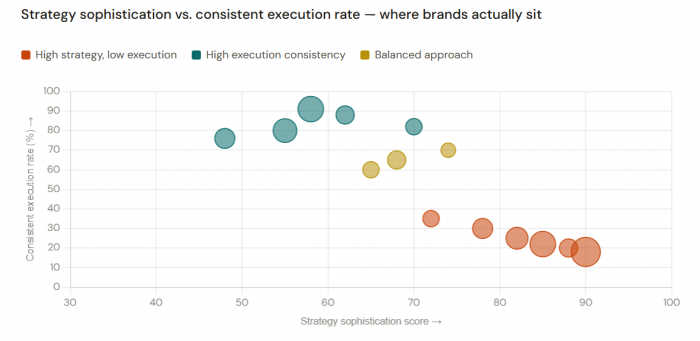
This isn't a personal failure. It's an industry-wide epidemic with measurable consequences. The distance between content strategy and its actual execution is one of the most consistently underreported causes of brand underperformance in digital spaces.
● 73% of marketers say they have a documented content strategy yet fewer than 40% describe it as mature or actively used
● 3.5× more leads generated by companies that prioritise consistent execution over those with elaborate strategies they rarely follow
● 63% of content teams cite "lack of time" as their biggest barrier but time is almost never the actual root cause
● 1 in 5 planned content pieces ever makes it to publication for the average solo creator or small team
The Content Marketing Institute's annual benchmark consistently finds that the highest-performing organisations are not necessarily those with the most sophisticated strategies. They are the ones with the shortest distance between decision and delivery. Strategy sophistication, without execution infrastructure, is intellectual decoration.
Anatomy of the Gap: Six Root Causes
The execution gap is not a monolith. It has distinct layers, and misdiagnosing which layer is broken leads to the wrong interventions. Most creators try to solve a motivation problem with a workflow tool, or a clarity problem with a discipline fix. Here is what the gap is actually made of.
The Clarity Illusion
You think you know your strategy. But ask yourself: can you describe your content's core premise not your niche, not your audience, your actual reason for existing in one sentence without hedging? Most creators can't. What they have is not a strategy; it's a collection of tactics glued together by vague intent. A real content strategy answers three non-negotiable questions:
● For whom, precisely? Not "entrepreneurs" but "first-generation founders building bootstrapped SaaS products who've never had a marketing hire."
● What singular problem do you solve through content? Not "education" or "inspiration" a specific recurring pain point your audience searches for answers to at 11pm.
● What does your content cause the reader to do, think, or feel differently? Strategy without a desired behaviour change is philosophy, not strategy.
Field Observation
In interviews with over 200 content creators across B2B and creator economy segments, those who could articulate their one-sentence content premise published 2.7× more consistently than those who described their content strategy in paragraph form.
The Planning-Without-Operationalising Trap
A content calendar is not a plan. It's a wishlist with dates. The missing layer between calendar and execution is operational translation converting each piece into a specific set of tasks, time estimates, dependencies, and decision triggers. Without this, every piece of content begins as a creative idea and becomes a cognitive negotiation every time you sit down to work on it.
The difference between planning and operationalising looks like this:
| Stage | Planning Mindset | Operationalised Mindset | Execution Impact |
| Ideation | "Write a post about email marketing" | "Write 1,200-word post on 5 subject-line formulas that lifted open rates targeting mid-level email marketers. Angle: counterintuitive data." | High clarity |
| Scheduling | "Publish Tuesday" | "Draft by Sunday 8pm. Review Monday 9am. Schedule Monday 11am for 6am Tuesday." | Accountable |
| Resource | "Need visuals" | "Canva template #3, brand palette, pull stat from row 14 of research doc." | Zero friction |
| Distribution | "Share on socials" | "LinkedIn post at 7am, Twitter thread 12pm, repurpose as newsletter section Friday." | Defined scope |
| Measurement | "See how it performs" | "Check engagement rate at 48h. KPI: 3% LinkedIn, 0.8% email CTR. Log in tracker." | Learnable |
| Backlog fallback | No plan if blocked | "If topic blocked: pull evergreen backup from Notion row 'E-queue'." | Often missing |
Decision Fatigue and the Daily Blank Slate
Every day a creator approaches content without a pre-committed workflow, they face a fresh slate of micro-decisions: What do I create? For which platform? In what format? What angle? What do I lead with? Each decision costs cognitive resources and by the time these are resolved, creative energy is already depleted before a word is written.
This is not a time management problem. It is a decision architecture problem. The solution is pre-commitment: locking decisions upstream so the only thing left is execution.
The Perfectionism–Consistency Tradeoff
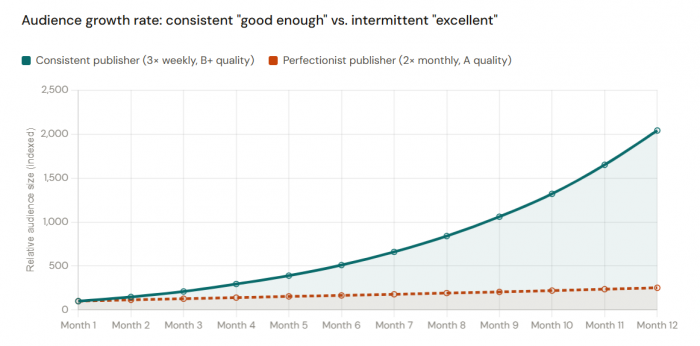
There is a documented inverse relationship between content perfectionism and output consistency. This isn't about lowering quality, it's about understanding that in content, the compounding effect of volume and frequency significantly outweighs the marginal gain of perfecting any individual piece. The audience that finds you inconsistently doesn't build a relationship with you at all, regardless of how polished each individual piece is.
The Repurposing Vacuum
Most content strategies treat each piece as a discrete unit. The highest-performing operations treat each piece as a core asset with multiple downstream expressions. When there's no repurposing plan built into the workflow, content teams end up creating from scratch every time tripling their workload for no proportional audience benefit. The gap widens because volume demands feel impossible to meet without recognising that one interview, one essay, one webinar can legitimately fuel eight to fifteen touchpoints across formats and platforms.
Misalignment Between Creator and Distribution Channel
Strategy often prescribes channel presence without interrogating creator energy. A creator who thrives in long-form written analysis building a primary TikTok strategy will execute poorly not due to lack of discipline, but due to format-energy mismatch. The execution gap here is a strategy design flaw, not a personal failure.
“Strategy should be built backwards from what a creator can sustainably produce, not forwards from what the algorithm theoretically rewards.”
The Execution Stack: What High-Output Creators Actually Do
Strip away the brand deals, the team announcements, and the viral moments and high-volume content creators have one thing in common: they have systematised every repeatable decision and left only creative judgment for the things that actually require it.
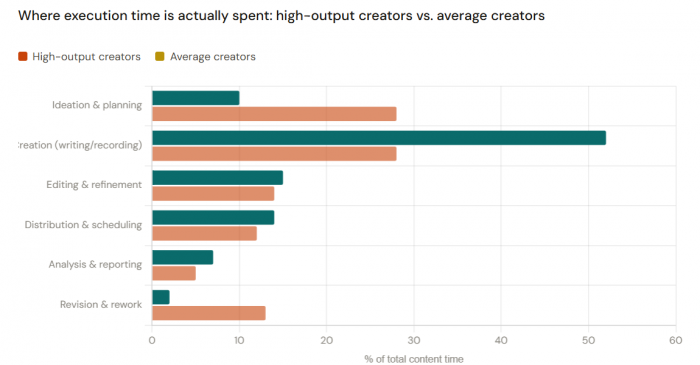
The practical differences come down to what we can call the Execution Stack, a layered infrastructure that sits beneath strategy and converts it into daily action.
The Five Layers of an Execution Stack
● Layer 1 — The Idea Reservoir: A consistently maintained backlog of pre-qualified ideas, already matched to formats, platforms, and audience stages. Not a dump of vague topics, a curated queue of ready-to-brief concepts with angles already chosen.
● Layer 2 — The Content Brief: Every piece that enters production gets a one-page brief: audience segment, core argument, supporting evidence, format, word count or duration, distribution plan, and success metric. Non-negotiable, even for short content.
● Layer 3 — The Production Workflow: A clearly defined sequence of states that every piece moves through Briefed → In Draft → In Review → Scheduled → Live → Repurposed. No free-form creative chaos; defined gates with clear owners.
● Layer 4 — The Repurpose Map: For every "pillar" piece (long-form article, podcast episode, webinar), a pre-defined repurposing tree showing exactly which derivative assets it will produce, in which sequence, and for which channels.
● Layer 5 — The Performance Feedback Loop: A lightweight tracking system that captures performance data at a fixed interval post-publication and directly informs the next 30 days of ideation. Not a vanity dashboard, a decision engine.
The Execution Gap by Creator Type
Not all creators experience the gap the same way. The failure mode changes significantly depending on creator context, and applying the wrong fix to the wrong problem is why generic advice so rarely works.
| Creator Type | Primary Gap Driver | Common Symptom | Highest-Leverage Fix |
| Solo creator / freelancer | Decision fatigue + perfectionism | Long gaps between posts, overthinking drafts | Pre-committed production schedule + “good enough” standard |
| Startup founder | Context-switching + no dedicated time blocks | Strategy exists on paper, sporadic bursts only | Batching sessions + delegation of distribution |
| Small content team (2–5) | Misaligned ownership + missing brief culture | Content quality inconsistent, team feels reactive | Content brief system + workflow states with clear DRIs |
| B2B marketing team | Approval bottlenecks + stakeholder misalignment | Long turnaround times, stale content by publication | Approval tiers + pillar–cluster architecture to reduce ad-hoc requests |
| Expert / thought leader | Format–energy mismatch + over-delegation | Content feels off-brand, creator disengaged from output | Format audit + ghost-writing brief alignment process |
How to Actually Fix It: The Execution Architecture Method
This is not a productivity tip. It's a structural intervention. The Execution Architecture Method operates on the premise that creative output is a systems outcome, not a willpower outcome. You cannot discipline your way to consistency; you must design your way there.
The method works in three phases, implemented sequentially over roughly six weeks.
Phase 1: The Strategy Stress Test (Week 1)
Before building any execution infrastructure, the strategy itself must be pressure-tested for operational viability. A strategy that cannot be practically executed is not a strategy, it is an aspiration document. Run each component of your current strategy through these diagnostic checks:
● Volume sanity check: Take your planned publishing frequency. Calculate the actual hours required to produce that volume at your current output rate. Does it fit within the time you realistically have available for content?
● Format-energy audit: Rank your planned content formats by your personal energy and skill level. Any format you've consistently avoided for more than 30 days despite planning it is a format that should be cut or outsourced.
● Specificity test: Rewrite your audience definition down to one person. If you can't describe their specific daily problem in their specific words, your targeting is too vague to drive coherent content decisions.
● Distribution reality check: For every channel in your strategy, confirm you have either ownership or a reliable contracted resource. Planned distribution with no operational owner does not exist.
Phase 2: Building the Operational Core (Weeks 2–4)
With a validated strategy, the operational infrastructure is built in a defined sequence not all at once, which leads to overwhelm and abandonment.
01. Build the Idea Reservoir
Spend one focused session generating 60–90 ideas. Don't filter. Then spend a second session scoring each against audience relevance, production effort, and strategic alignment. The top 20 become your active queue.
02. Create Your Brief Template
Design a single-page content brief you'll actually use. Keep it under 10 fields. It should take no more than 15 minutes to complete. If it takes longer, it won't be used consistently.
03. Define Your Production States
Map every piece through named workflow stages. Assign a maximum time limit for each stage. A piece stuck in any stage beyond its limit triggers a defined escalation publish as is, cut, or schedule to next window.
04. Set Batch Production Days
Content produced in batches (2–3 pieces per session) outperforms daily production in quality and consistency. Protect these sessions as fixed calendar blocks, not aspirational intentions.
05. Build One Repurpose Tree
Take your highest-performing format and map every downstream asset it can produce. Implement this for your next three pillar pieces before scaling the repurposing system further.
06. Install the Feedback Loop
Create a single tracking document. Every piece gets logged with five data points at the 72-hour mark: reach, engagement rate, click-through, qualitative response, and one hypothesis about what drove performance.
Phase 3: Calibration and the 90-Day Cadence (Weeks 5–6 Onward)
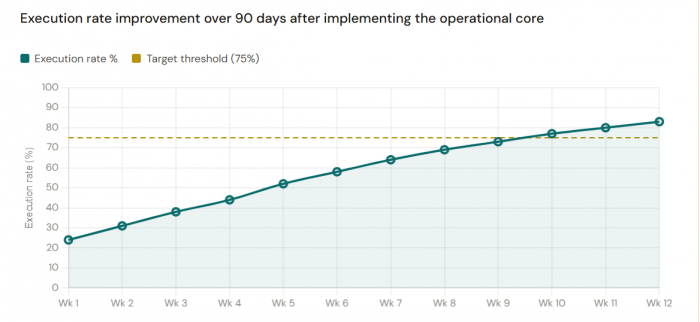
The system is now running, but it requires calibration. This is where most creators stop too early, assuming the system has failed when it has merely not yet compounded. The rule of thumb: give any new content execution system a minimum of 12 published pieces before evaluating its efficacy. This typically takes four to eight weeks depending on frequency.
At the 90-day mark, a formal content audit should examine:
● Execution rate: What percentage of planned content was actually published? Below 60% indicates a planning overload issue. Above 85% indicates the system is working and capacity can be explored.
● Format performance distribution: Which content types are driving disproportionate engagement relative to production effort? These are candidates for frequency increase.
● Audience signal analysis: What comments, replies, and DMs reveal about which topics are generating genuine resonance vs. polite engagement?
● Workflow bottleneck identification: At which production stage are pieces most commonly delayed? This stage is the priority for process improvement or resource investment.
The Measurement Layer: What to Actually Track
One of the most reliable causes of the execution gap is measuring the wrong things and then losing motivation when those metrics don't move fast enough. Vanity metrics follower count, likes, raw impressions are lagging, unpredictable, and only partially within a creator's control. The metrics that actually govern execution quality are leading indicators that can be influenced directly.
| Metric | Type | Why It Matters | Review Frequency |
| Execution rate (planned vs. published) | Leading | Directly reflects operational health of the system | Weekly |
| Time from brief to publication | Leading | Identifies bottlenecks in production workflow | Per piece |
| Content-to-distribution ratio | Leading | Measures repurposing efficiency — output per core asset | Monthly |
| Ideas queued (reservoir depth) | Process | Early warning signal for creative drought before it hits | Weekly |
| Saves and shares per post | Process | Quality signal: saves indicate utility, shares indicate resonance | 72h post-publish |
| Follower / subscriber growth | Lagging | Outcome of execution over months — not a real-time indicator | Monthly only |
| Total impressions | Lagging | Heavily algorithm-dependent; best not to optimise for this directly as a primary metric | Quarterly |
The Core Principle
Measure the system, not just the output. A content operation with an 85% execution rate, a full idea reservoir, and a two-day average production cycle will outperform almost any competitor in its space within six months regardless of its starting audience size. The system is the strategy made real.
The One Shift That Changes Everything
After everything the frameworks, the tables, the workflow states, the measurement layers it comes down to a single cognitive reframe. Stop treating content as a creative expression that happens to have a distribution plan. Start treating it as a manufacturing operation that happens to require creativity.
Manufacturing operations don't stall because inspiration didn't strike. They don't miss deadlines because the creator wasn't feeling it. They have inputs, a process, defined outputs, and quality standards. The creative part, the part that makes content worth consuming, is still there. It just lives inside a container that guarantees it gets made.
The creators and teams who have closed the execution gap completely have done so by making peace with one uncomfortable truth: their most important content asset is not any single piece they've made. It's the operational reliability that ensures the next piece gets made, and the one after that, and the one after that until the compounding finally, inevitably, makes itself visible.