Uzzu TV occupies a strange spot in the streaming market: too well-known to be a fringe player, too unreliable to be recommended without serious qualification. Sold as a budget escape from $80-a-month cable replacements, it markets one promise above all others every NFL, NBA, NHL, and MLB game with no regional blackout, delivered for less than the cost of a single league pass. The execution of that promise is where the trouble begins.
What Uzzu TV actually is
Stripped of the homepage gloss, Uzzu TV is an internet-protocol television service oriented almost exclusively around live American professional sports. Subscribers receive credentials usually from an M3U playlist or Xtream codes that are loaded into a third-party IPTV player such as IPTV Smarters, TiviMate, or, where available, a recommended companion app. There is no listing in the Apple App Store or the Google Play Store, no presence on the Roku channel store as an official application, and no DVR, no replays, and no on-demand library to fall back on when a stream fails.
The core offering centers on four leagues: the NFL, NBA, NHL, and MLB, packaged alongside a rotation of premium entertainment channels totaling roughly 61 in the standard lineup. Soccer, UFC, boxing, and pay-per-view events appear depending on availability. The selling point is structural: because Uzzu sources feeds from a centralized pipeline rather than licensed regional networks, the geo-blackouts that frustrate fans of out-of-market teams simply do not exist on this platform.
What it costs and what's quietly disappeared
The original three-tier structure of weekly, monthly, and annual subscriptions has, by most recent accounts, been consolidated heavily toward the annual plan. Multiple long-time subscribers report that monthly billing was withdrawn and that the website's references to short-term plans no longer reflect what is actually offered at checkout. A weekly trial occasionally resurfaces but is not a stable option to rely on.
| Plan | Approximate Cost | Stated Inclusions | Reality on the Ground |
| Weekly Trial | ~$8.99 / week | 1080p sports streams, 2 device limit, all four leagues | Availability intermittent; sometimes withdrawn entirely |
| Monthly | ~$19.99 / month | Historic tier with 100+ sports channels at some point | Reported as discontinued or unreachable through standard signup |
| Annual | $119 – $129 / year | Full season access, no blackouts, all four leagues | The default and effectively only consistent option |
At the annual rate of roughly $129, the math is undeniably attractive equivalent to about $11 per month for coverage that would cost three to four times as much across legitimate league passes and a cable replacement service. The catch, as the next several sections make plain, is that the price-per-promise calculation only matters when the service actually delivers what was paid for.
Channels, sports and the gaps nobody mentions
The sports inventory is the strongest part of the product description. The NFL package includes Sunday Ticket equivalents, NFL Network, and NFL RedZone. The NBA side covers something close to a League Pass scope with roughly forty games a week visible plus ESPN and ABC national broadcasts. NHL Center Ice and the major regional sports networks appear on most plans, and MLB feeds, including in-market RSN coverage and the league-owned network, complete the four-league lineup.
What gets advertised heavily
● NFL Sunday Ticket-style access plus NFL RedZone and NFL Network
● NBA League Pass-equivalent volume with national broadcasts
● NHL Center Ice with regional sports networks
● MLB in-market coverage and MLB Network
● UFC pay-per-view prelims, boxing main cards, and select wrestling
● European football including Champions League and Premier League
What rarely gets mentioned
College football and college basketball coverage is patchy and inconsistent one of the most common complaints from subscribers who assumed a Saturday slate would be included. Premium entertainment add-ons such as movie channels exist in the 61-channel bonus tier, but the lineup shifts unannounced, and channels disappear without notice. When ESPN distribution disputes affected mainstream providers earlier this year, Uzzu's mirrored feeds degraded as well, leading to a noticeable drop in usability during the most-watched window of the college football and NFL playoff schedule.
We have had Uzzu for years with no problem at all. This year the service has deteriorated to something almost unusable. Unless it improves I can't justify renewing. They had the best service. It's a shame. - Veteran subscriber, public review platform, January 2026
Where it runs, and the friction nobody warns about
Compatibility is broad on paper. The service explicitly supports Amazon Fire TV and Fire TV Stick, Roku, Android TV boxes, NVIDIA Shield, Xbox, Windows and macOS browsers, iOS and Android phones, and a range of smart TVs through external IPTV apps. The reality is messier. Without a native, vendored application in any major app store, every device setup requires sideloading or third-party app configuration, which is straightforward for technically comfortable users and frustrating for everyone else.
The companion apps recommended at various points the original Uzzu app, NUFU Pro, Smart One, IPTV Extreme, and others change with frequency. Subscribers report that an app working perfectly one season is replaced with new instructions the next, sometimes requiring the user to email the MAC address from the device screen and wait for a manual configuration response. That workflow is acceptable in theory and disastrous in practice when support response times stretch into weeks.
What paying subscribers actually report
The most useful question to ask about any IPTV provider is not what the homepage says, but what the people writing in after they have paid actually report. The aggregated picture across the four most-cited consumer review platforms is unambiguous: a low overall trust score, dominated by a small but persistent group of satisfied long-term users and a much larger contingent of recent buyers who feel either disappointed or financially burned.
Uzzu TV across major consumer review platforms
● Sitejabber - 1.9 stars, 45 reviews
● Trustpilot - 2.1 stars, 897 reviews
● PissedConsumer - 2.5 stars, 7 reviews
● Trustindex.io - 3.1 stars, 20 reviews
Roughly 970 combined reviews across the four platforms converge on a weighted score in the low-twos out of five. This is not the distribution of a service experiencing isolated technical hiccups. It is the signature of a structural reliability problem combined with deteriorating post-sale support.
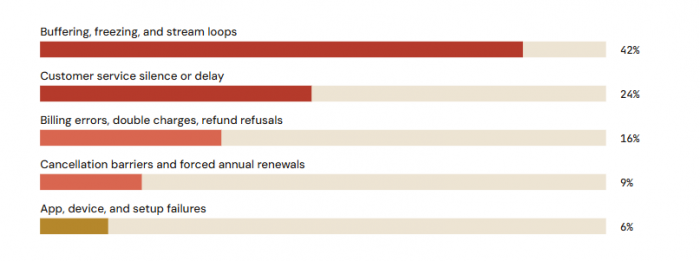
Complaint Frequency Breakdown
Five recurring failure modes
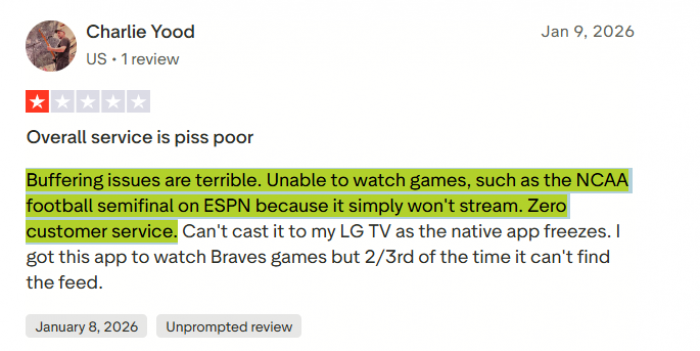
1. Buffering during the games that matter most
The most frequent complaint is also the most damning. Subscribers with confirmed download speeds well above 100 Mbps report streams that freeze for ten-second intervals, loop the same play repeatedly, or fall fifteen minutes behind live action. The pattern is particularly acute on Sunday afternoons during the NFL season and during marquee national broadcasts exactly the windows the service is purchased to cover.
2. The five-minute delay nobody warns you about
Streams typically go live around five minutes ahead of scheduled tip-off or kickoff but trail the actual broadcast feed by several minutes during play. Acceptable for casual viewing, unworkable for anyone watching with bettors or trying to coordinate with a second screen.
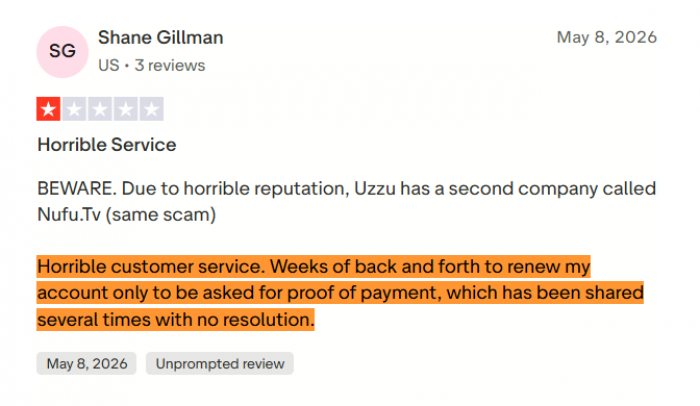
3. Customer service that disappears at exactly the wrong moment
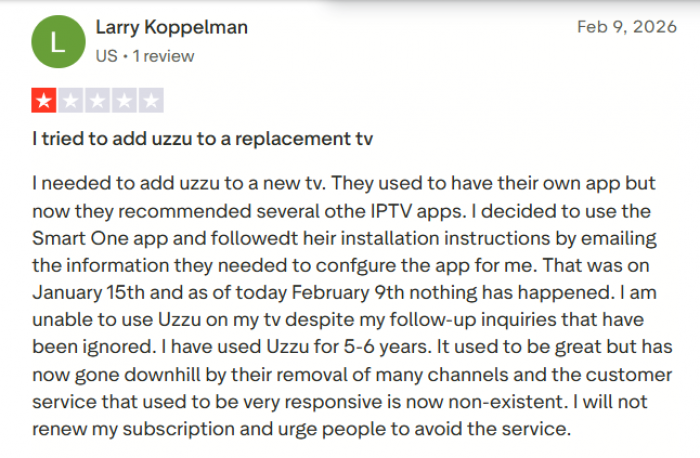
Reports of unanswered support emails are unusually consistent. The pattern is not a slow response but no response sometimes after a confirmation that a ticket was opened, sometimes after a single boilerplate apology with no follow-through. One review platform notes that the company has not been replying to negative reviews at all, which compounds the issue when public complaints are the only escalation route a frustrated user has left.
4. Billing that turns into a dispute
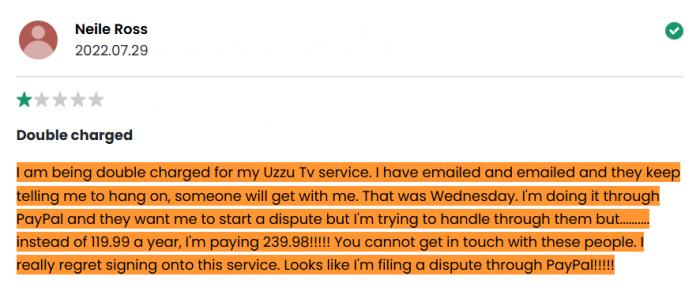
Two failure modes appear repeatedly. The first is double charges: subscribers report paying the annual rate, then seeing a second identical charge appear within days, with no acknowledgment from support and no refund forthcoming. The second is unauthorized renewals on cards customers believed had been removed. Both cases tend to end in either a PayPal dispute or a credit-card chargeback rather than a resolved support ticket.
5. Account blocks without explanation
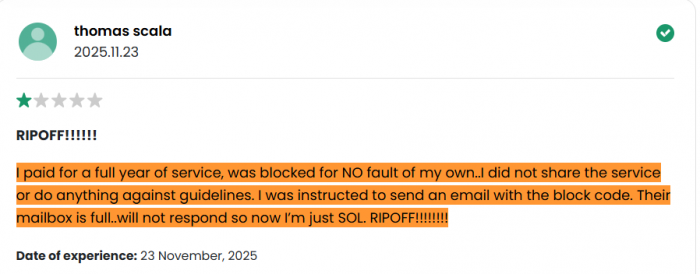
A smaller but distinct cluster of complaints describes paying customers being locked out mid-subscription, told to email a block code to a support address, and then receiving either an inbox-full bounce or no reply at all. Whether these blocks reflect anti-piracy enforcement, VPN detection, or technical errors is unclear from the outside but the absence of any communication path back to a working subscription is consistently described.
The streams used to be dependable, but now support is non-existent. If your stream glitches during a game, you'll have no help at all. - Trustpilot review
Where loyalists still defend it
The positive minority is worth examining honestly, because the people defending Uzzu TV are not necessarily wrong about their experience. Multi-year subscribers, particularly those who set up the service early, use a hardwired ethernet connection, and watch on Fire TV with a clean cache consistently report a workable experience. Their gratitude is grounded in two specific values: the absence of regional blackouts on out-of-market team coverage, and the per-month price working out to about a quarter of what FuboTV's sports-focused tier costs after the regional sports network fees are tacked on.
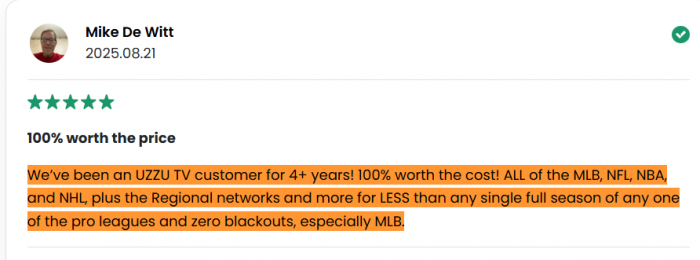
The honest read on the praise is that Uzzu TV is not a uniformly bad product. It is a product whose quality has degraded measurably between the period when long-term defenders signed up and the period when recent buyers wrote their negative reviews. Both groups are describing the same service at different moments in its decline.
The Legal Question : The grey area nobody acknowledges clearly
Uzzu TV markets itself as a legitimate streaming service. Independent analysts and most technical reviewers disagree. The absence of any official licensing arrangement with the leagues whose content is being redistributed, the lack of presence in any verified app store, and the use of M3U playlists and third-party players to deliver feeds all sit firmly in IPTV grey-market territory. Enforcement against individual end users is rare, but the operational risk that the service is shut down mid-season, taking the unrefunded balance of an annual subscription with it is real and explicitly mentioned in subscriber reviews going back several years.
The service's recommendation that customers use a VPN while streaming is itself an implicit acknowledgment that the legality story is more complicated than the homepage suggests. A genuinely licensed streaming service does not need its subscribers to mask their IP addresses.
Pros and cons, weighed honestly
What works
● True out-of-market coverage with no regional blackouts on the four major US leagues
● Annual pricing equivalent to roughly $11 per month a fraction of legitimate sports-tier streaming
● 1080p stream quality when the connection is hardwired and the stream is stable
● Broad device compatibility through standard IPTV players
● Multi-year subscribers report consistent service for the first two to three seasons
What doesn't
● Buffering, freezing, and stream loops during high-traffic game windows
● Customer service that does not consistently respond to billing or technical issues
● Documented patterns of double charges and unauthorized annual renewals
● No DVR, no replays, no on-demand library to fall back on
● No official app store presence every setup requires third-party software
● Operates in a legal grey area without licensed content distribution
● Cancellation and refund processes that frequently end in payment-processor disputes
● Service quality has visibly declined across the past two seasons by subscriber consensus
Five Alternatives worth considering instead
None of the legitimate alternatives match Uzzu TV's price-to-content ratio. That is the honest trade-off. What they do offer is licensed content, official applications, predictable billing, real customer service, and the operational stability of being able to survive a regulatory crackdown without dragging the subscriber's annual fee with them.
Fubo

Best for serious sports coverage
The closest legal substitute for what Uzzu TV is sold as. Sports-first lineup with NFL RedZone, regional sports networks, and one of the broadest sets of niche channels available soccer, combat sports, racing, and college coverage. High stream quality and 1,000 hours of cloud DVR. The cost is real, and regional sports network fees push the actual monthly outlay higher than the headline number.
Pricing : ~$80 / mo
YouTube TV

Best mainstream all-rounder
The most polished overall live-TV experience, with broad sports coverage including ESPN family, NBC, CBS, Fox, and most regional sports networks. Unlimited cloud DVR and three concurrent streams are included. Less specialized than Fubo on combat sports and international leagues but stronger on integration, app quality, and predictable billing.
Pricing : ~$83 / mo
Sling TV

Best budget legal option
The cheapest path to live ESPN, Fox networks, and major sports content among legitimate providers. Sling Orange covers ESPN and ABC-adjacent content; Sling Blue picks up NBC and Fox. The combined plan still undercuts both Fubo and YouTube TV. Tradeoffs include fewer regional sports networks and a less comprehensive overall channel count.
Pricing : ~$46 / mo
DIRECTV Stream
Best for regional sports networks
The most cable-like of the cord-cutting services. Heavy investment in regional sports networks makes this the strongest option for following local pro teams without satellite. Multiple package tiers allow scaling up or down depending on whether national or local sports coverage is the priority. Pricier than Sling, less specialized than Fubo.
Pricing : ~$80 / mo
Hulu + Live TV
Best bundle value
Live TV with 95+ channels, plus the full Hulu on-demand library, Disney+, and ESPN+ rolled into one subscription. Sports coverage is solid across all four major leagues. The bundle calculus is the genuine differentiator for households already paying separately for streaming entertainment and a live-TV service, this consolidates the bill meaningfully.
Pricing : ~$83 / mo
The Final Scorecard: How Uzzu TV grades on what matters
Editorial Scorecard · Out of 10
| Metric | Score |
| Content coverage | 8.0 |
| Price-to-value (in theory) | 8.8 |
| Stream reliability | 3.8 |
| Stream quality (when stable) | 7.0 |
| Customer support | 2.5 |
| Billing transparency | 3.5 |
| Setup friction | 5.0 |
| Legal and operational risk | 3.0 |
| Overall | 5.4 |
The Bottom Line : Who, if anyone, should still subscribe
Uzzu TV makes the most defensible case for itself in exactly one scenario: a technically comfortable user with a hardwired internet connection, a primary interest in out-of-market access to one specific team across one of the four covered leagues, a tolerance for occasional buffering during peak windows, and the willingness to handle billing disputes through a payment processor rather than the company's support team. For that narrow profile, the annual cost is low enough to absorb the operational risk and the reliability concerns.
For everyone else and that is the larger group the calculus has shifted. The aggregated review data is not ambiguous, the customer service pattern is not improving, and the legal posture of the service has not changed. A legitimate live-TV alternative will cost three to five times as much per month and deliver something the budget IPTV market structurally cannot: a service that will still be answering the phone next season, regardless of what enforcement actions or distribution disputes affect the broader streaming landscape.
The honest verdict is not that Uzzu TV is unusable. It is that what it costs in money has become much less interesting than what it costs in stability, support, and peace of mind. The original promise of every game, no blackouts, one low price is still alive on the homepage. It is much harder to find in the actual customer experience.