WhatsonTech.org looks active from the first visit. It publishes across AI, software, business technology, digital tools, crypto, gaming, education, and workplace topics. But activity alone does not make a website authoritative. The real question is whether WhatsonTech gives readers enough proof to trust its content beyond basic topic discovery.
This review looks at WhatsonTech.org from a reader’s point of view: what it publishes, how the content feels, where the expertise shows, where transparency feels weak, and whether readers should treat it as a reliable tech source or a search-focused content site.
First Impression: Active, Broad, and Easy to Scan
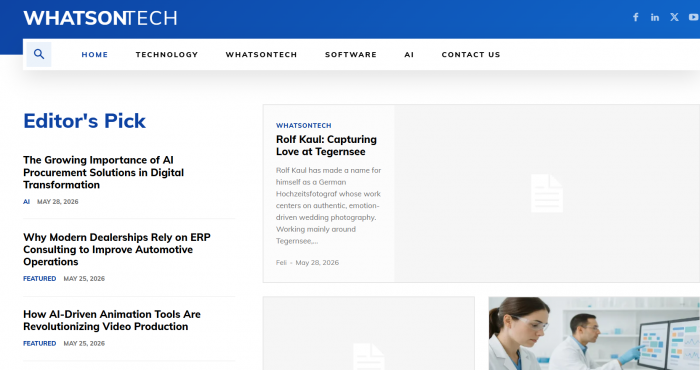
At first glance, WhatsonTech.org feels like a busy technology blog. The layout is familiar, the categories are easy to understand, and the homepage shows a steady flow of recent articles. A reader can quickly find posts around AI, software, website operations, business systems, automation, and digital transformation.
That first impression is not negative. An active site with recent posts is better than a dead domain or a thin website with outdated pages. WhatsonTech appears to publish regularly, and its topics match areas people are actively searching for right now.
The issue starts with the range. The site does not stay inside one tight technology niche. Alongside AI and software content, readers may also find workplace culture posts, business-service articles, local service profiles, and topics that feel less connected to core tech publishing. That wide mix makes the site look less like a specialist publication and more like a broad content platform.
For casual readers, this can still be useful. For readers looking for expert guidance, it creates a trust question. A site can cover many topics, but the wider the coverage becomes, the more it needs strong author profiles, editorial standards, sourcing, and clear disclosure.
The Content Map: Tech, AI, Software, and Some Unexpected Turns
WhatsonTech.org’s content can be divided into a few broad areas. This helps explain what kind of site it appears to be.
| Content Area | What Readers Will Notice |
| AI and automation | Articles about AI tools, AI-assisted coding, procurement automation, productivity, and digital transformation. |
| Software and SaaS | Posts about business software, workplace systems, website tools, remote-work apps, and platform operations. |
| Technology and business operations | Content around ecommerce, cybersecurity, ERP, workplace culture, migration, and digital infrastructure. |
| Broader digital topics | Gaming, crypto, education, and internet-adjacent content that expands the site beyond a narrow tech niche. |
| Service/profile-style posts | Some articles feel closer to guest-post or promotional content than independent technology analysis. |
This content map shows the strength and weakness of WhatsonTech at the same time. The strength is coverage. A reader can land on the site and find many topics connected to modern digital work. The weakness is focus. When a site covers too many areas without strong visible author expertise, it becomes harder to know which subjects it truly understands.
A focused software review site can build trust by testing products. A cybersecurity publication can build trust through expert authors and technical depth. An AI publication can build trust through model testing, tool comparisons, prompt examples, and output analysis. WhatsonTech has the topic coverage, but it does not consistently show that deeper layer of proof.
The Reader Test: Does the Content Go Beyond the Basics?
The easiest way to judge WhatsonTech.org is to ask a simple question: after the first few paragraphs, does the article tell the reader something they could not find in a basic SEO explainer?
In many cases, the writing is clear and easy to follow. The articles use short sections, direct language, and simple explanations. That makes the site accessible for beginners. Someone who wants a quick introduction to an AI or software topic may find the content useful.
The weakness is depth. Many posts explain what a topic is, why it matters, and how it can help businesses, but they do not always move into original analysis. Strong tech content usually adds something extra: product screenshots, test results, expert quotes, current pricing checks, real examples, benchmarks, security warnings, or side-by-side comparisons.
WhatsonTech.org often feels strongest at the “understand the topic” stage, not the “make a decision” stage. That is an important distinction. A reader may use the site to learn basic vocabulary or understand a trend, but they should not rely on it alone before buying software, choosing an AI tool, following cybersecurity advice, or making business decisions.
The writing style also leans toward familiar business-tech language. Phrases around digital transformation, efficiency, automation, workflows, and smarter decisions appear often in this type of content. Those ideas are relevant, but without examples and evidence, they can make the writing feel generic.
The Author Question: Who Is Behind the Advice?
A tech article does not only need to be readable. It needs to make the reader confident about who is speaking.
This is one of WhatsonTech’s weaker areas. The site shows author names on posts, but the visible author identity does not appear strong enough for a serious technology publication. Some names read more like display names than detailed expert profiles. Readers do not get enough context about the writer’s background, qualifications, industry experience, or area of expertise.
That matters because WhatsonTech.org covers subjects where expertise is important. AI, cybersecurity, software, business systems, cloud infrastructure, and automation are not casual topics. If an article discusses software decisions, security practices, or business technology, readers should know whether the author has tested the product, worked in the field, interviewed experts, or researched the topic deeply.
A proper author profile should ideally show the writer’s full name, professional background, subject area, article history, and role on the site. It should also clarify whether the person is a staff writer, contributor, guest author, or sponsored content creator.
Without those signals, the content may still be readable, but the trust level drops. The reader is left judging the article mostly by the wording, not by the author’s expertise.
Contact Page, Advertising Signals and the Missing About Page
This is the most important transparency issue on WhatsonTech.
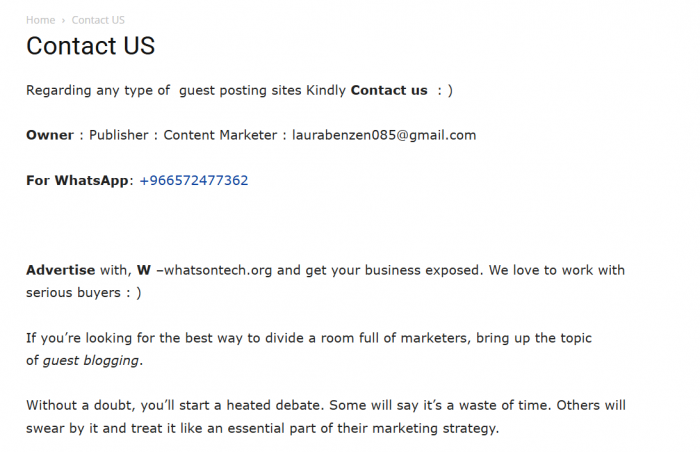
The Contact page is not written like a standard publication contact page. Instead of focusing only on editorial inquiries, corrections, reader support, or newsroom contact details, it directly mentions guest posting, advertising, an owner/publisher/content marketer email, and WhatsApp contact information. It also includes language about guest blogging, backlinks, SEO performance, and finding reputable guest blogging sites.
That does not automatically mean the site is fake or unsafe. Many websites accept guest posts or advertising. The problem is that when a site positions itself around guest posting and promotion, it needs stronger transparency elsewhere. Readers should be able to tell which articles are independent editorial content, which are contributed posts, and which are paid or promotional placements.
The missing About page makes this weaker. A proper About page should explain who runs the site, when it was started, what its editorial mission is, who the editorial team is, what topics it specializes in, and how articles are reviewed before publication. Without that page, readers have less context about the people and process behind WhatsonTech.org.
For a technology site, this matters more than it might seem. Tech content often influences buying decisions, software choices, security practices, AI adoption, and business workflows. If a site accepts guest posts or advertising, readers need clear separation between editorial guidance and promotional publishing.
A stronger version of WhatsonTech would include:
● A clear About page explaining the site’s ownership, purpose, editorial focus, and publishing standards.
● A contributor policy that explains whether guest posts are accepted and how they are reviewed.
● A sponsorship or advertising disclosure page that separates paid content from editorial content.
● Author pages with real bios, topic expertise, article archives, and professional links.
● A correction policy so readers know how errors are handled.
● Clear labels for contributed, sponsored, or partner content.
Right now, the Contact page gives more evidence of content placement and advertising activity than editorial structure. That does not make every article unreliable, but it changes how readers should interpret the site.
The Search-First Signal: When SEO Feels Stronger Than Editorial Identity
WhatsonTech.org appears search-first. That does not automatically make it bad. Every online publication needs search traffic, and SEO is part of modern publishing. The issue is whether SEO is supported by strong editorial quality.
Several signals make the site feel search-first. The topic range is very wide. The articles often match keyword-friendly subjects. The structure is easy to scan and built around common explainer patterns. Some posts also feel closer to service or profile content than independent technology reporting.
The concern is not that WhatsonTech uses SEO. The concern is that search visibility appears stronger than editorial identity. A reader can understand what topics the site publishes, but it is harder to understand what the site is known for, who its experts are, and what standards guide its content.
That is the gap between a search-focused content site and an authoritative technology publication. A search-focused site can help readers discover topics. An authoritative site helps readers make better decisions because it proves experience, expertise, and accountability.
The Trust Gap: What Is Present and What Is Missing
WhatsonTech.org does have some basic trust signals. It is active, structured, and easy to navigate. It has visible categories, recent posts, social labels, and contact access. Those are positive signs.
But a stronger tech publication needs more than activity. It needs proof of editorial responsibility.
| Trust Signal | WhatsonTech Shows | What Is Still Missing |
| Publishing activity | The site appears active and publishes across current tech topics. | Activity does not prove expertise, independence, or accuracy. |
| Topic coverage | It covers AI, software, technology, crypto, education, gaming, and business tools. | The broad range needs stronger author credentials and editorial standards. |
| Author names | Articles show bylines or display names. | Detailed bios, credentials, social links, and subject expertise are not clearly strong. |
| Contact access | The site provides a contact page with email and WhatsApp details. | A proper About page, ownership details, editorial policy, correction policy, and sponsorship disclosure would improve trust. |
| Readable structure | Articles are easy to scan and beginner-friendly. | Original testing, citations, screenshots, and deeper reporting are not consistently visible. |
This is the central trust gap. WhatsonTech has the surface of an active publication, but not enough visible evidence to prove strong editorial authority.
For a casual blog, that may be acceptable. For a site writing about AI, software, cybersecurity, and business technology, it is a limitation. Readers need to know not just what the article says, but why the article should be trusted.
Where WhatsonTech.org Actually Helps
WhatsonTech.org is not useless. Its best value is discovery-level reading.
If someone wants a quick introduction to a topic, the site can help. The writing is usually simple, the articles are easy to move through, and the topics are relevant to current digital work. A reader can use WhatsonTech to understand basic terms, discover related ideas, or get a general sense of a subject before researching further.
It may be helpful for readers who want to get a simple overview of an AI, software, or technology trend before reading deeper sources. It can also help readers understand business-tech language without needing technical documentation. For broad discovery, that has value.
That is the right way to use WhatsonTech. It can introduce a topic, but it should not close the research process.
Where Readers Should Slow Down
Readers should be more cautious when an article moves from general explanation to advice. This is especially important in areas where a bad decision can cost money, expose data, or mislead a business.
If WhatsonTech.org discusses software selection, readers should verify pricing, features, user reviews, and official documentation elsewhere. If it discusses cybersecurity, readers should cross-check with security experts, vendor documentation, or government-backed security resources. If it covers AI tools, readers should look for hands-on tests, current product pages, output examples, and real user feedback.
The biggest caution areas are software buying decisions, cybersecurity topics, AI tool recommendations, and business service articles. These areas need more than readable explanations. They need evidence, expertise, and current verification.
This does not mean readers should avoid the site entirely. It means they should read it with context. WhatsonTech can help frame a subject, but important claims should be checked elsewhere.
The Bigger Issue: Active Does Not Mean Authoritative
WhatsonTech.org’s biggest challenge is not a lack of content. It has content. The challenge is proving why that content deserves trust.
Many search-focused websites publish frequently. Frequency helps visibility, but authority comes from evidence. A site becomes more trustworthy when it shows qualified authors, clear sourcing, editorial review, correction policies, original reporting, first-hand testing, and transparent sponsorship rules.
WhatsonTech does not appear to make those signals strong enough. The site may be active, but activity is only one layer of trust. A reader still needs to know who wrote the article, how the information was checked, whether the article is independent, and whether the author has enough experience to guide readers.
That distinction is what separates a general content site from an authoritative publication. WhatsonTech currently looks closer to the first category than the second.
Final Reflection
WhatsonTech.org is an active, readable, search-focused technology content site. It can be useful for casual readers who want simple introductions to AI, software, business technology, and digital trends.
But it does not show enough visible expertise, author transparency, original reporting, editorial depth, or site-level transparency to be treated as a high-authority tech publication. The Contact page’s focus on guest posting, advertising, and backlinks makes the missing About page even more noticeable.
The fairest verdict is this: WhatsonTech.org is useful for basic overviews and topic discovery, but readers should verify important claims through official sources, established expert publications, product documentation, independent reviews, or first-hand testing.
It is not necessarily unreliable, but it is not strong enough to be the final source for serious technical, business, security, or buying decisions.