The honest answer, the trade-offs, and a five-tag formula that survives 2026's platform limits.
For about three years, my posting routine ended the same way every time. I wrote a caption, pasted in a block of thirty hashtags I kept saved in my notes app, hit publish, and hoped the numbers would move. Sometimes they did. Most times they did not, and I could never tell you why.
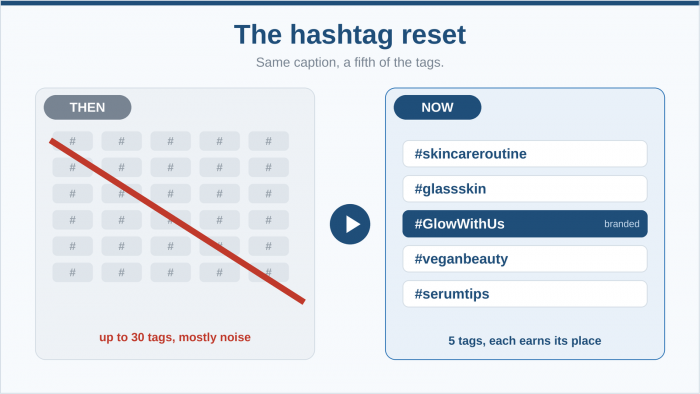
Then Instagram quietly capped hashtags at five, and that saved block turned useless overnight. I had to actually decide which tags earned their place. That dragged a question into the open that I had been dodging for years: when I pick my small handful of tags, should they be branded ones tied to me, or trending ones tied to whatever the internet is shouting about this week?
This article is the answer I wish someone had handed me back then. I will walk through what each type actually does, show you the exact moments where one beats the other, and hand you a formula you can run on any platform without guessing. By the end, the question in the title stops being a coin flip.
What Hashtags Actually Do Now (And Why the Old Playbook Broke)
Before I can answer which hashtags to use, I have to clear up what hashtags even do anymore, because the job changed while most of us were still copy-pasting.
Here is the short version. Hashtags used to be a distribution channel. You could follow a tag like #travelphotography, and posts using it would show up in your feed. More tags meant more doors into more feeds. That mechanism is gone. Instagram removed the ability to follow hashtags in December 2024, so a tag no longer pushes your post toward strangers on its own.
What replaced that role is quieter but still useful. Hashtags now work as labels that tell the algorithm what your post is about and who might want to see it. Adam Mosseri, who runs Instagram, has said plainly that hashtags no longer lift reach the way people assume. They categorise. They help your content surface when someone searches a topic.
So as you read the rest of this guide, hold one idea in your head: a hashtag is a filing label, not a megaphone. That single reframe decides everything about branded versus trending, which I get into next.
What Branded Hashtags Are
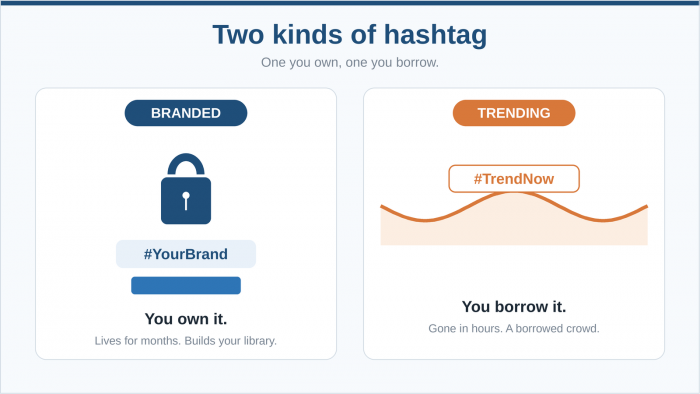
A branded hashtag is a tag you own. You invent it and use it consistently, until it becomes a little home for everything connected to your brand.
It does not have to contain your company name. #ShareACoke worked for Coca-Cola without spelling out the brand in the tag, and #LikeAGirl carried an entire Always campaign. Nike’s #JustDoIt is a slogan that doubles as a gathering point for posts. The thread running through them is ownership: each tag belongs to one brand and means one thing.
Why bother creating one? A branded hashtag turns scattered posts into a searchable collection. When a customer films themselves using your product and adds your tag, you can find that clip and repost it, building a library of proof that real people use what you sell. It also gives a campaign a measurable boundary. Count the posts under the tag and you have a rough read on how far the idea travelled.
The catch is patience. A brand new branded hashtag reaches almost nobody on day one, because nobody is searching for a tag they have never seen. It needs awareness before it earns its keep, which is why a tiny account inventing #MyBrilliantStartup2026 hears crickets for a while. Branded tags reward the long game, a point that matters when I line them up against trending tags below.
What Trending Hashtags Are
A trending hashtag is the opposite kind of animal. You do not own it. You borrow it. It is a tag riding a wave of attention right now, whether that wave is a cultural moment, a weekly ritual like #MondayMotivation, or a sudden spike around a news event or a new gadget release.
The appeal is obvious. A trending tag already has a crowd standing around it. Step into the conversation at the right moment and your post can reach people who have never heard of you. For a brand new account stuck in the cold-start problem I described with branded tags, that borrowed visibility is tempting.
The trouble comes bundled. Competition is brutal, because every other opportunist piles onto the same tag, so your post sinks within hours. The lifespan is short too, since today’s trend is tomorrow’s dead tag. Worst of all is the relevance trap: bolt a trending tag onto a post it has nothing to do with, and you pull in people who bounce instantly, which teaches the algorithm that your content disappoints. That backfire got more dangerous in 2026, and I will spell out why in the mistakes section.
Branded vs Trending, Side by Side
I find decisions easier when the trade-offs sit in one place, so here is the contrast I keep in my head when I plan a post.
| Factor | Branded hashtag | Trending hashtag |
|---|---|---|
| Ownership | You create and control it | Borrowed from a public moment |
| Main purpose | Identity and community | Quick visibility |
| Speed of reach | Slow to build | Fast, sometimes instant |
| Longevity | Months or years | Hours to days |
| Competition | Low, you own the space | High, everyone piles in |
| Tracking | Easy to measure a campaign | Hard to isolate your impact |
| Best suited for | Long-term growth and UGC | New accounts chasing reach |
| Biggest risk | Slow start, low early reach | Irrelevance and penalties |
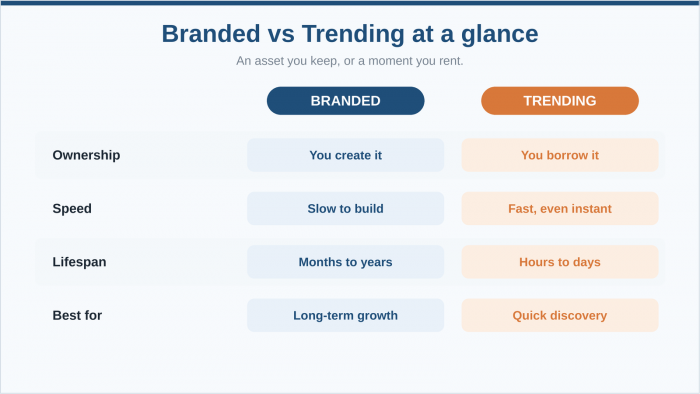
Read down the two columns and a pattern jumps out. Branded tags are slow to start but compound over months. Trending tags spike fast and fade just as fast. One builds an asset you keep. The other rents you a moment. That difference is the whole reason the next two sections exist, because the right pick depends entirely on which of those outcomes you are chasing.
When Branded Hashtags Are the Right Call
Reach for a branded hashtag when you are playing for keeps rather than for a spike.
A couple of situations make this obvious. If you are building a personal brand or a business identity, a consistent tag becomes the spine that holds your content together over the years. The same goes for any campaign you need to measure, since a unique tag is the cleanest way to count what your idea produced. Branded tags also give your audience a place to drop the content they make about you, which is how user-generated proof piles up.
Picture a small skincare startup launching a thirty-day challenge. They create #GlowWithUs, ask buyers to post their before-and-after photos under it, and suddenly they own a folder of authentic testimonials they can reshare for months. The tag did two jobs at once: it tracked the campaign and it built a community around it. No trending tag could pull that off, because a trending tag belongs to everyone and remembers no one.
When Trending Hashtags Earn Their Spot
Trending tags shine in the moments branded tags cannot reach: when you need eyes now and you have something genuinely relevant to add.
The clearest case is a young account with no audience yet. You have good content and nobody to show it to, so borrowing a crowd makes sense. The second case is timeliness. If a relevant cultural moment is happening and your post legitimately fits it, riding that wave can introduce you to thousands of people in an afternoon. A bakery posting a clever take on a viral food trend belongs in that conversation. A bakery slapping #WorldCup on a plain croissant does not.
That last line is the rule. The second a trending tag stops being relevant to your post, it stops helping and starts hurting, for reasons I lay out in the mistakes section coming up. Use trending tags as a discovery tool while you are small, then lean harder on branded tags as your own audience grows. The two are stages of a journey, not rivals.
The Strategy That Beats Picking One
Here is where I landed after all the testing, and it is the real answer to the title: you do not pick. You blend, but you blend inside the hard limits each platform now enforces.
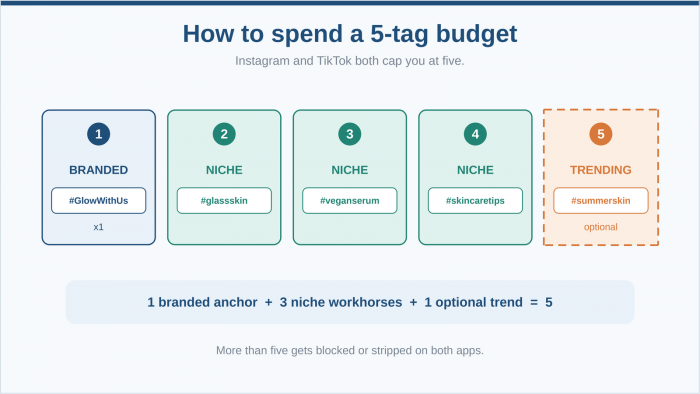
The old advice still floating around says things like “use two branded, five niche, and three trending tags for thirty total.” Ignore it. That formula is a relic from when Instagram allowed thirty hashtags. Since December 2025, Instagram caps posts and Reels at five, full stop. Try to add a sixth and the platform blocks the post or strips the extras. TikTok holds the same five-tag ceiling. So any plan built on stuffing ten or more tags is already dead on the platforms most people care about.
Inside a five-tag budget, here is the mix I use. Spend most of your slots on niche tags that describe exactly what the post is about, since those are the labels that actually help the algorithm file you correctly. Keep one slot for a branded tag so the post joins your own collection. Then, only if a trend genuinely fits, spend one slot on a trending tag. On a five-tag post that lands at one branded, three niche, and an optional trending tag.
The counts shift by platform, though, and treating every app the same is the fastest way to look like a spammer. This is the cheat sheet I keep pinned.
| Platform | Tags per post | What to prioritise |
|---|---|---|
| 3 to 5 (hard cap at 5) | Niche tags, one branded | |
| TikTok | 3 to 5 (cap at 5) | Niche plus one fitting trend |
| 3 to 5 | Industry and niche topics | |
| X (Twitter) | 1 to 2 | One relevant or trending tag |
| 1 to 2 | Keep it minimal | |
| YouTube | 3 to 5 (never above 15) | Topic tags; over 15 voids them all |
| 10 to 15 | Descriptive keyword tags |
Two numbers on that chart catch people off guard. X punishes hashtags fast: one or two lift engagement, but three or more drag it down. And YouTube hides a landmine, because cross the fifteen-tag line and it ignores every hashtag on the video, including the valid ones. Match your habits to the column you are posting in, and you sidestep penalties most creators never notice.
Mistakes I See Constantly (And Made Myself)
Every painful lesson here cost me reach before I understood the rules above. Learn them cheaper than I did.
- Bolting on irrelevant trending tags. This is the backfire I flagged earlier. An off-topic trend pulls in viewers who swipe away in a second, and in 2026 that bounce signals low-intent content, which gets you shown less. One large study found posts leaning on hashtag stuffing pulled in roughly a third fewer views.
- Stuffing the caption. The thirty-tag dump is not only outdated, it is now blocked on Instagram and TikTok. More tags stopped meaning more reach a long time ago.
- Recycling the same block on every post. Copy-pasting one saved set tells the algorithm nothing specific about each piece. Tailor the tags to the actual content in front of you.
- Skipping niche tags for mega ones. A tag like #love or #marketing is so crowded your post vanishes in seconds. Smaller, specific tags reach a smaller crowd that actually cares about your topic.
- Never checking what worked. If you are not glancing at which tags drove reach in your analytics, you are guessing. Drop the dead ones and keep the performers.
Notice that four of those five mistakes come from treating hashtags like a reach hack instead of the filing labels they became. Fix the mindset and the tactics follow.
So, Which Should You Use?
If you came here wanting me to crown one winner, here is the honest verdict: branded and trending tags answer different questions, so the right one depends on the question you are asking today.
Choose branded when you are building something that should still be standing next year. It is your identity and the home for everything your customers make about you. Choose trending when you are small, hungry for discovery, and holding something that authentically fits the moment.
For almost everyone, the move is to run both at once inside that five-tag budget: a branded anchor, a core of niche tags doing the heavy lifting, and a trending tag only when it earns the slot. Branded tags are the savings account. Trending tags are the lottery ticket you buy occasionally with money you can spare.
Pick your next post, open your analytics from the last month, and swap your three weakest tags for sharper niche ones. That single edit will teach you more about your own audience than any list of best hashtags ever could.