I used to think the photo did all the work. Post something good, drop in a few hashtags, wait for the likes. Then I started studying the accounts I kept coming back to, and most of them weren’t posting better photos than mine. They were writing better captions. The thing I’d been treating as an afterthought was carrying the post.
This guide is everything I learned closing that gap. I’ll hand you the framework I run every post through, a swipe file of hooks, the mistakes that quietly drain your reach, and side-by-side rewrites that take a flat caption and turn it into one that pulls comments. None of it assumes you write for a living. It assumes you have something worth saying and want more of the right people to read it.
Start where the engagement actually begins, which is understanding why the words under your photo matter as much as the photo itself.
Why Instagram Captions Matter More Than Most People Think
The image stops the scroll. The caption decides what happens next. It hands people context and gives them a reason to do something about what they’re seeing.
Here’s the part that changed how I write. When a caption sparks a reply, people linger on the post, and that dwell time tells Instagram the post is worth pushing to more feeds. Saves and shares carry even more weight than a quick like now, because they signal that someone found your post useful enough to keep or send to a friend.
There’s a slower payoff too. A steady voice across your captions is how strangers start recognizing you. Give it a few weeks and people stop scrolling past “some account” and start reading you.
Worth remembering: a caption can’t save weak content. It can pull a lot more engagement out of content that’s already good.
The 5 Elements of a High-Engagement Caption
Every caption that has worked for me carries the same five parts. Drop one and the whole thing gets shaky. I’ll take them in order, because they stack on each other.
1. Open With a Hook That Survives the Cutoff
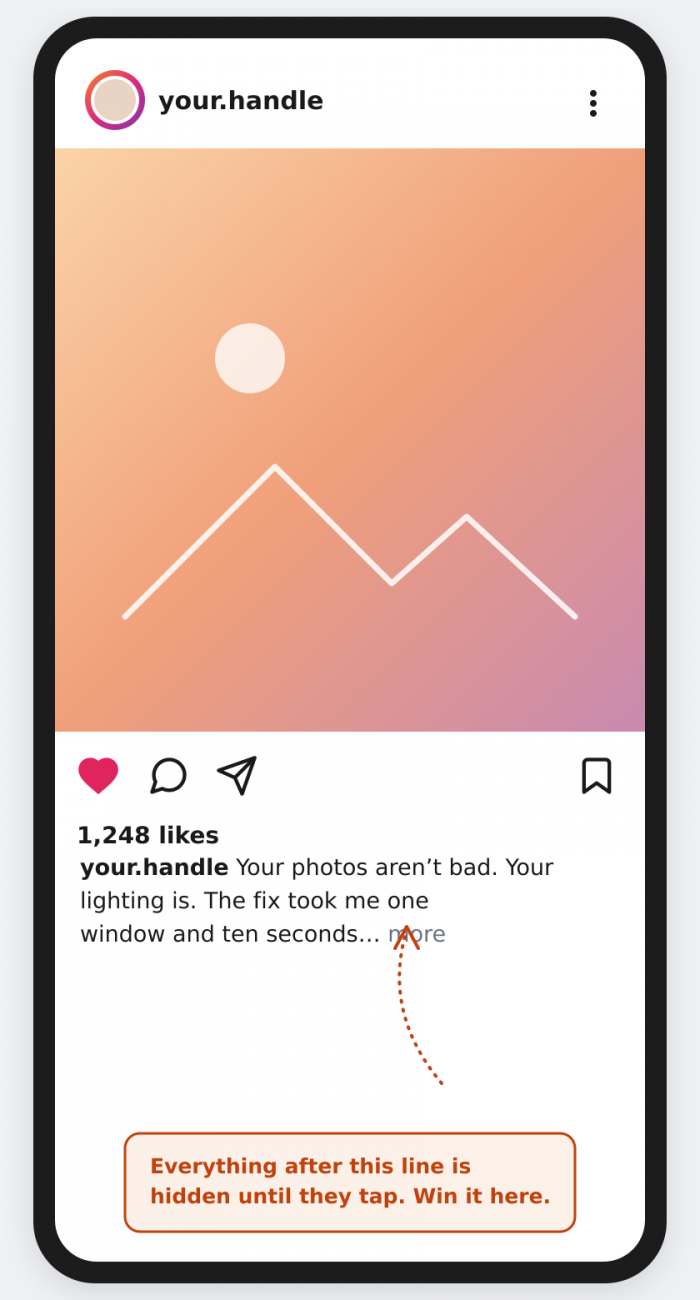
Instagram shows only the first line or so before it collapses your caption behind “...more.” If that opening line doesn’t earn the tap, nobody reads the rest. Your first sentence isn’t a warm-up. It’s bait.
A few ways I open:
- A claim bold enough that people want to argue with it
- A question aimed straight at a real frustration
- A number or fact that lands somewhere unexpected
- A curiosity gap that holds back the payoff
I keep a whole file of openers I rotate through, and I’ve laid out twelve of them in their own section further down. For now the rule is simple. Write the hook as if the next line depends on it, because it does.
2. Tell a Story Instead of Selling
People scroll past pitches and stop for stories. A small moment from your day, a peek at what happened before the clean final shot, the kind of detail that feels human and pulls a reader in.
Watch the difference:
WEAK: Our new planner is now available. Link in bio to shop.
STRONGER:I missed my sister’s birthday because I “forgot.” That was the week I built the planner that’s now in my bio.
Same one I use so the things that matter stop slipping past me.
The product sits in both versions. Only one makes you feel something before it asks for the click.
3. Earn the Read With Value
Give people a reason to keep going past line one. Value shows up in a few forms. Teach them something they can use, move them, or make them laugh. A caption that nails one of those earns the save, and saves feed your reach, as I mentioned a moment ago.
4. End With One Clear CTA
“Like and follow” asks for the laziest action on the platform, so it rarely starts a conversation. Trade it for one specific invitation. This is the swap table I keep open while I write.
| Tired CTA | Swap that pulls more |
|---|---|
| Like if you agree | Which side are you on? Tell me below. |
| Follow for more | Save this so it’s there when you need it. |
| Check the link in bio | Tag the one friend who needs to see this. |
| Comment your thoughts | What would you have done? I read every reply. |
One ask per caption. Two splits attention and you walk away with neither.
5. Make It Easy to Read
A block of text gets skipped on sight. I break captions into short paragraphs, leave a line of space between them, and add an emoji only when it pulls its weight.
You get 2,200 characters. You rarely need them. A 40-word caption that says one thing well beats a 300-word one that wanders. Use the length your point earns, then stop.
The OPEN Framework: My Formula for Any Caption
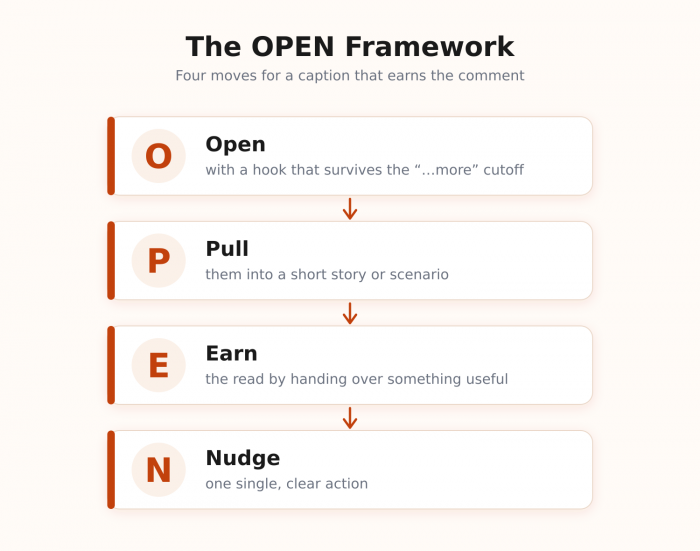
When I’m staring at an empty caption box, I run four letters. I call it OPEN, partly because that’s the job: a good caption opens a door.
O: Open with a hook that survives the “...more” cutoff
P: Pull them into a short story or scenario
E: Earn the read by handing over something useful
N: Nudge one clear action
Those four steps are the five elements from the previous section, squeezed into something you can run in your head. Here’s a full caption built on it:
I lost 4,000 followers overnight and it was the best thing that happened to my account.
Most of them never engaged anyway. When they left, my reach per post climbed, because the people who stayed actually cared what I posted.
If your follower count dipped lately, check your engagement rate before you panic. A small, awake audience beats a big, sleeping one.
What’s your engagement rate sitting at right now? Drop it below and I’ll tell you whether it’s healthy.
Four moves, every line earning its place.
12 Caption Hooks That Grab Attention Instantly
This is the file I promised you up in the hook section. Twelve openers that consistently stop the scroll, with the reason each one works and the kind of post it fits.
| Hook | Why it works | Reach for it on |
|---|---|---|
| “Nobody tells you this...” | Promises insider info | Educational posts |
| “I wish I’d known this sooner.” | Regret signals high value | Tips and lessons |
| “Here’s what happened when...” | Opens a story loop | Experiments, personal stories |
| “Stop doing this.” | A pattern interrupt with a jolt | Myth-busting |
| “The biggest mistake I see...” | Frames you as the one who knows | How-to content |
| “If you’re struggling with this...” | Names a problem people feel | Solution posts |
| “You don’t need X to get Y.” | Punctures a common assumption | Beginner advice |
| “Most creators get this wrong.” | Curiosity plus a nudge to the ego | Contrarian takes |
| “The truth about X.” | Promises an honest reveal | Transparency, debunking |
| “Read this before you post again.” | Urgency tied to their next move | Quick tips |
| “This cost me $400 to learn.” | A specific number buys attention | Hard-won lessons |
| “Unpopular opinion:” | Invites agreement and pushback | Debate starters |
Don’t burn all twelve in one week. Rotate them, and match the hook to what the post is actually about. A story hook slapped on a sales post reads like a bait-and-switch.
Common Mistakes That Quietly Kill Engagement
I’ve made every one of these. Each row pairs the problem with the fix, so you can scan for the one you’re guilty of.
| Mistake | Why it hurts | The fix |
|---|---|---|
| Writing with no goal | The caption wanders and asks for nothing | Decide the one action you want before you type |
| A flat opening line | It dies behind the “...more” cutoff | Lead with your strongest hook |
| No CTA | Readers enjoy it, then drift off | Add one specific ask |
| Giant text blocks | People skip what looks like work | Short paragraphs with line breaks |
| Hashtag overload | Reads as spam and buries your words | A handful of relevant tags at the end |
| Robotic tone | Nobody bonds with a brochure | Write the way you’d text a friend |
| Selling every post | Audiences tune out a constant pitch | Give several times for every time you sell |
| Ignoring the comments | Conversations die on arrival | Reply fast, especially in the first hour |
Look closely and most of these are just one of the five elements gone missing. The cure is almost always going back to the part you skipped.
Real Captions, Rewritten: Bad vs Better
Principles click once you watch them work. Here are three post types, each with the weak version I’d have shipped a few years back and the one I’d publish now. Every rewrite is the OPEN framework doing its job.
Educational Post
WEAK Some tips for sharper photos. Natural light helps. A clean lens helps too.
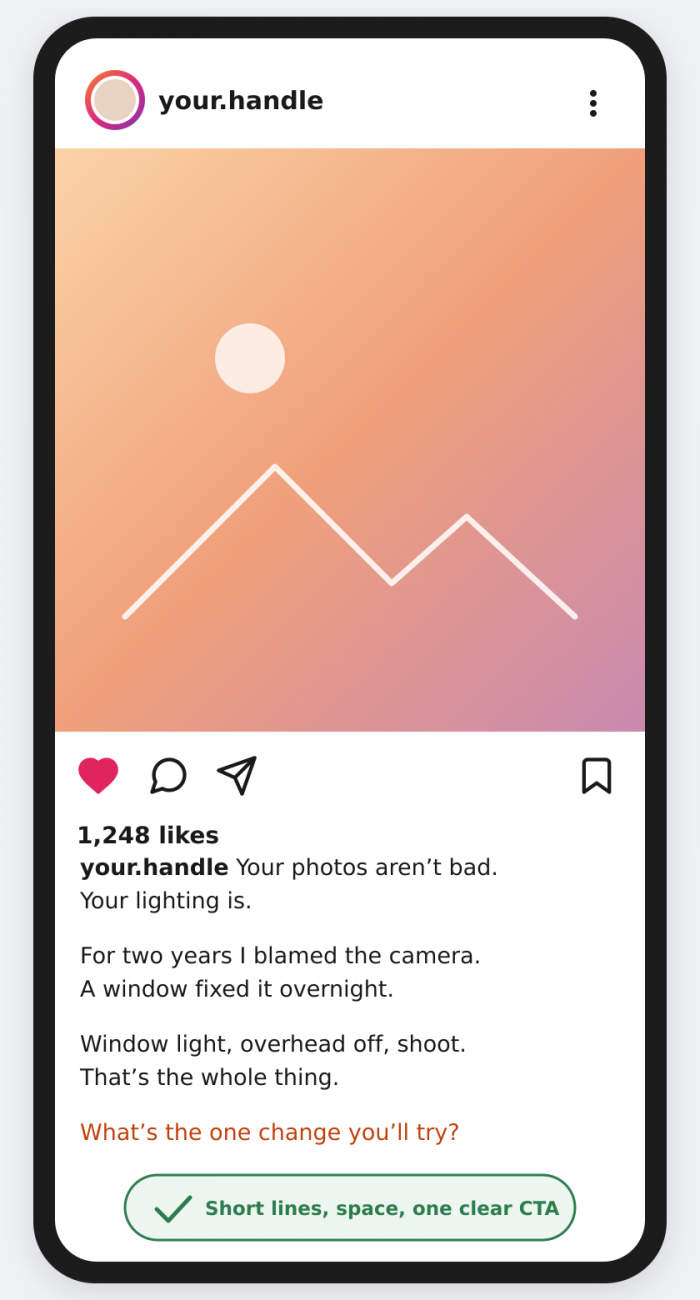
STRONGERYour photos aren’t bad. Your lighting is.
For two years I blamed my camera. Then I started shooting next to a window in the morning, and everything looked different overnight.
Move within three feet of a window, kill your overhead light, then shoot. That’s the whole fix.
Try it on your next post and tell me if you can see the difference.
Product Promotion
WEAK New candles in stock. 20% off this week. Shop the link in bio.
STRONGER
My apartment used to smell like old takeout and deadlines.
I started making these candles because I wanted a small daily reset, something to light the second the laptop closes. They’re 20% off this week, link in bio if you want one.
What’s the one scent your space is missing?
Personal Story
WEAK Throwback to last year’s trip. Good times with good people.
STRONGER
A year ago today I quit the job everyone told me to keep.
This photo is from the week after. I was broke, a little terrified, and lighter than I’d felt in years.
If you’ve been sitting on a decision you keep pushing to next month, treat this as your sign to stop researching and choose.
What’s the leap you keep putting off?
Three post types, one structure underneath all of them. Once you see the pattern, you stop writing captions from scratch and start filling in a shape you already trust.
Before You Hit Publish: A Quick Checklist
I run every caption through this before it goes live. It takes fifteen seconds and saves me from posting flat.
☐ Does the first line still pull a tap after the “...more” cutoff? ☐ Is there a clear reason to read past line one? ☐ Did I give a story, a lesson, or a laugh? ☐ Is there exactly one CTA? ☐ Can someone scan it in a couple of seconds? ☐ Does it sound like me and not a template? ☐ Did I read it out loud to catch the clunky parts? |
Seven boxes. The day a caption checks all seven tends to be the day it beats the three before it.
The Bottom Line
Good captions are a skill that compounds. The first ten you write with a deliberate hook and a single CTA will feel mechanical. By the fiftieth, the structure runs in the background, and you start bending the rules on purpose, because by then you know why each one is there.
Treat this guide as a scaffold you will outgrow.
The OPEN framework and the hook swipe file exist for one reason: to get you to the point where you trust your own ear. Until you’re there, lean on them.
Let your own analytics settle every argument. When two captions disagree, the one that pulled more saves and replies was right, whatever a guide told you. Watch which hooks earn the tap and which CTAs get answered, then write more of those.
Your move: open the next post, write the first line before you choose the photo, and build down from there. A caption that opens on the right sentence is already halfway to the comments.