
I posted every day for six weeks. Then one Tuesday I opened a blank document and had nothing.
That blank screen is where most content advice fails you. We get told to show up and stay consistent, but nobody hands us the machine that makes consistency possible once motivation is gone and the calendar still says post today.
The hard part was doing it again next week, and the week after, without my brain feeling scraped clean. I wrote this for creators, freelancers, marketers, and small-business owners who want to publish on a schedule they can keep.
A myth to drop first: consistent creators are not more gifted than you. They built a process that remembers and sorts for them. Consistency is a rhythm you can hold for a year, usually one strong anchor piece a week with smaller pieces pulled from it. Here is how to build it, in order.
Why Most Creators Run Out of Content Ideas
The blank screen has four causes. They stack, which is why willpower alone never fixes it.
Creating Instead of Capturing
Most people capture and create in the same moment, waiting for inspiration at the keyboard. Professionals capture all week and create later from a full well. That one habit explains most of the gap between people who last and people who quit by month two. The fix is the idea bank, below.
Lack of a Content System
Posting at random feels free for a few weeks, then decision fatigue turns every blank day into an argument with yourself. A framework ends the argument: content pillars, next.
Consuming More Than Creating
Feeling unprepared, you read and save more until research feels like progress. Past a point it only produces paralysis: forty open tabs, no published post. The cure is a place to put what you consume so it converts into ideas, which is the idea bank again.
Perfectionism
You hold a post back because it is not perfect, and not yet becomes never. The post you ship at seventy percent teaches you more than the masterpiece in drafts, because real readers react to real work.
So here is the reframe. Consistency is not a creativity problem. It is a systems problem. The rest of this guide builds that system, starting with the foundation.
The Foundation: Build 3 to 5 Content Pillars
Everything ahead sits on this. Content pillars are why you stop staring at a blank calendar wondering what you are about.
A pillar is one of the few core themes you return to again and again, like the main rooms in a house. Every post lives in one. Most creators do best with three to five: fewer and you sound repetitive within a month, more and your audience cannot tell what you stand for.
Pick pillars where what you know well meets what your audience wants and what moves your goals. Test each one: could you post on it fifty times without boredom, and does someone genuinely care? Pass both and it stays.
Here are five that work for a personal-brand coach:
- Personal Branding
- Marketing
- Productivity
- Business Growth
- Industry Trends
Now make yours, before reading on, because the engine next runs on these answers.
| Your pillar | Why you are credible here | What the audience wants | How it serves your goals |
|---|---|---|---|
| Pillar #1 | |||
| Pillar #2 | |||
| Pillar #3 | |||
| Pillar #4 | |||
| Pillar #5 |
The Idea Engine: Storage, Sources, and Angles
With pillars set, build the engine that makes ideas on demand. It has three parts. Storage is one home where every raw idea lives. Sources are where raw ideas come from. Angles are the shapes that turn a raw idea into a finished topic. Build them in that order, because you need the container before you fill it.
Part 1: Build an Idea Bank That Never Runs Dry
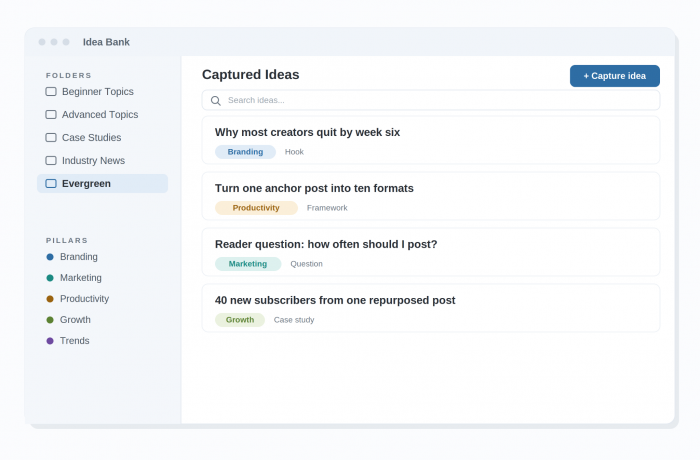
This is the fix for capturing and creating at once. An idea bank is one trusted place where you drop every spark the moment it appears, so your brain can let it go. Use whatever captures fastest, a notes app or a board. If saving takes longer than ten seconds, you will stop.
Capture more than finished ideas:
- An offhand observation about your work
- A question someone asked you
- A short personal story
- A statistic or screenshot worth keeping
- A real example of something done well or badly
- A reaction to someone else's post
Once a week, sort it into folders and tag each idea with its pillar:
- Beginner topics
- Advanced topics
- Case studies and examples
- Industry news with a short shelf life
- Evergreen ideas that never expire
Part 2: Where Your Ideas Will Come From
The bank only works if something fills it. Four sources keep it topped up, each answering a different question.
Audience questions come first, because they are handed to you. Mine comments, email replies, DMs, sales calls, and support tickets. Keep a note titled questions people actually ask; it becomes the most valuable page in your bank.
Competitor research reads demand someone has already proven. Watch a rival's best posts, the complaints repeating in their comments, and the obvious questions none of them has answered. That last one is your opening.
Community research is unfiltered, because people speak plainly about what frustrates them. Skim subreddits, Quora, active Facebook groups, busy LinkedIn comments, and industry forums, sorted by the threads with the most replies.
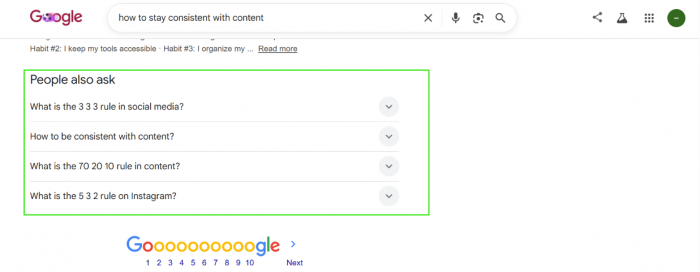
Search intent reveals the people who never ask you and just type into a search bar. Four free sources show their words: autocomplete, the People Also Ask box, the related searches at the bottom of the page, and a video platform's search suggestions.
Part 3: 10 Angles That Turn Any Pillar Into a Topic
A raw idea is not a topic yet; an angle gives it shape. Apply any angle below to a pillar and you have a topic with a title. Run one pillar through all ten and you have ten posts.
- How-To. Teach one result step by step. Title: How to plan a month of content in an afternoon.
- Mistakes. Name the errors costing results. Title: 7 content mistakes killing your reach.
- Myths vs Facts. Correct a wrong belief. Title: The post-daily myth, and what actually grows an audience.
- Beginner Guide. Take a newcomer to a first win. Title: A beginner's guide to your first content calendar.
- Checklist. Make a process tickable. Title: The checklist I run before every post.
- Case Study. Break down one real result. Title: How one repurposed post brought 40 subscribers.
- Lessons Learned. Share what experience taught you. Title: 5 lessons from my first year posting weekly.
- Before and After. Show a transformation. Title: My workflow before and after I built a system.
- FAQ. Answer the questions you keep getting. Title: Your top questions about staying consistent, answered.
- Trend Analysis. React to something new and say what it means. Title: What the latest platform change means for small creators.
One pillar, ten angles, ten topics, with the others untouched. Next, stretch one topic across a week of platforms.
How to Turn One Idea Into 20 Pieces of Content
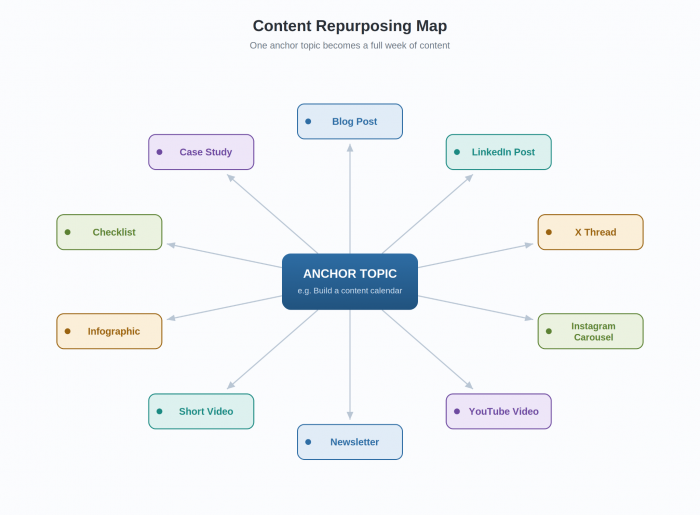
Consistency stops being expensive here. You need one strong idea and a habit of reshaping it, the multiplication I promised in the introduction. Take one topic, say building a content calendar, and reshape it into formats native to each place:
- A long-form blog post, the anchor
- A LinkedIn post with the main insight
- An X thread of the steps
- An Instagram carousel, one step per slide
- A YouTube video walking through it
- A newsletter with your take
- A short vertical video on the best tip
- An infographic of the process
- A downloadable checklist
- A short case study
That is ten. To reach twenty, split the long pieces: a ten-step post becomes ten short videos, a thread becomes several graphics. Create one anchor a week, then batch-slice it into the rest. You produce once, then repackage.
The Weekly Content Planning Routine
A system you cannot run on a busy week is useless. This routine fits in one morning.
Collect for fifteen minutes, skimming your sources and dropping ideas into the bank by pillar. Prioritize for fifteen more, picking one anchor topic plus its spin-offs by asking whether each helps your audience or earns trust. Batch-create the anchor in one block; several posts in one sitting beats one post on several days, because you skip the cost of starting cold. Schedule everything so a bad Thursday cannot break your streak. Then measure: note your best two or three pieces, ask why they worked, promote winning themes into stronger pillars, and drop the angle that flopped. Treat analytics as next week's idea source rather than a report card.
| Day | Task | Time |
|---|---|---|
| Monday | Collect and prioritize, then choose the week's anchor topic | 30 min |
| Tuesday | Batch-create the anchor piece in one focused block | 2 hr |
| Wednesday | Repurpose the anchor into the smaller formats | 1 hr |
| Thursday | Schedule the full week ahead | 20 min |
| Friday | Review last week's numbers and update your pillars | 20 min |
What This Looks Like in Practice
What does this look like in people who last? Three habits, none repeating the theory above.
They document instead of invent. A founder films a clip on a decision she just made; a freelancer writes up the client problem he solved that morning. The work produces the content, so there is no separate idea time to dread.
They reuse what already won. A post that landed six months ago still holds, and the audience has turned over, so they republish it with a fresh opening.
They build assets that outlast the day. A post is spent the day it publishes; an asset keeps working. A library of reusable frameworks and saved examples is what separates the creator who feels stretched thin from the one who feels stocked up.
Common Mistakes That Lead to Content Burnout
A few habits quietly break the system. Posting daily with no plan trains your audience to expect noise and you to resent the work; frequency only pays once pillars and routine exist.
Ignoring analytics repeats what fails, so glance at them weekly. Chasing every trend hands your consistency to an algorithm you do not control, so use trends as seasoning, never the meal. Spreading across six platforms at once burns good creators out by spring; pick one or two and let repurposing cover the rest. Skipping the calendar forces every decision under last-minute pressure, draining the energy you need to create.
Content Consistency Tools and Resources
Tools make the system lighter to run; they cannot create consistency on their own. Choose one per job.
For capture and planning, you need one place you actually open, organized by pillar; Notion, Google Docs, or a notes app all work. For scheduling, pick a tool that supports your platforms and shows a calendar at a glance, like Buffer or Later, then queue the week on Monday. For idea management, that same planning tool with tags and folders is usually enough, with simple stages from captured to ready. For analytics, your platforms' built-in numbers are enough to start; track engagement and saves rather than vanity counts, and answer one question weekly: what should I make more of?
Where to Start: Your First Seven Days
You do not need all of this at once. Start here.
Day one: pick your three to five pillars with the worksheet above.
Day two: set up your idea bank with a folder per pillar.
Day three: spend thirty minutes on the sources and drop in fifteen raw ideas.
Day four: run five ideas through the ten angles and write ten titles.
Day five: pick one title and create the anchor.
Day six: repurpose it into three formats and schedule them.
Day seven: rest, then book a recurring thirty-minute slot for Monday's collect-and-prioritize.
Do that once and you will have published, repurposed, and scheduled before most people finish deciding what they are about. Run the loop again next week. By the third, reaching for an idea feels like reaching into a stocked pantry instead of an empty fridge, and the blank screen that started this guide is a problem you used to have.