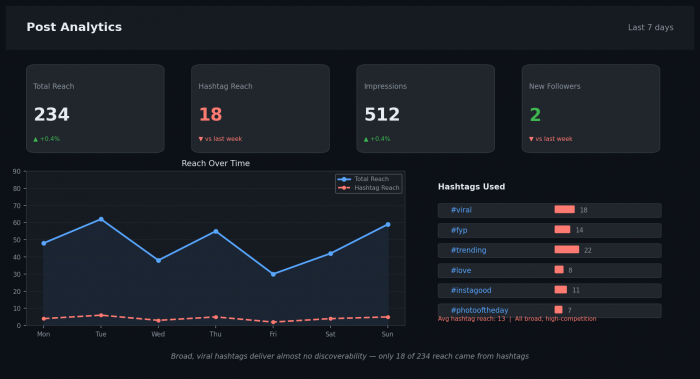
You spent 20 minutes picking the perfect hashtags. You added the ones you see on every big post: the viral tags, the trending ones, everything that looked like it was working for someone else. You hit publish and waited.
Nothing.
A handful of likes from people who already follow you. No new reach. No new followers. The hashtags did not work.
That experience is not rare. And the problem is almost never the hashtags themselves. It is how they are being used. I have gone through this cycle enough times to know that a bad hashtag strategy silently kills reach without ever announcing itself. Before I get into the mistakes, let me clear up a few things people get very wrong about hashtags in general.
First, Let's Debunk the Myths
Before diving into what you are doing wrong, it helps to know what was never true in the first place.
Myth 1: More hashtags always mean more reach.
Platform algorithms do not reward volume. They reward relevance. Thirty hashtags that do not match your content tell the algorithm nothing useful.
Myth 2: Trending hashtags guarantee visibility.
A post about accounting software using #WorldCupFinal is not going to attract any audience worth having. Trend mismatch creates noise, not reach.
Myth 3: Hashtags alone make posts go viral.
Saves and watch time drive virality far more than any hashtag does. Hashtags help with discoverability at the entry point. What happens after someone sees the post is entirely on the content.
Myth 4: Every platform uses hashtags the same way.
They absolutely do not. What works on Instagram does nothing on Facebook. TikTok has moved significantly toward keyword-based discovery. The platform-specific section later in this guide covers exactly what that means for each platform.
Do Hashtags Still Matter in 2026?
Yes. But not in the way most people think.
Hashtags have shifted from being a primary discovery tool to a supporting signal. Platforms now use a mix of visual content recognition, caption keywords, user behavior data, and engagement patterns to decide who sees what. Hashtags are one input among many.
Where hashtags still hold real value:
- Instagram: still useful for niche and community hashtags
- LinkedIn: helps categorize professional content for the right audiences
- X (Twitter): trending hashtags still drive conversation entry
- YouTube Shorts: hashtags assist in category placement alongside SEO
Where their impact is limited: Facebook has largely deprioritized hashtag-driven discovery, and TikTok now leans on captions and spoken audio for content categorization more than tags.
The fact that hashtags carry less weight than they did five years ago does not mean abandoning them. It means using them smarter. That starts with understanding how algorithms actually process them.
How Social Media Algorithms Use Hashtags
Algorithms use hashtags to answer one question: what is this content about, and who should see it?
When you add a hashtag, you give the platform a categorization signal. Get it right and your content reaches an audience that is already interested in that topic. Get it wrong and your post gets shown to an audience with no interest in it. That tanks your engagement rate and tells the algorithm your content is low quality.
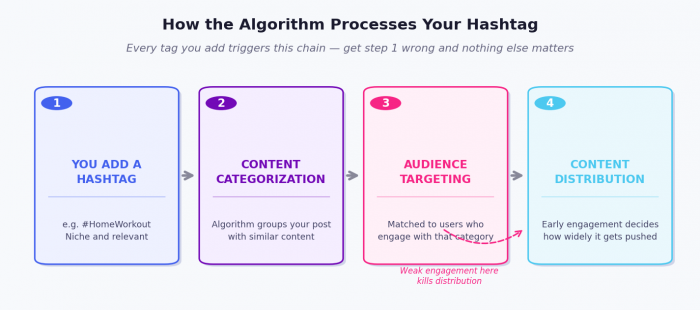
There are four ways algorithms process hashtag data:
- Content categorization: grouping your post with similar content
- Audience targeting: matching your post to users who engage with that category
- Search and discoverability: surfacing your post when someone searches that tag
- Engagement weighting: using early engagement within a hashtag to decide how widely to push it
A post that gets strong early engagement under a niche hashtag gets boosted. A post that gets weak engagement under a massive hashtag gets buried instantly. This is exactly why choosing hashtags that feel safe because everyone uses them is one of the most common reasons posts underperform.
Now let's look at exactly what those mistakes are.
10 Hashtag Mistakes That Are Limiting Your Reach
1. Using Irrelevant Hashtags (Viral, Trending, or Random)
This covers multiple patterns rolled into one root problem: relevance mismatch. Find high-performing relevant hashtags instantly with Technylo Hashtag Generator and boost your post reach.
Using #viral, #fyp, or whatever is trending that day might feel like a shortcut to reach. It is not. Algorithms detect when a hashtag does not match the content it is attached to. The result is poor engagement, which signals low quality, which reduces distribution.
Fix: Ask yourself before adding any hashtag: does the audience of this hashtag actually want to see this content? If the answer is no, cut it.
2. Copy-Pasting the Same Hashtags and Never Testing New Ones
Using the same 15 hashtags on every post tells the algorithm that every post is identical. Platforms detect repetitive tag patterns and reduce the reach of accounts that use them.
The second layer of this mistake is never testing anything new. You cannot optimize what you do not measure.
Fix: Rotate hashtag groups across posts. Keep a core set of two or four relevant tags constant, and test new niche and community tags on a rolling basis. Track which posts get the highest reach from hashtag sources and adjust from there. More on tracking in Mistake 9 below.
3. Using Too Many Hashtags
The "more is better" instinct is wrong here. Platform-specific guidance varies significantly:
| Platform | Recommended Range |
|---|---|
| 3 to 5 | |
| TikTok | 3 to 5 |
| 3 | |
| X (Twitter) | 1 to 2 |
| YouTube Shorts | 3 to 5 |
Stacking 30 hashtags on a LinkedIn post does not increase reach. It signals spam-adjacent behavior to both the algorithm and anyone reading your post.
4. Using Only Broad Hashtags Instead of Niche Ones
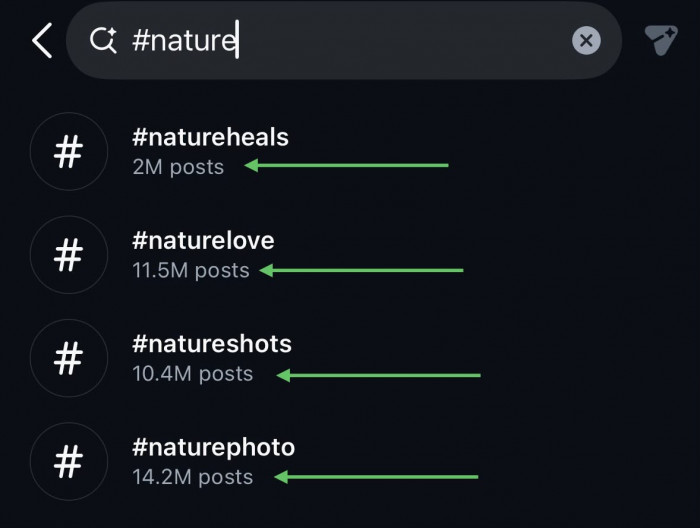
#Business has over 500 million posts. #MarketingStrategy has around 2 million. #B2BContentMarketing has a few hundred thousand. Which one gives a new post a real chance of being seen?
Broad hashtags are dominated by accounts with massive followings and established engagement rates. Niche and community hashtags are where mid-size and growing accounts actually compete.
Fix: Build a layered approach. Use one medium-competition hashtag alongside two or four niche tags that closely match your content. Save the broad ones for posts where you already have strong engagement momentum.
5. Using Banned or Restricted Hashtags
This one can damage your reach without any warning. Platforms periodically restrict hashtags associated with spam, policy violations, or misuse patterns. The tricky part is that Instagram never publishes an official list. A hashtag that was perfectly safe last month can become restricted today, and one that was banned can come back. Your saved hashtag sets can quietly go stale.
When you use a restricted tag, your post may be removed from hashtag feeds entirely, even if your content is perfectly fine.
Fix: Before using any hashtag, search for it directly on Instagram. If the page shows a message that recent posts are hidden, or shows no recent posts at all despite the tag having millions of uses, do not use it. For faster checking, free tools like MetaHashtags and Spikerz let you paste your full hashtag set and flag any restricted ones in seconds. Run your saved groups through one of these every few weeks, the list changes often enough that a monthly check is worth building into your routine.
6. Never Looking at What Competitors Are Doing
If a competitor's post with 10,000 likes is using #IndependentBookstoreOwner and you are using #BookLovers, you are not competing. You are invisible to the same audience.
Competitor hashtag research is not about copying. It is about identifying which niche and community tags are already driving engagement in your space.
Fix: Pick three to five accounts in your niche that are performing well. Look at the hashtags on their highest-performing posts. Identify the patterns. Build your own variation of those tag sets.
7. Ignoring Search Intent
Hashtags carry intent signals. A post using #HowToInvestMoney is targeting users in research mode. A post using #LondonEats is targeting someone with local, immediate intent. Using the wrong intent signals means your content reaches people at the wrong stage of decision-making.
The four intent types worth matching:
- Informational: users learning about a topic (#PythonForBeginners)
- Commercial: users evaluating options (#BestCRMForSmallBusiness)
- Local: users looking for nearby services (#NYCFitnessStudio)
- Community: users who identify with a group (#WomenInTech)
Fix: Before selecting hashtags, ask what state of mind your ideal viewer is in. Match the intent of the tag to the purpose of the content.
8. Not Creating Branded Hashtags
A branded hashtag is a long-term asset. When your audience uses it, they create content that points back to you. When someone searches it, they find a curated feed connected to your brand.
Small accounts benefit from this too. Not because the hashtag will trend, but because it creates a searchable archive of your content and makes it easy for your community to participate.
Fix: Create one simple, ownable hashtag tied to your brand or a recurring content series. Mention it consistently across posts and encourage your audience to use it.
9. Ignoring Analytics
Posting without checking analytics is the equivalent of running the same experiment forever without reading the results.
Here is where this gets important: Instagram significantly scaled back its per-post hashtag data in early 2025. The old "reach from hashtags vs. reach from Explore vs. reach from Home" breakdown is no longer available for standard feed posts in most account views. If you have been looking for it and not finding it, it is not missing from your account specifically — it is simply gone.
What you can still track, and where to find it:
Open any post → tap View Insights → scroll to the Reach section. You will see:
- Followers vs. Non-followers reached — this is your most useful proxy for hashtag performance. If non-follower reach is consistently low, your tags are not pulling in new audiences.
- Saves and shares — the clearest signal that your content-hashtag match is working. People save posts that are exactly what they searched for.
- Follower growth per post — tracks whether individual posts convert new viewers into followers.
For Reels, the source breakdown is still available. Tap any Reel → View Insights → scroll to the Views section. You will see a breakdown by source: Home, Hashtags, Explore, Profile, and Other. This is the closest current equivalent to the old per-post breakdown, and it is the most useful place to evaluate whether your hashtags are doing anything.
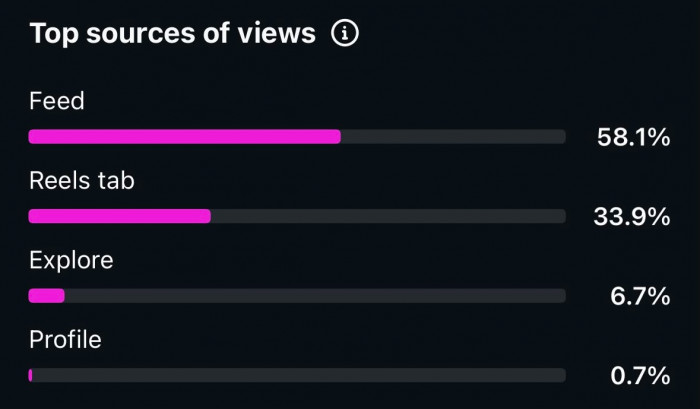
Fix: Once a week, check your three most recent Reels and look at where Views are coming from. If the Hashtags line is near zero consistently, your tags are wrong for the content. For feed posts, watch non-follower reach. A post that reaches a high percentage of non-followers is being discovered — a post stuck at 90%+ followers-only reach is not.
10. Expecting Hashtags to Replace Strong Content
This one is worth saying directly: hashtags are a distribution tool, not a quality multiplier.
A weak post with perfect hashtags will still underperform. Engagement rate, watch time, saves, and audience relevance determine how widely platforms distribute content. Hashtags help you get the first set of eyes. The content itself decides whether the algorithm pushes it further.
Platform-Specific Mistakes
Most of the mistakes above apply across all platforms, but a few are specific enough to call out separately.
| Platform | Key Mistake | Better Approach |
|---|---|---|
| Using 20+ hashtags | Stick to 3 to 5 highly relevant tags | |
| TikTok | Ignoring captions for keywords | TikTok indexes spoken words and captions; hashtags are secondary |
| Using niche consumer hashtags | Keep tags professional and category-focused | |
| YouTube Shorts | Skipping video SEO entirely | Hashtags support SEO but do not replace title and description keywords |
| Over-relying on hashtags | Facebook barely uses them; focus on post copy and audience targeting instead | |
| X (Twitter) | Using more than two hashtags per tweet | More than two tags actively reduces engagement on this platform |
Building Your Hashtag Strategy
As discussed throughout the mistakes section, the right hashtag strategy comes down to research and relevance. Testing and adjustment come after.
Step 1: Know your audience. What topics do they search for? What communities do they belong to? Build your hashtag list around their behavior, not yours.
Step 2: Research competitors and community leaders. Look at who is performing well in your niche. Audit their hashtags, as covered in Mistake 6.
Step 3: Use a layered mix. The framework below works across most platforms and goals.
| Hashtag Type | Count | Example |
|---|---|---|
| Branded | 1 | #YourBrandName |
| Niche / Specific | 2 | #FreelanceDesignTips |
| Medium Competition | 2 | #GraphicDesign |
| Community | 1 | #DesignCommunity |
| Location (if relevant) | 1 | #LondonDesigner |
Step 4: Match every hashtag to the content. If it would not make sense for someone browsing that hashtag to land on your post, cut it.
Step 5: Review performance monthly. Hashtag effectiveness changes as platforms evolve and audience behavior shifts. This is not a set-and-forget system.
Real Examples
Example 1: The over-broad approach that failed
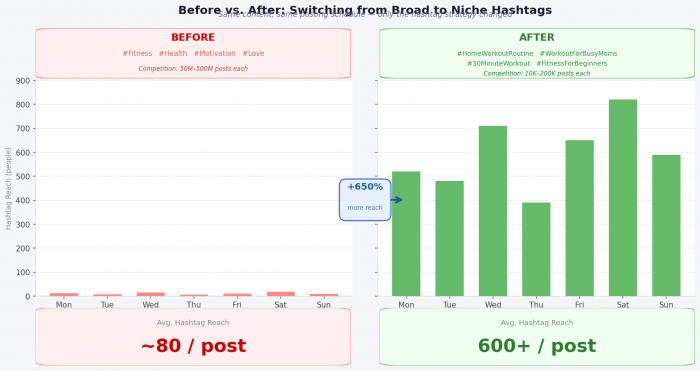
A fitness coach who was adding broad tags like #Fitness and #Health to every post averaged 80 impressions per post from hashtags. After switching to #HomeWorkoutRoutine, #WorkoutForBusyMoms, #30MinuteWorkout, and #FitnessForBeginners, the same content type averaged 600+ impressions from hashtag sources within two weeks. The content did not change. The targeting did.
Example 2: Instagram niche vs. broad hashtags
A food blogger using #Food and #Foodie, both 300M+ post hashtags, switched to #DinnerIdeasForFamily and #EasyWeeknightMeals. Saves went up by 40%. The audience that found the post through the niche tags was far more likely to actually want that specific type of content.
Example 3: TikTok keywords over hashtags
A skincare creator noticed that their highest-performing TikTok posts were not ranking in hashtag results. They were surfacing in search. The captions included phrases like "how to get rid of hormonal acne" and "affordable skincare routine." The hashtags were secondary. This reflects how TikTok's algorithm now works: caption keywords drive more discoverability than tags on that platform.
Tools for Hashtag Research
You do not need to guess. There are four categories of tools that cover the full research workflow:
- Trend discovery: identifies hashtags gaining momentum before they peak, useful for timely content
- Competitor analysis: shows which tags competitors rank in and which generate their highest engagement
- Analytics: tracks hashtag-specific reach, saves, and follower growth tied to specific tag sets. Most platforms offer native analytics for this
- Keyword research: helps match hashtag selection to actual search behavior on platforms like TikTok and YouTube
Each platform's native analytics should be your first stop before investing in any third-party tool.
Best Practices Checklist
Use this before every post:
- Every hashtag is directly relevant to the content
- At least two hashtags are niche or community-specific
- No banned or restricted hashtags (searched and confirmed on-platform)
- Hashtag count matches platform best practice
- Hashtags are rotated from the previous post
- A branded hashtag is included where it applies
- Analytics have been reviewed in the past month to guide tag selection
Hashtags are one signal in a system that also weighs content quality, watch time, audience behavior, and consistency. Get the content right first. Then use these principles to make sure the right people can actually find it.
The Bottom Line
Most people approach hashtags the same way they approach a lottery ticket: pick the popular numbers and hope something hits. Everything in this guide pushes against that instinct.
The accounts that consistently pull in new reach are not using better hashtags than you. They are using more specific ones. They are thinking about who is on the other side of that search, not just how many people search it.
That shift takes about an hour to apply to your current strategy. Audit what you are using now, run it against the checklist at the end of this guide, cut anything that does not belong, and add two or four niche tags you have not tried yet. Then give it four weeks and look at the numbers.
The audience for your content exists. Hashtags are just the bridge. Build a better one.