The Question Every Caption Guide Skips
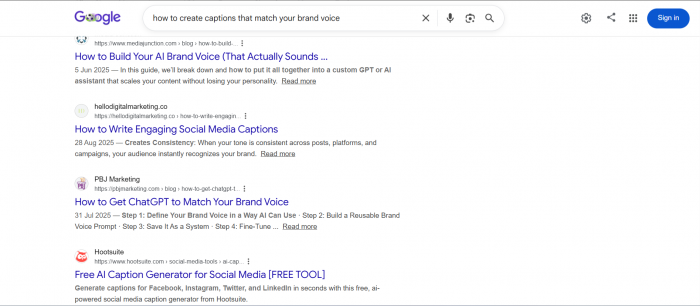
A few weeks ago I went looking for how to write captions that match a brand voice. I read article after article. By the fourth one I could finish the sentences before I got to them.
The advice never changed. Be consistent. Define your tone and write it down.
All true. And every piece of it skipped the question I actually hear from business owners every week. If my posts are already getting views, why should I care about brand voice?
It is a fair question. Plenty of brands post with no system behind them. One day the caption reads like a press release, the next it sounds like a friend texting you from a concert. The views still arrive anyway. So why build a voice at all?
Most guides refuse to answer that. They assume you already agree that brand voice matters and rush you toward a checklist. I am not going to assume it. Let me start with the question hiding underneath this one.
The Real Question Most Brands Are Asking
Picture two brands.
Both hit 100,000 views this month. Both pull in comments and saves. Both look like winners if you only check the analytics tab.
Now skip ahead two years. One of them has become a name people recognize on sight. You can show someone a single post with no logo attached and they already know who made it. The other is still posting, still going viral now and then, and still forgettable the second you scroll past.
Same views. Different outcome.
The difference is that reach and brand are not the same thing, even though we treat them like they are. Reach is how many people saw you. Brand is what stays in their head after they look away. You can buy attention, trick an algorithm into attention, or get lucky with attention. None of that hands you the second thing.
Viral content gets you seen. It does not get you remembered. A post can pull a million views and leave behind zero impression of who you are or why you exist.
Which raises the obvious next question. If brand voice is the thing doing the remembering, what is it exactly?
What Is a Brand Voice?
Here is the simplest definition I can give you.
Your brand voice is the personality that shows up every time your brand says something. It lives in your tone and your word choices, and in the attitude sitting underneath both.
The easiest way to feel it is to watch one sentence change clothes. Take a flat announcement: "Our new collection is now available."
A luxury brand says it like this: "The new collection has arrived. Quietly exceptional, made for those who already know."
A friendly brand says it like this: "It's here! The new collection just dropped and I cannot stop staring at it."
A playful brand says it like this: "New collection alert. Warning: your cart is about to suffer."
An expert brand says it like this: "The new collection is live. Here are the three design decisions behind it and why they matter."
Same fact. Four different humans behind it.
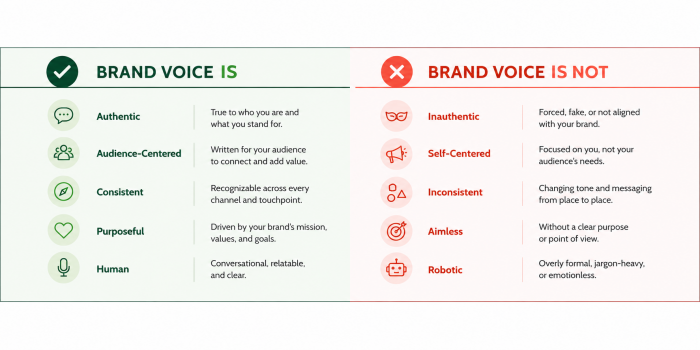
Notice what brand voice is not. It is not a script you paste into every post. It is not a template. It is not a pile of impressive vocabulary stacked up to sound clever.
What it actually is comes down to personality people can feel and a point of view that holds steady, plus enough consistency that someone recognizes you before they see your name.
So the next question writes itself. If this is the personality, why should your captions match it?
Why Captions Should Match Your Brand Voice
Once your voice holds steady, a few things start happening that scattered captions never deliver.
Recognition. People start to recognize how you talk. Before they check the handle, they sense a post is yours. That feeling outvalues any single view.
Expectation. Your followers learn what they signed up for. They know the kind of value or humor coming their way, and that predictability reads as comforting, not boring.
Trust. Familiarity builds quietly. The more consistent you sound, the more a stranger starts treating you like someone they already know. Trust is what turns a follower into a customer.
Difference. A competitor can copy your product by next week. They can match your price and your packaging. What they cannot copy is your personality, because it grows out of how you think, not what you sell.
The long game. People rarely remember individual posts. They remember brands. A consistent voice is how a hundred forgettable posts add up to one memorable name.
Here is where I have to be straight with you, though, because this is exactly the point where most articles start lying by omission.
Matching your brand voice will not magically increase your views.
The Biggest Misconception About Brand Voice
Brand voice does not guarantee more views.
I need to say it plainly, because the entire internet seems to imply the opposite.
Strong content can carry a weak caption. You have watched it happen. A strong video performs even when the caption was clearly typed in four seconds flat. Meanwhile, plenty of creators post with zero consistency in their captions and still go viral on a regular schedule.
The algorithm is not reading your brand guidelines. It watches whether people stop, watch, save, and come back. It rewards performance, not polish.
So if you measure brand voice by whether it spikes your reach, you will be disappointed, and you will probably quit on it.
That is the wrong scoreboard.
The job of brand voice was never to win the view count. Its job is to make sure that when people do show up, they understand who they are looking at and why they should stay. Reach gets the room full. Voice decides whether anyone remembers the host.
This is the gap I kept hitting in every other guide. They sell brand voice as a growth hack. It is a memory system instead. Once you see it that way, the real question changes shape. It stops being whether voice grows you and becomes when voice earns its place.
When Brand Voice Matters Most
So when does this actually count? Here are the situations where I would never skip it.
If you sell products, your caption is part of the buying experience. The voice that sells a $400 jacket cannot sound like the voice selling a $4 sticker. People feel the mismatch even when they cannot name it.
If you provide a service, your captions are auditions. Someone is deciding whether to trust you with their money, their project, or their face on camera. A scattered voice makes them hesitate.
If you have a team posting on your behalf, voice is the only thing stopping five different people from sounding like five different brands. Without it, your feed becomes a group chat with no host.
And if you are building something meant to last, the long-term brand depends on people forming a stable picture of you. Every inconsistent caption smudges that picture a little.
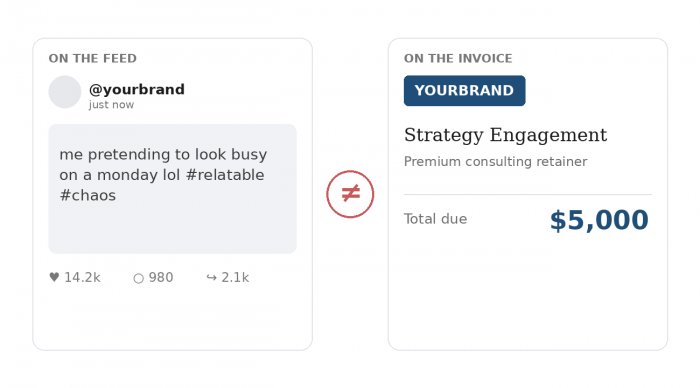
Here is the trap I see most often. A social account turns into a chaotic meme page because chaos pulls clicks, while the actual business is a premium consulting firm charging serious money. The audience the memes attract is not the audience that books a $5,000 engagement. The personality on the feed and the personality on the invoice do not match, and that gap quietly bleeds sales.
Brand voice closes the gap. It is not equally urgent for everyone, though, and pretending otherwise would make me one of those guides I complained about.
When Brand Voice Matters Less
I would be lying if I told you everyone needs a locked-down voice.
Some accounts thrive on the opposite. A meme page lives and dies by the joke, not the steadiness of its tone. A trend-chasing account is supposed to shapeshift, because that is the whole appeal. Pure entertainment accounts chase the next laugh, and an early-stage creator who is still figuring out who they are should be experimenting wildly instead of policing their tone.
If your only goal right now is attention, a strict brand voice can slow you down. You start second-guessing posts that might have flown. You sand off the rough edges that make content spread.
So give yourself permission. If you are in the testing phase, test. Throw things at the wall. Learn what your audience reacts to before you carve anything in stone.
The shift happens the moment your goal changes from "get seen" to "build something." A creator becoming a business. A hobby turning into income. The day you want people to remember you and buy from you, consistency stops being optional and becomes the asset.
The honest version is this: attention first, voice second, depending on where you are standing right now.
So now that you know whether you need one, let me show you how to actually build it.
How to Define Your Brand Voice
This is where it gets real. Four steps, and you can finish all of them in an afternoon.
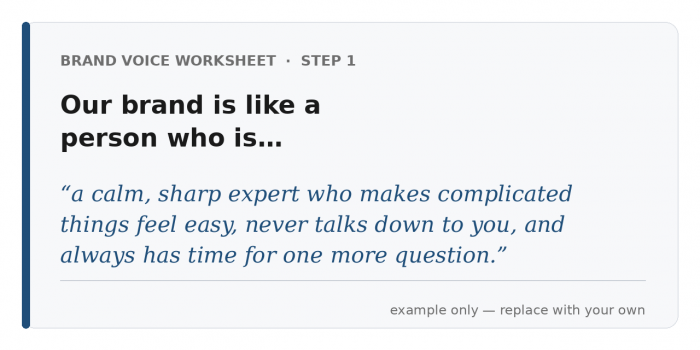
Step 1: Describe your brand as a person.
Finish this sentence honestly: "Our brand is like a person who is..." Maybe yours is the calm expert who never panics. Maybe it is the witty friend who makes hard things feel easy. Whatever falls out, write it down before you overthink it.
Step 2: Pick three to five traits.
Choose the small handful of words that define how you sound. Friendly. Expert. Bold. Helpful. Playful. Five is the ceiling. Go past it and you are describing a crowd, not a person.
Step 3: Build a "We Are / We Are Not" table.
This single tool fixes more caption problems than anything else I use. List who you are in one column and who you are not in the other.
| We Are | We Are Not |
|---|---|
| Helpful | Pushy |
| Clear | Complicated |
| Confident | Arrogant |
The "We Are Not" column is the one that saves you. It tells your brain exactly what to delete.
Step 4: Know what your audience came for.
Your voice meets your audience halfway. Did they follow you to learn something, or to switch off and laugh? Write down the main reason, because every caption is a small promise to deliver it again.
Once you have those four pieces, you have a voice. Now it has to survive contact with a real caption.
How to Create Captions That Match Your Brand Voice
Now the actual writing. I run the same four moves every time, and it takes under a minute once it becomes a habit.
Move 1: Start with the goal of the post.
What is this caption supposed to do? Sell, teach, entertain, or open a conversation. Name it before you type a single word.
Move 2: Find the core message.
Strip the post down to the one thing the reader should walk away with. Everything else is decoration.
Move 3: Run that message through your personality.
This is the step almost everyone skips, and it is the one this whole article is named after. Pull up the traits you picked and your "We Are Not" list, then rewrite the plain line so it carries them. If "warm" is on your list, ask where the warmth lives in this sentence. If "pushy" sits on the Not side, find the word leaning too hard and cut it. Think of it as translation. The plain fact goes in one end and your voice comes out the other.
Move 4: Check it against your traits.
Read it back and ask whether it sounds like the person you described. If a "We Are Not" word sneaked in, cut it.
Let me run the whole thing on one message. The plain version of a caption might read: "We are offering 20% off this weekend."
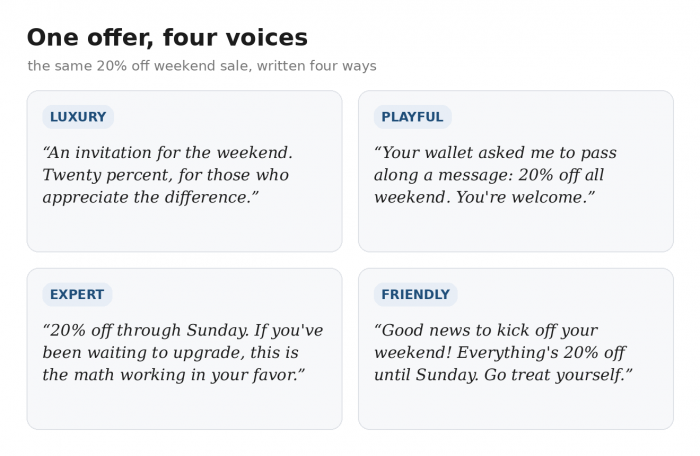
Here is that same offer wearing four different voices.
Luxury: "An invitation for the weekend. Twenty percent, for those who appreciate the difference."
Playful: "Your wallet asked me to pass along a message: 20% off all weekend. You're welcome."
Expert: "20% off through Sunday. If you have been waiting to upgrade, this is the math working in your favor."
Friendly: "Good news to kick off your weekend! Everything's 20% off until Sunday. Go treat yourself."
One offer. Four brands. The discount is identical, but the personality is doing all the work of telling people who is talking.
That shows the four voices side by side. Here is what the full process looks like on one brand, move by move.
You run a friendly brand and you want to share a tip. Goal: teach. Core message: posting at the same time each day helps the algorithm. Through your voice it becomes, "Here is a small one that worked for me. Pick one posting time and actually stick to it. The algorithm likes a routine as much as you do." Last check: it reads friendly and clear, and "lecturing" never crept in. Post it.
Common Mistakes to Avoid
I have made most of these myself, so none of it is theoretical.
Copying your competitor. Their voice was built for their personality. Borrow it and you sound like a tribute act. Study what works for them, then translate it into who you are.
Switching personality every post. Sounding corporate on Monday and unhinged on Tuesday teaches your audience one thing only: that you have no center.
Forcing trends that do not fit. Not every trend is yours to take. A serious financial brand jumping on a goofy dance trend reads as desperate, not relatable. Skip the ones that fight your voice.
Confusing consistency with repetition. Consistency means the personality stays the same. It does not mean posting the same sentence in a fresh outfit every day. Same voice, new things to say.
Sounding like a robot in the name of being on brand. This is the saddest one. People get so afraid of breaking their own guidelines that every caption turns stiff and lifeless. A brand voice is supposed to sound like a person, not a compliance document.
Clear these and you are already ahead of most accounts in your niche. There is one last test I run before anything goes live.
A Simple Test for Every Caption
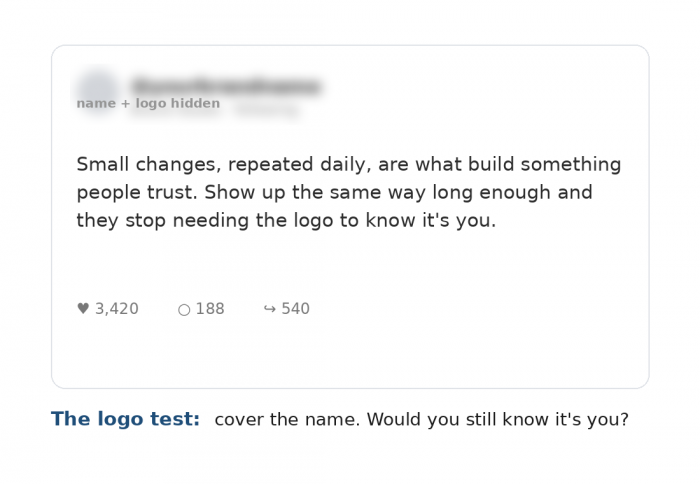
Before you hit the post, run one check. I call it the logo test.
Cover your name, your handle, your profile picture. Strip away everything that announces who you are. Now read the caption cold, the way a stranger would.
Would they still know it was you?
If the answer is yes, your voice is doing its job. The words carry your fingerprint even with the label gone. That is the entire goal.
If the answer is no, the caption is generic. It could belong to any account in your industry, which is the exact problem you set out to solve. Rewrite it until your personality shows up on its own.
That one question is the fastest way I know to tell a real brand voice from filler.
Back to the Question I Started With
Let me close where I opened, with the question that sent me reading in the first place. If random captions can rack up views, why write captions that match your brand voice?
Because the two were never solving the same problem.
Views get people to see your content. Voice gets them to recognize who made it. The first is traffic. The second is the reason any of that traffic sticks around.
You do not need every caption to be perfect. You need them to add up to something a stranger could pick out of a lineup. Strong content keeps pulling attention in. A steady voice is what turns that attention into a name people trust.
That is the line between collecting an audience and building one that belongs to you.