The best-performing posts I’ve ever written didn’t start as great ideas. Here is the process I use to turn small, ordinary thoughts into content people stop scrolling for.
Where Good Posts Begin
For the longest time, I sat down to create content with the same quiet panic. The cursor blinked. The page stayed empty. I kept waiting for a brilliant idea to arrive, certain that the creators I looked up to woke up every morning with something genius to say.
That belief held me back for years.
After publishing hundreds of posts and paying close attention to which ones landed, I noticed a pattern that caught me off guard. My best-performing content almost never started as a brilliant idea. It started as something small. A passing thought I nearly ignored. A mistake I kept repeating. A question a client asked me twice in one week. A lesson that only made sense in hindsight.
The idea was rarely the thing that mattered. What mattered was how I shaped it.
This article walks through the exact process I use to take an ordinary thought and turn it into a post that earns attention and starts conversations. I’ll move through the framework one stage at a time, then put the whole thing to work on a real example near the end so you can watch it run.

The Mistake That Cost Me Months
Most creators carry the same assumption I once did. They believe the formula reads like this:
Great idea → great post.
What I eventually learned is that the real path has more steps hiding inside it. A simple idea has to travel through a few stages before it earns a reader’s time. It needs a hook that stops the scroll, a message that stays clear, an emotional thread the reader can feel, and a reason to act once they reach the end.
Here is the part that took me a while to swallow.
I watched ordinary ideas beat brilliant ones again and again, for a single reason. The ordinary ideas were packaged better.
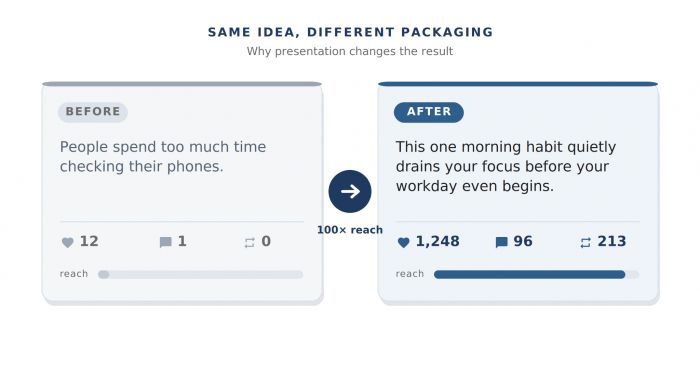
Take a plain observation like this one:
“People spend too much time checking their phones.”
Most creators publish that line and wonder why nobody reacts. Now look at the same idea wearing different clothes:
“This one morning habit quietly drains your focus before your workday even begins.”
Same thought. Different packaging. The distance in performance between those two sentences is enormous, and nothing about the underlying idea changed at all.
That single realization became the foundation for the framework I’ll lay out next.
The Framework, Stage by Stage
Whenever an idea shows up, I push it through five stages before it goes live. I’ll take them one at a time, since each stage leans on the one before it.
Stage One: Catch the Observation
Almost everything I post begins as an observation I scribbled down without thinking much of it.
A few that grew into real posts:
- Clients kept asking me the same question
- People told me they couldn’t stay consistent
- I noticed most creators quit far too early
- Small habits seemed to produce outsized results
The rule at this stage stays simple. Don’t judge anything yet. Just capture it. Some of my strongest posts began life as one lonely sentence in my notes app, the kind of line I almost deleted for being too obvious.
Stage Two: Find the Pain Underneath
An observation on its own gives a reader no reason to stop scrolling. So I ask one question of every idea. Why would anyone care about this?
Watch how that question reshapes a flat idea.
The observation: most creators stop posting after a few weeks.
The pain underneath it: they don’t see quick results, so they decide content marketing doesn’t work and quietly walk away.
Now the idea has a pulse. People rarely react to a neutral observation, but they lean in when you name a problem they are living through right now. This is the hinge the rest of the post swings on, and it sets up the hook I’ll build in the next stage.
Stage Three: Build a Hook That Earns Attention
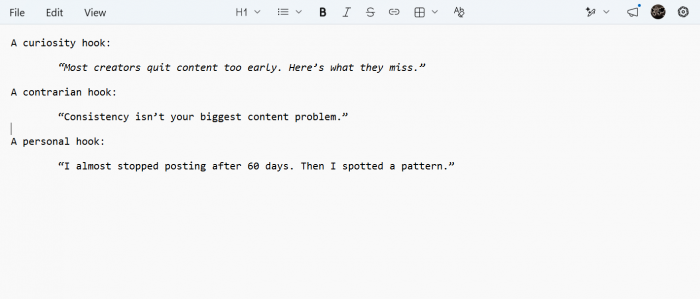
This is where most posts are won or lost. I usually write three versions of a hook and keep the one that pulls hardest.
A curiosity hook:
“Most creators quit content too early. Here’s what they miss.”
A contrarian hook:
“Consistency isn’t your biggest content problem.”
A personal hook:
“I almost stopped posting after 60 days. Then I spotted a pattern.”
Cheap bait earns a click and loses trust in the same second. I’m after a few seconds of honest attention here, the kind the story in the next stage has to repay.
Stage Four: Wrap It in a Story
This is the stage that turns forgettable content into something people carry with them. Instead of jumping straight to the lesson, I walk the reader through what happened.
I tell them what I noticed, what I tried, what shifted, and what I finally understood. The shape matters less than the honesty.
Facts inform people. Stories move them. A statistic about consistency slides right off the reader, but a short account of the night I almost quit tends to stick, because the reader recognizes themselves inside it.
Stage Five: Close With a Reason to Act
Every post should hand the reader something usable the moment they finish. So I ask one last question before publishing. What should this person do now?
Sometimes the answer is a small step they can take today. Sometimes it is a question that invites a reply. Sometimes it is a challenge, and sometimes it is simply a fresh way of seeing something they assumed they already understood.
Content that only raises awareness fades quickly. Content that nudges behavior stays with people, and it is the reason they come back for the next post.
The Formula I Reach For Most
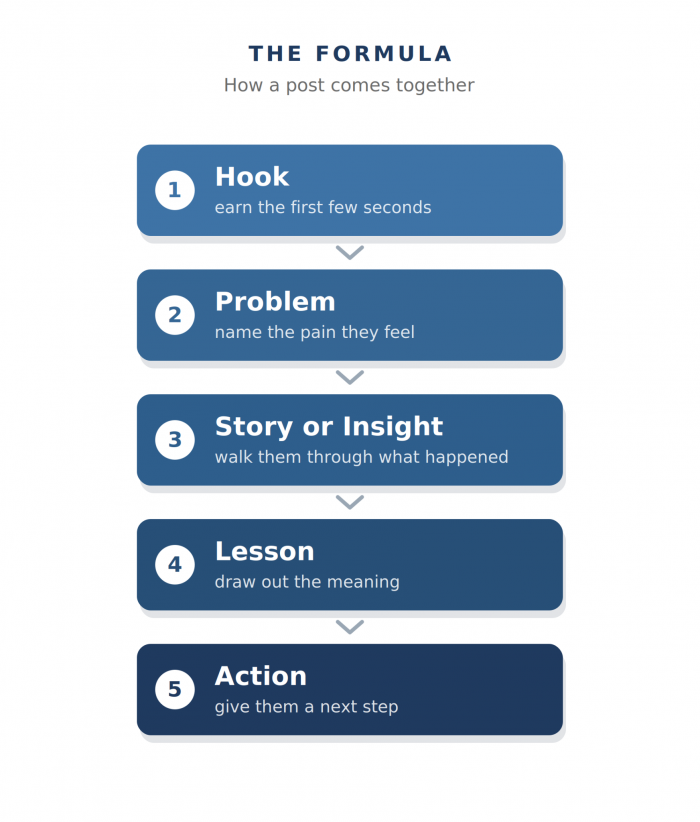
Those five stages fold down into a structure I lean on for nearly every post:
Hook → Problem → Story or Insight → Lesson → Action
I keep returning to this order because it mirrors the way a person naturally takes in information. You catch their attention, show them a problem they recognize, walk them through something real, draw out the meaning, and point them toward a next step. None of it feels forced, which is the whole reason it holds together.
Watching the Framework Work on a Real Idea
Theory only carries you so far, so let me run an ordinary idea through everything I described above.
The starting idea:
“Most people overcomplicate content creation.”
First I find the pain underneath it. People burn hours planning and rarely hit publish.
Then I bring in a story. For a long stretch, I spent more time organizing my ideas than making anything from them. My notes app looked immaculate. My output stayed thin.
Then I pull out the lesson. Publishing imperfect work beats planning perfect work that never ships.
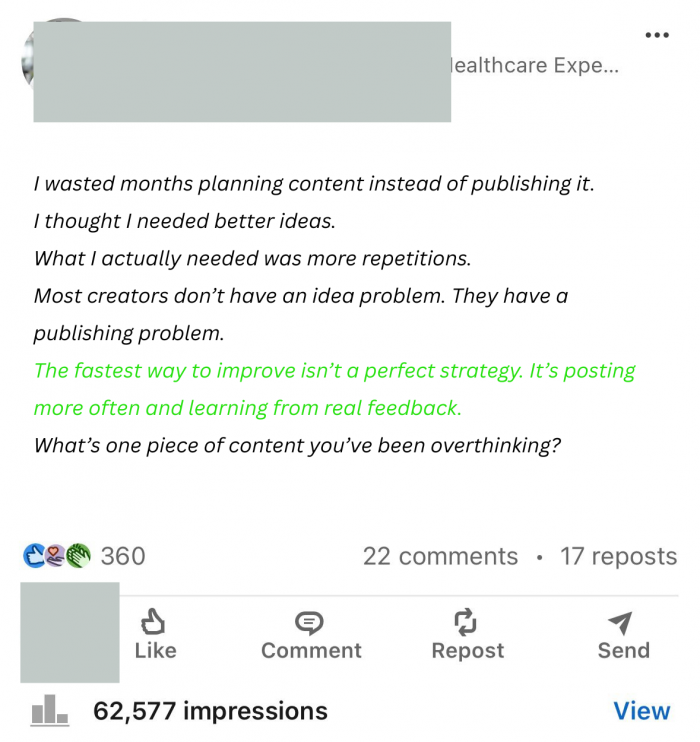
Stitched together, the finished post reads like this:
I wasted months planning content instead of publishing it.
I thought I needed better ideas.
What I actually needed was more repetitions.
Most creators don’t have an idea problem. They have a publishing problem.
The fastest way to improve isn’t a perfect strategy. It’s posting more often and learning from real feedback.
What’s one piece of content you’ve been overthinking?
Same idea I started with. The execution is the only thing that changed, and the execution is the entire game.
What the Posts That Win Have in Common
After studying my own results across a handful of platforms, plus the posts I kept envying from other creators, I noticed the strong ones almost always carry at least one of these qualities:
- Curiosity that makes you want the next line
- Relatability that makes a reader feel seen
- Emotion the reader can feel
- A story worth following to the end
- Advice a reader can put to use the same day
- A clear, confident opinion
- A piece of real personal experience
You don’t need every quality stuffed into one post. A single one, used well, often carries the whole thing. The more of them you can fold in without straining, the harder the post lands.
Your Next Post Is Probably Already in Your Notes
So the next time an idea feels too small to bother with, treat that feeling as a clue instead of a verdict. The smallness is usually where the relatability hides. Take that thin little sentence, walk it through the five stages, and watch what happens when you stop hunting for a better idea and start giving the one in front of you a better delivery.
Open your notes app. The post is already sitting there. It just hasn’t been packaged yet.