I’ve watched good products flop in public. Strong photography, a fair price, a launch the whole team felt proud of. The post goes live, and then almost nothing happens. A few likes. One comment from somebody’s cousin. No sales.
For a long stretch I blamed the algorithm for that silence. Then I started reading the captions sitting under those posts, and the problem was right there in plain text.
The caption was doing nothing.
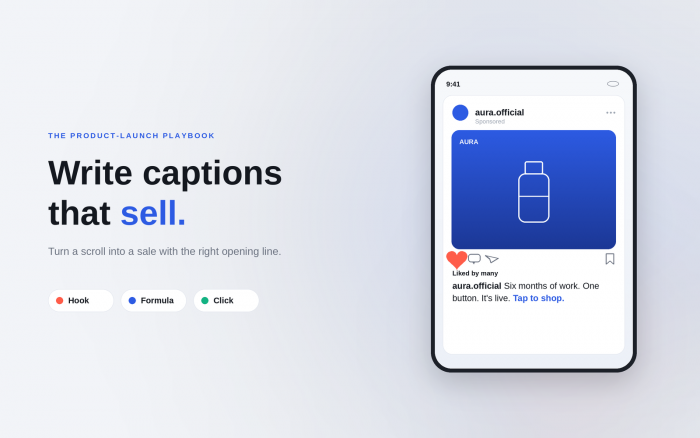
Your photo shows the product. Your caption is the only part of the post that can speak, persuade, and ask for the click. When someone scrolls past something they liked the look of, the words usually failed to give them a reason to stop and tap.
This guide is the playbook I wish someone had handed me three launches ago. I’ll walk you through why captions move money, the psychology working under the good ones, the formulas I reuse on every release, and ready-to-paste lines for your next promo. By the end you’ll write captions that earn the sale instead of hoping for it.
Why Captions Decide the Sale
Most people treat the caption as a label. They describe the product, drop a price, add ten hashtags, and move on. That habit costs sales every single day.
Here’s the mechanic that proves it. On Instagram and Facebook, your caption gets cut off after the first line or two, hidden behind a small “more” link. That truncation means your opening line does the heavy lifting before anyone chooses to read the rest. A weak first line never earns the expand, so the rest of your beautifully written caption is never seen.
There’s a second mechanic. The feed pushes posts that collect saves and shares, and a photo on its own rarely earns either. People save a post because the caption gave them a reason to come back to it. They share it because the words said something worth passing on.
So the caption holds two jobs at once. It convinces the human to buy, and it signals the platform to show your post to more humans.
A great product with a flat caption is a sale you already paid for and then walked away from. You paid for the shoot and the ad budget already. The caption is the cheapest lever you own, and it’s the one most brands ignore.
If captions carry this much weight, the obvious question is why certain words make people act while others slide past. That comes down to a handful of psychological triggers, which is where we go next.
The Psychology That Makes Captions Convert
Every caption that sells is pulling one or more psychological levers. You don’t need a degree in behavioral science to use them. You need to know they exist and reach for the right one.
Five do most of the work.
The curiosity gap. You say enough to make someone need the rest. “We changed one thing about this product and it sold out in a day.” Now they have to know what changed.
Urgency and scarcity. A deadline or a limited run nudges a fence-sitter off the fence. “Only 50 made” hits harder than “available now.”
Emotion and the fear of missing out. People buy how a product makes them feel: the pride of owning it, or the worry that everyone else gets there first.
Benefit over feature. Nobody wakes up wanting a 2000mAh battery. They want a phone that survives a full day. Translate every spec into the life it buys.
Social proof. “Three thousand people switched this month” tells a buyer they’re joining something, not gambling on it.
These five are the raw ingredients. On their own they just sit in a drawer. In the section below I’ll show you how I combine them into repeatable formulas, so you never stare at an empty caption box the night before a launch again.
Five Caption Formulas You Can Reuse
A formula hands you a skeleton, so writing a caption becomes assembly instead of invention. I keep five within reach and rotate them by mood and goal. For each one below I’ll show you the weak version most brands post, then the rewrite that earns the click.
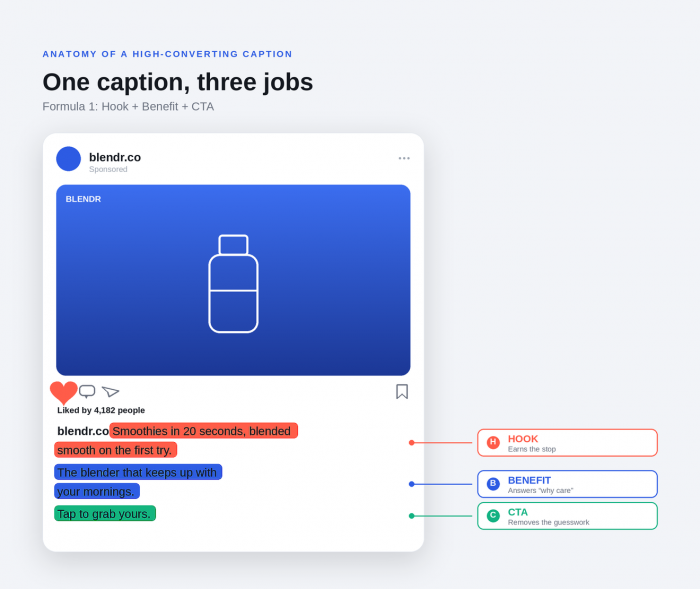
Formula 1: Hook + Benefit + CTA
Weak: “Our new blender is here. It has a powerful motor. Buy now.”
Strong: “Smoothies in 20 seconds, blended smooth on the first try. The blender that keeps up with your mornings. Tap to grab yours.”
The hook earns the stop. The benefit answers “why should I care.” The CTA removes the guesswork about what to do.
Formula 2: Problem → Solution → Result
Weak: “Our planner helps you stay organized.”
Strong: “Your to-do list lives in four apps and your head. This planner puts it on one page, so you start the day knowing the three things that matter.”
Name the pain first. A reader who feels seen keeps reading.
Formula 3: Tease → Reveal → Action
Weak: “New product available now.”
Strong: “We sat on this for six months. It’s finally live, and it’s the one we’re proudest of. Go see it.”
The tease builds a little suspense. The reveal pays it off, and the action points them to the door.
Formula 4: Emotion → Product → Action
Weak: “Buy our skincare set.”
Strong: “That feeling when your skin behaves for once. Bottled into a three-step routine. Try it tonight.”
Lead with the feeling, then attach the product to it.
Formula 5: Feature → Transformation → CTA
Weak: “Lightweight running shoes, now available.”
Strong: “200 grams on your foot. The miles stop feeling like a fight. Lace up a pair this week.”
A spec means nothing until you show the change it creates.
Formulas hand you the structure. What they don’t hand you is the exact wording for a specific moment, like a 24-hour sale or a quiet premium drop. That’s the job of the swipe file in the next section.
A Swipe File for Launches and Promotions
Some nights you don’t want a formula, you want a line you can paste and tweak. Here’s a swipe file I pull from, sorted by the moment you’re posting into. Treat them as starting points and bend them to your brand voice.
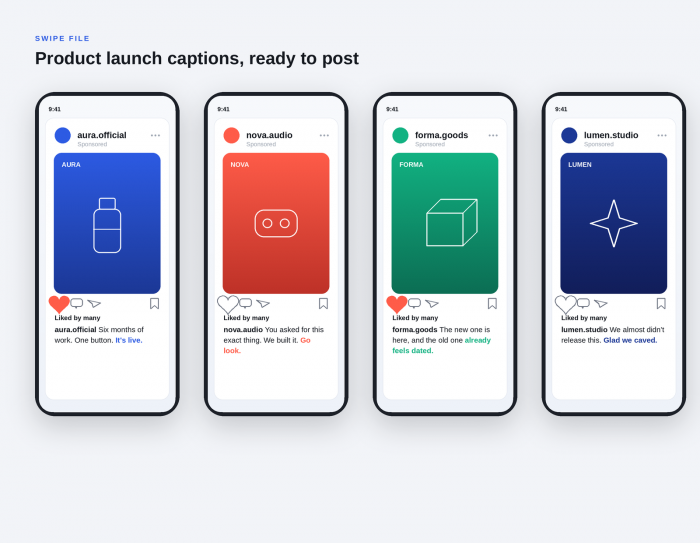
For a product launch:
- “Six months of work. One button. It’s live.”
- “You asked for this exact thing. We built it. Go look.”
- “The new one is here, and the old one already feels dated.”
- “We almost didn’t release this. Glad we caved.”
For a promotion or discount:
- “48 hours. Then these prices walk.”
- “The sale is live, and the popular sizes never last the weekend.”
- “Your cart has been waiting. Now it’s on offer.”
- “Good time to stock up. Future you will approve.”
For a premium or luxury drop:
- “Made for the people who notice the stitching.”
- “Quiet design. Loud performance.”
- “Built once, built right, kept for years.”
- “If you know, you already want it.”
For a fun or viral angle:
- “Add to cart and pretend you needed it.”
- “This is your sign. It’s also 20% off.”
- “Warning: you’ll want a second one within a week.”
- “Stop scrolling. You can thank me later.”
A line that lands in your feed can fall flat somewhere else, though. The same words read differently on a fast TikTok scroll than on a LinkedIn timeline. So before you reuse any of these, tune them to the platform, which the next section covers.
Tuning Captions for Each Platform
Every platform rewards a slightly different voice. Same product, same offer, different delivery. Here’s how I adjust.
Instagram lives and dies on the first line, since that’s the part that shows before the “more” cut I mentioned earlier. Lead with the hook and keep it short, then let a little emotion and an emoji or two through.
TikTok wants you to sound like a person talking, not a brand announcing. Write the caption the way you’d say it out loud, and ride whatever sound or trend the post is built on.
Facebook gives you room to tell a short story before the link, so a sentence of context ahead of the offer works well here.
LinkedIn responds to value and outcomes stated plainly. Skip the hype. Name the result your product creates, and write like a professional talking to peers.
Paid ads are their own animal. Direct and benefit first, with the call to action near the front instead of buried at the bottom.
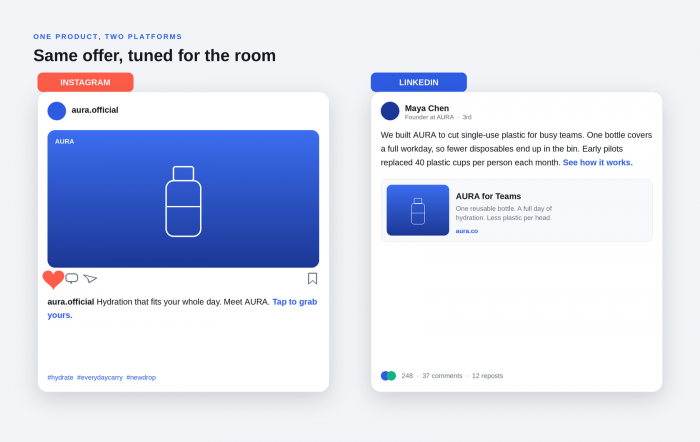
Notice that every version still uses one of the formulas from the previous section, and every version still ends by telling the reader what to do. That closing instruction is the call to action, and it’s where plenty of strong captions quietly leak the sale. We fix that next.
The Call to Action That Gets the Click
A caption without a clear instruction is a conversation that ends on an awkward pause. The reader liked your post, felt the pull, then had no idea what you wanted them to do. So they did nothing.
Tell them. Plainly.
Strong calls to action share one quality: they name a single specific next step.
- “Shop now.”
- “Tap to see the full drop.”
- “Pre-order before Friday.”
- “Grab yours before the popular sizes sell out.”
One clear instruction beats four competing ones. Ask a reader to like, comment, share, and buy in the same breath, and most will do the easiest thing on that list, which is usually nothing that earns you money. Pick the action that matters for this post and ask for that alone.
Place it where the eye lands. On a short caption, the call to action sits at the end as the natural close. On a longer one, repeat it once near the top so a skimmer catches it without reading every word.
A sharp call to action can’t rescue a caption that already lost the reader earlier, with the mistakes we cover next.
Mistakes That Quietly Kill Conversions
I’ve made every one of these. Each looks harmless in the moment and adds up to a post that underperforms.
Vague praise. “Best product ever” gives a reader nothing to picture or believe. Show the specific thing it does instead.
A buried lead. If your first line is a throat-clear like “We’re so excited to announce,” you’ve wasted the one line most people see. Open on the hook.
The wrong tone for the room. A meme-heavy caption on LinkedIn or a stiff corporate line on TikTok both read as off, and people scroll past whatever reads as off.
No call to action. We just covered this one. A post with no ask leaks the exact sale it was built to make.
Hashtag overload. Twenty hashtags read as desperate and clutter the caption. A few relevant ones do the job.
Features with no translation. Listing specs without the change they create asks the reader to imagine the benefit for you, and most won’t bother.
Clean these up and your captions already beat most of your feed. To move from good to best, you measure, which is the final piece.
Measure, Test, and Improve
Guessing which caption works is expensive. Measuring is close to free, and it ends the argument fast.
Run two caption styles against similar posts and watch which numbers move. Not likes. Likes are flattery. Track the link clicks and the saves. Shares count too, since those map to intent and the reach you don’t pay for.
Remember the curiosity gap from the psychology section. Testing tells you which curiosity hook your specific audience bites on, which no guide can predict for your niche.
A few habits sharpen every test. Start each caption with a verb when you can, since action words pull better than passive setups. Keep that first line strong enough to earn the expand every time. Match the caption to what the image already says, so the two reinforce each other instead of competing. Use urgency in small doses, because a brand that screams “last chance” every week trains people to ignore the phrase.
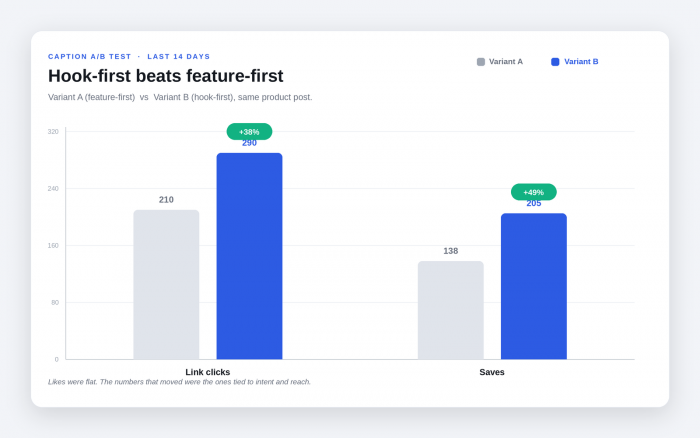
The brands that win at captions aren’t the most clever writers. They’re the ones who post, then check the numbers and improve the next one.
The One-Page Cheat Sheet
Save this section. When you’re staring at a blank caption box, this table gets you to a draft in under a minute. Pick the formula that fits your goal, then swap in your product.
| Formula | When to use it | Example |
|---|---|---|
| Hook + Benefit + CTA | A straightforward launch or restock | “Charges in 15 minutes, lasts all day. Meet the new earbuds. Tap to grab a pair.” |
| Problem → Solution → Result | When the pain point is obvious | “Tangled cables all over your desk? This dock clears them in one move.” |
| Tease → Reveal → Action | A hyped or long-awaited drop | “We kept this quiet for a year. It’s live now. Go see.” |
| Emotion → Product → Action | Lifestyle and beauty, where feeling drives the buy | “The calm of a tidy inbox, built into one app. Try it free today.” |
| Feature → Transformation → CTA | When a spec needs translating | “Half the weight of your old pack. Long hikes stop wrecking your shoulders. Gear up now.” |
Your Next Post
Here’s the only assignment that matters. Before you publish your next post, rewrite its caption with one formula from this guide. Just one. Then compare the saves and the link clicks against your last post.
That single comparison will teach you more about your buyers than any article can, this one included.
Your product already earned its photo. Give it words that earn the sale.