AI text-to-speech has moved far beyond robotic narration. In 2026, the best TTS tools can handle YouTube voiceovers, product walkthroughs, podcasts, training modules, audiobooks, and even real-time voice applications with a level of clarity that now feels commercially usable rather than experimental.
But choosing one is no longer about finding the tool with the most voices. The smarter way to compare text-to-speech platforms is to look at how they fit into actual work: some are better for polished studio voiceovers, some are built for API-heavy products, and others are designed for marketers who need quick narration without touching audio software.
This guide breaks down eight leading AI text-to-speech tools through a more practical lens: how they sound, what using them feels like, where they quietly outperform competitors, and what they actually cost.
What matters in a TTS tool
A good AI voice platform should do more than read text aloud. Voice realism, pacing control, language support, editing flexibility, and pricing model all shape whether a tool feels useful in production or frustrating after the free trial ends.
That is why the tools below are not ranked only on “features.” They are judged on workflow fit: whether they are better for creators, teams, educators, developers, or brands that need reliable and repeatable voice output.
1. ElevenLabs
A voice engine built for expressive audio
ElevenLabs has become one of the most widely discussed AI voice tools because it balances natural delivery with creator-friendly controls. It is frequently listed among the top AI voice generators, especially for users who want realistic narration, voice cloning, and multilingual output without sounding flat or mechanical.
What makes ElevenLabs stand out is the way it handles delivery. The voices usually sound fluid rather than overprocessed, which is why the platform works well for storytelling, YouTube videos narration, audiobooks, and character-style content. For many creators, it feels less like a text reader and more like a lightweight voice production studio.
Where it stands out
● Strong voice realism for narration-heavy content.
● Useful for voice cloning and multilingual production.
● Scales from solo creator plans to business-level tiers.
Pricing
| Plan | Price |
| Free | $0/month |
| Starter | $6/month |
| Creator | $11/month for the first month shown on the pricing page, then higher standard pricing may apply depending on billing/promotion |
| Pro | $99/month |
| Scale | $299/month |
| Business | $990/month |
2. Murf AI
A better fit for structured voiceover work
Murf AI feels less like a pure TTS engine and more like a voiceover workspace. It is often recommended for training videos, explainers, presentations, and business narration because the platform combines AI voices with a cleaner editing environment than many basic text-to-speech tools.
Its biggest strength is workflow. Instead of generating a single clip and leaving you to fix timing elsewhere, Murf lets you work in a more project-based way, which makes it especially useful for teams building modules, demos, onboarding videos, or client-facing explainers.
Where it stands out
● Better for full voiceover projects than quick one-line generation.
● Strong fit for training, presentation, and explainer content.
● Offers both studio subscriptions and API-style pricing in adjacent products.
Pricing
| Plan | Price |
| Free | $0 |
| Creator | $29/month |
| Business | $99/month |
| Enterprise | Custom pricing |
3. PlayHT
Built for creators who want speed and variety
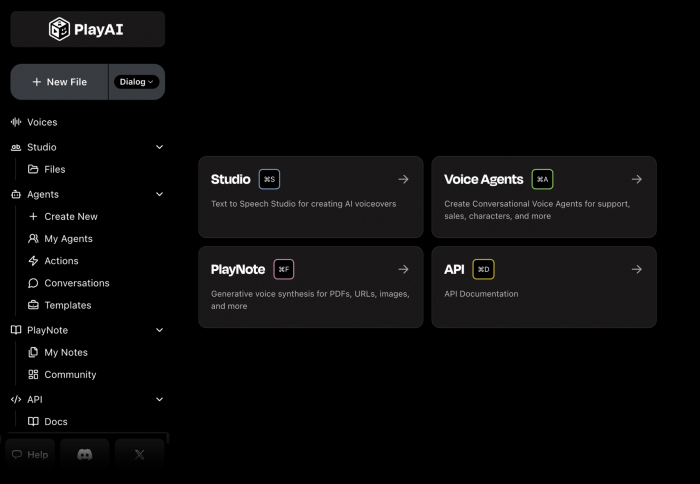
PlayHT is often positioned as a practical choice for users who want a wide range of AI voices and straightforward audio generation. It regularly appears in voice generator roundups and is especially relevant for creators, small businesses, and developers looking for a tool that supports both content production and API use cases.
Using PlayHT typically feels fast and direct. It is not as editor-heavy as Murf, but that can be a benefit if your goal is to generate clean voice clips, test multiple voices quickly, and move on. That makes it useful for podcasts editing, videos, app narration, and automated content systems.
Where it stands out
● Good balance between creator-friendly access and API potential.
● Works well for fast-turnaround voice generation.
● Commercial tiers are clearly segmented for different usage levels.
Pricing
| Plan | Price |
| Free | $0 |
| Professional | $39/month |
| Premium | $99/month |
| Team | $198/month |
| Enterprise | Custom pricing |
4. WellSaid Labs
Clean voices for business-grade narration
WellSaid Labs is often treated as a more polished, business-facing TTS platform. It is known for studio-style voices aimed at training, enterprise learning, internal communications, and professional narration where consistency matters more than novelty.
The platform feels tailored to organizations that want dependable output rather than endless experimentation. That makes it appealing for companies producing onboarding content, corporate explainers, and e-learning material where the voice needs to sound clear, neutral, and credible.
Where it stands out
● Strong fit for e-learning and internal business content.
● Pricing and features are structured with teams in mind.
● Better for professional consistency than flashy voice experimentation.
Pricing
| Plan | Price |
| Trial | $0 |
| Creative | $55/month |
| Business | $160/month per user |
| Enterprise | Custom pricing; help center also lists annual enterprise pricing options |
5. Speechify
Best when listening matters more than producing
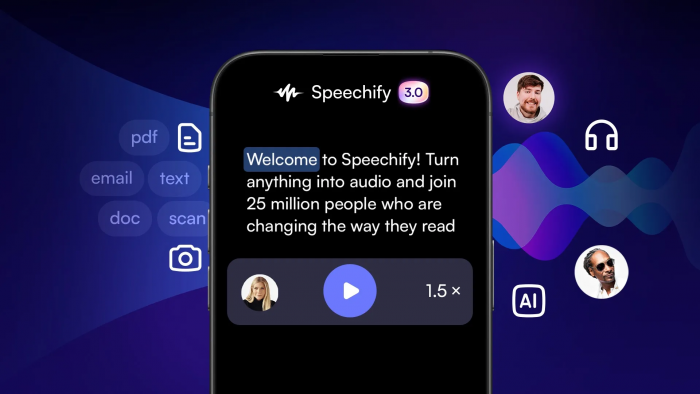
Speechify sits a little differently from the other tools on this list. While many AI voice platforms are built around voice generation for creators or businesses, Speechify is especially popular for turning written material into listenable audio for personal productivity, study, and reading workflows.
That means its value is less about full studio production and more about convenience. If your goal is to listen to documents, articles, PDFs, or notes in a natural-sounding voice, Speechify makes more sense than a tool designed around voiceover pipelines.
Where it stands out
● Excellent for reading and listening workflows.
● More consumer-friendly than production-heavy TTS platforms.
● Premium plan pricing is relatively straightforward.
Pricing
| Plan | Price |
| Free | $0 |
| Premium annual equivalent | $139/year, about $11.58/month |
| Premium monthly | $29/month |
6. Google Cloud Text-to-Speech
The developer-first option
Google Cloud Text-to-Speech is one of the clearest choices for teams building products rather than publishing voiceovers manually. It offers multiple voice families and a usage-based pricing structure, which makes it easier to estimate costs at scale when voice is part of an application, workflow, or customer experience.
It does not feel like a creator studio, and that is the point. This platform is best when you want programmatic generation, infrastructure reliability, and voice synthesis that plugs into apps, bots, services, or internal systems.
Where it stands out
● Better for developers and product teams than casual creators.
● Usage-based pricing is clearer for scale scenarios.
● Supports multiple voice classes with different price points.
Pricing
| Voice / Model | Price |
| Standard voices | $4 per 1 million characters after free usage |
| WaveNet voices | $4 per 1 million characters after free usage |
| Neural2 voices | $16 per 1 million characters after free usage |
| Chirp 3 HD voices | $30 per 1 million characters after free usage |
| Studio voices | $160 per 1 million characters after free usage |
| Gemini 2.5 Flash TTS | Input $0.50 per 1 million text tokens; output $10 per 1 million audio tokens |
7. OpenAI Text-to-Speech
A practical pick for modern AI apps
OpenAI’s text-to-speech offering is most useful for developers and product builders who already work in the OpenAI ecosystem. It is not marketed like a no-code creator suite; instead, it functions more as a flexible API layer for products that need speech generation, voice interfaces, or real-time interactions.
That makes it attractive for startups, SaaS products, assistants, and experimental voice experiences. If your workflow revolves around code, automation, or combining TTS with other AI capabilities, OpenAI’s voice models make more sense than a standalone narration app.
Where it stands out
● Strong fit for app builders and API-driven workflows.
● Useful when TTS is one part of a larger AI product stack.
● Realtime voice pricing expands its relevance beyond static narration.
Pricing
| Model / Service | Price |
| TTS-1 | $15 per 1 million tokens |
| TTS-1 HD | $30 per 1 million tokens |
| GPT-Realtime-Translate | $0.034 per minute |
| GPT-Realtime-Whisper | $0.017 per minute |
| GPT-Realtime-2 audio input | $32 per 1 million tokens |
| GPT-Realtime-2 audio output | $64 per 1 million tokens |
8. Resemble AI
A serious option for voice cloning workflows
Resemble AI is more specialized than many mainstream TTS tools because it leans into custom voices, cloning, localization, and API-based deployments. It is often discussed in contexts where the voice itself is part of the product or brand experience rather than just a narration layer.
That focus makes it appealing for companies working on branded voices, multilingual dubbing, interactive systems, or custom deployments. It is not the simplest platform for casual use, but it becomes much more interesting when voice identity matters.
Where it stands out
● Better suited to cloning and branded voice workflows.
● Flexible enough for API-led product use.
● Pricing spans from low entry access to business-scale usage.
Pricing
| Plan | Price |
| Creator | $1/month |
| Professional | $99/month |
| Business | $499/month |
| Enterprise / Flex | Custom or pay-as-you-go options are also described in recent pricing summaries |
Quick Snapshot of 8 TTS Tools
| Tool | Best For | Starting Price* |
| ElevenLabs | Expressive creator‑grade voices | Free; paid from $6/month |
| Murf AI | Training, explainers, slides + voiceovers | Free; paid from $29/month |
| PlayHT | Fast content and API voice generation | Free; paid from $39/month |
| WellSaid Labs | Corporate and e‑learning narration | Trial; paid from $55/month |
| Speechify | Reading/listening to articles and docs | Free; paid from $29/month or $139/year |
| Google Cloud TTS | Developer and product integrations | From $4 per 1M chars (standard voices) |
| OpenAI TTS | Apps using AI + TTS via API | From $15 per 1M tokens (TTS‑1) |
| Resemble AI | Branded and cloned custom voices | Paid from $1/month |
Final word
If the goal is realistic narration with broad creator appeal, ElevenLabs is hard to ignore. If the goal is training content or explainers, Murf AI and WellSaid Labs are easier to justify, while Google Cloud and OpenAI are stronger choices for teams building with voice at scale.
For a publish-ready blog, this structure works well because it does not reduce every tool to the same dull checklist. Instead, each platform is framed around the kind of work it is actually best at, which makes the article more useful for readers trying to choose a tool rather than just scan a pricing list.